
Microsoft on Thursday took the wraps off an ongoing campaign
impacting popular web browsers that stealthily injects
malware-infested ads into search results to earn money via
affiliate advertising.
“Adrozek,” as it’s called by the Microsoft 365 Defender Research
Team, employs an “expansive, dynamic attacker infrastructure”
consisting of 159 unique domains, each of which hosts an average of
17,300 unique URLs, which in turn host more than 15,300 unique
malware samples.
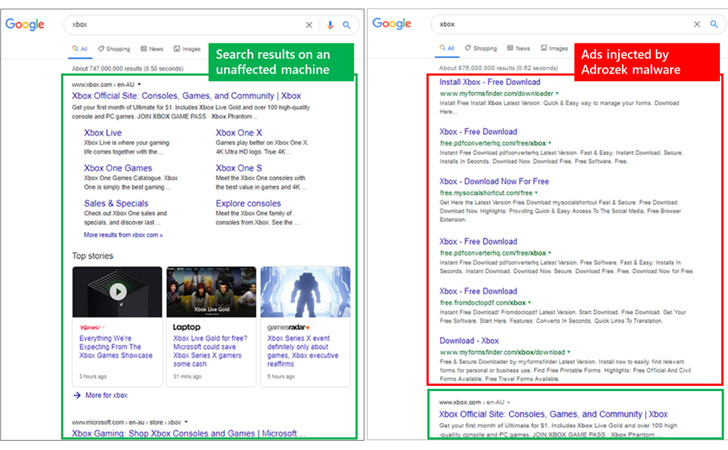
The campaign — which impacts Microsoft Edge, Google Chrome,
Yandex Browser, and Mozilla Firefox browsers on Windows — aims to
insert additional, unauthorized ads on top of legitimate ads
displayed on search engine results pages, leading users to click on
these ads inadvertently.
Microsoft said the browser modifier malware was observed since
May this year, with over 30,000 devices every day at its peak in
August.
“Cybercriminals abusing affiliate programs is not new—browser
modifiers are some of the oldest types of threats,” the Windows
maker said[1]. “However, the fact that
this campaign utilizes a piece of malware that affects multiple
browsers is an indication of how this threat type continues to be
increasingly sophisticated. In addition, the malware maintains
persistence and exfiltrates website credentials, exposing affected
devices to additional risks.”
Once dropped and installed on target systems via drive-by downloads[2], Adrozek proceeds to
make multiple changes to browser settings and security controls so
as to install malicious add-ons that masquerade as genuine by
repurposing the IDs of legitimate extensions.
Although modern browsers have integrity checks to prevent
tampering, the malware cleverly disables the feature, thus allowing
the attackers to circumvent security defenses and exploit the
extensions to fetch extra scripts from remote servers to inject
bogus advertisements and gain revenue by driving traffic to these
fraudulent ad pages.
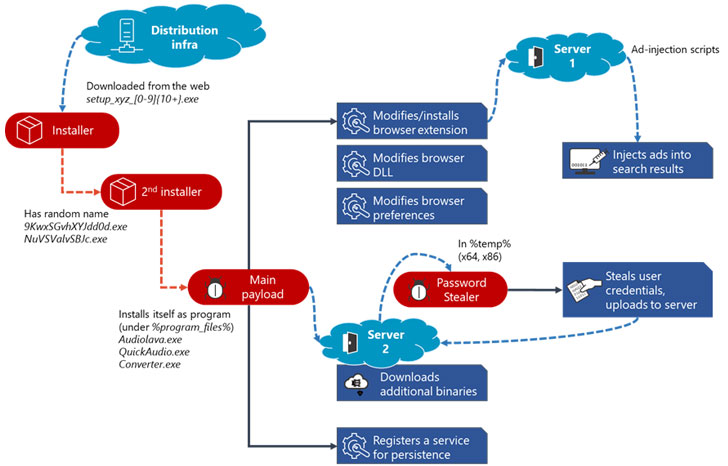
What’s more, Adrozek goes one step further on Mozilla Firefox to
carry out credential theft and exfiltrate the data to
attacker-controlled servers.
“Adrozek shows that even threats that are not thought of as
urgent or critical are increasingly becoming more complex,” the
researchers said.
“And while the malware’s main goal is to inject ads and refer
traffic to certain websites, the attack chain involves
sophisticated behavior that allows attackers to gain a strong
foothold on a device. The addition of credential theft behavior
shows that attackers can expand their objectives to take advantage
of the access they’re able to gain.
References
- ^
said
(www.microsoft.com) - ^
drive-by
downloads (www.kaspersky.com)