A team of researchers today unveiled previously undisclosed
capabilities of an Android spyware implant—developed by a
sanctioned Iranian threat actor—that could let attackers spy on
private chats from popular instant messaging apps, force Wi-Fi
connections, and auto-answer calls from specific numbers for
purposes of eavesdropping on conversations.
In September[1], the US Department of
the Treasury imposed sanctions on APT39 (aka Chafer, ITG07, or
Remix Kitten) — an Iranian threat actor backed by the country’s
Ministry of Intelligence and Security (MOIS) — for carrying out
malware campaigns targeting Iranian dissidents, journalists, and
international companies in the telecom and travel sectors.
Coinciding with the sanctions, the Federal Bureau of
Investigation (FBI) released a public threat analysis report[2]
describing several tools used by Rana Intelligence Computing
Company, which operated as a front for the malicious cyber
activities conducted by the APT39 group.
Formally linking the operations of APT39 to Rana, the FBI
detailed eight separate and distinct sets of previously undisclosed
malware used by the group to conduct their computer intrusion and
reconnaissance activities, including an Android spyware app called
“optimizer.apk” with information-stealing and remote access
capabilities.
“The APK implant had information stealing and remote access
functionality which gained root access on an Android device without
the user’s knowledge,” the agency stated.
“The main capabilities include retrieving HTTP GET requests from
the C2 server, obtaining device data, compressing and
AES-encrypting the collected data, and sending it via HTTP POST
requests to the malicious C2 server.”
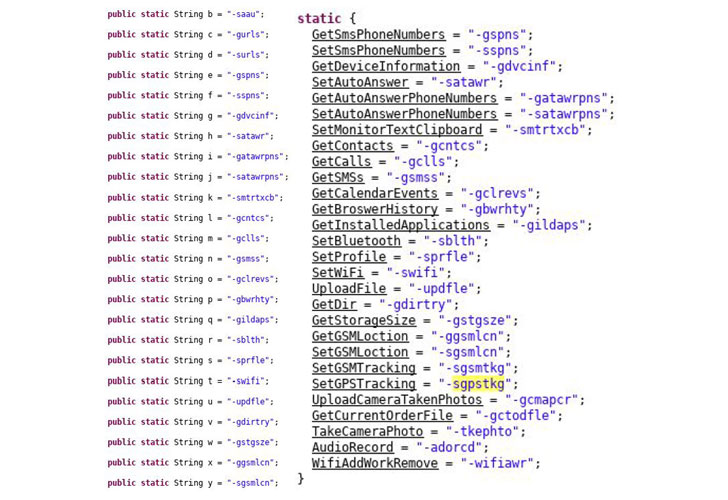
ReversingLabs, in a newly published[3]
report today, dug deeper into this implant
(“com.android.providers.optimizer”) using a previous unobfuscated
version of the malware described in the FBI Flash report.
According to researcher Karlo Zanki, not only did the implant
have permissions to record audio and take photos for government
surveillance purposes, but it also contained a feature to add a
custom Wi-Fi access point and force a compromised device to connect
to it.
“This feature was probably introduced to avoid possible
detection due to unusual data traffic usage on the target’s mobile
account,” Zanki said in an analysis.
Also of note was the ability to automatically answer calls from
specific phone numbers, thereby allowing the threat actor to tap on
conversations on-demand.
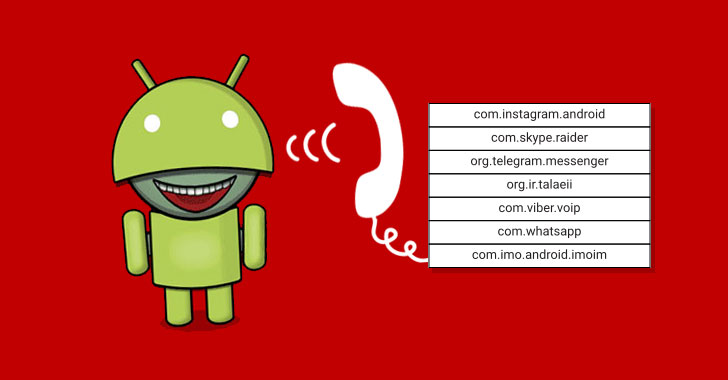
Besides featuring support for receiving commands sent via SMS
messages, the latest variant of “optimizer” malware referenced by
the FBI abused accessibility services to access contents of instant
messaging applications such as WhatsApp, Instagram, Telegram,
Viber, Skype, and an unofficial Iran-based Telegram client called
Talaeii.
It’s worth noting that Telegram had previously issued “unsafe”
warnings to users of Talaeii and Hotgram in December 2018 following
disclosure from the Center for Human Rights in Iran (CHRI[4]) citing security
concerns.
“When targeting individuals, threat actors often want to monitor
their communication and movement,” Zanki concluded. “Mobile phones
are most suitable for such goals because of the computing power
contained in your pocket, and the fact that most people carry them
all the time.”
“Since the Android platform maintains the biggest part of the
global smartphone market share, it follows that it is also the
primary target of mobile malware.”