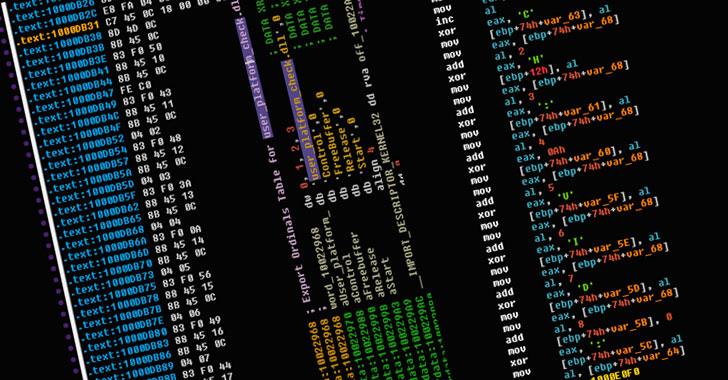
TrickBot[1], one of the most
notorious and adaptable malware botnets in the world, is expanding
its toolset to set its sights on firmware vulnerabilities to
potentially deploy bootkits and take complete control of an
infected system.
The new functionality, dubbed “TrickBoot[2]” by Advanced
Intelligence (AdvIntel) and Eclypsium, makes use of readily
available tools to check devices for well-known vulnerabilities
that can allow attackers to inject malicious code in the UEFI/BIOS
firmware of a device, granting the attackers an effective mechanism
of persistent malware storage.
“This marks a significant step in the evolution of TrickBot as
UEFI level implants are the deepest, most powerful, and stealthy
form of bootkits,” the researchers said.
“By adding the ability to canvas victim devices for specific
UEFI/BIOS firmware vulnerabilities, TrickBot actors are able to
target specific victims with firmware-level persistence that
survives re-imaging or even device bricking capability.”
UEFI[3]
is a firmware interface and a replacement for BIOS that improves
security, ensuring that no malware has tampered with the boot
process. Because UEFI facilitates the loading of the operating
system itself, such infections are resistant to OS reinstallation
or replacement of the hard drive.
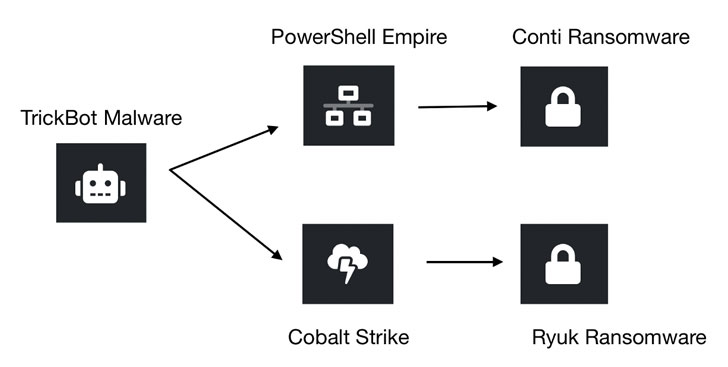
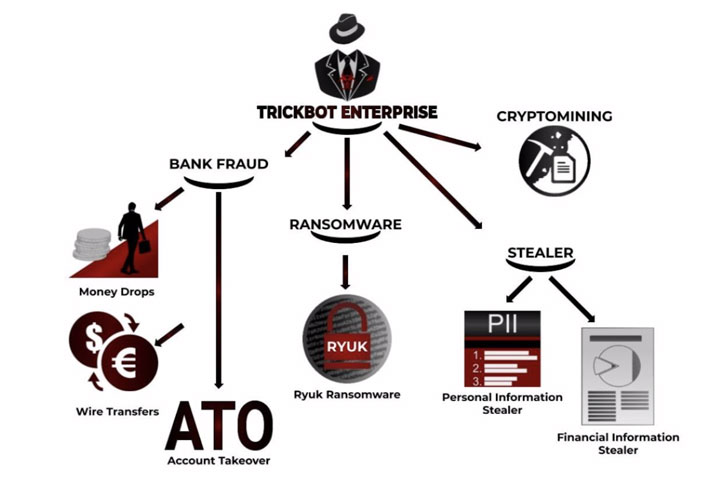
TrickBot emerged in 2016 as a banking trojan but has since
evolved into a multi-purpose malware-as-a-service (MaaS) that
infects systems with other malicious payloads designed to steal
credentials, email, financial data, and spread file-encrypting
ransomware such as Conti and Ryuk.
Its modularity and versatility[4] have made it an ideal
tool for a diverse set of threat actors despite attempts by cyber
vendors to take the infrastructure down[5]. It has also been
observed in conjunction with Emotet campaigns to deploy Ryuk
ransomware.
“Their most common attack chain largely begins via Emotet
malspam campaigns, which then loads TrickBot and/or other loaders,
and moves to attack tools like PowerShell Empire or Cobalt Strike
to accomplish objectives relative to the victim organization under
attack,” the researchers said. “Often, at the end of the
kill-chain, either Conti or Ryuk ransomware is deployed.”
To date, the botnet has infected more than a million computers,
according to Microsoft and its partners at Symantec, ESET, FS-ISAC,
and Lumen.
From a Reconnaissance Module to an Attack Function
The newest addition to their arsenal suggests that TrickBot can
not only be used to target systems en masse with ransomware and
UEFI attacks but also provide criminal actors even more leverage
during ransom negotiation by leaving a covert UEFI bootkit on the
system for later use.
The development is also yet another sign[6]
that adversaries are extending their focus beyond the operating
system of the device to lower layers to avoid detection and carry
out destructive or espionage-focused campaigns.
The researchers found that TrickBot specifically targets the
SPI[7]
flash chip that houses the UEFI/BIOS firmware, using an obfuscated
copy of RWEverything[8]
tool’s RwDrv.sys driver to check if the BIOS control register is
unlocked and the contents of the BIOS region can be modified.
Although the activity is limited to reconnaissance so far, it
wouldn’t be a stretch if this capability is extended to write
malicious code to the system firmware, thereby ensuring that
attacker code executes before the operating system and paving the
way for the installation of backdoors, or even the destruction of a
targeted device.
What’s more, given the size and scope of the TrickBot, an attack
of this kind can have severe consequences.
“TrickBoot is only one line of code away from being able to
brick any device it finds to be vulnerable,” the researchers noted.
“The national security implications arising from a widespread
malware campaign capable of bricking devices is enormous.”
With UEFI persistence, “TrickBot operators can disable any OS
level security controls they want, which then allows them to
re-surface to a modified OS with neutered endpoint protections and
carry out objectives with unhurried time on their side.”
To mitigate such threats, it’s recommended that the firmware is
kept up-to-date, BIOS write protections[9]
are enabled, and firmware integrity is verified to safeguard
against unauthorized modifications.
References
- ^
TrickBot
(thehackernews.com) - ^
TrickBoot
(www.eclypsium.com) - ^
UEFI
(en.wikipedia.org) - ^
modularity and versatility
(thehackernews.com) - ^
take the
infrastructure down (thehackernews.com) - ^
yet
another sign (thehackernews.com) - ^
SPI
(en.wikipedia.org) - ^
RWEverything
(rweverything.com) - ^
BIOS
write protections (eclypsium.com)