
Multiple botnets are targeting thousands of publicly exposed and
still unpatched Oracle WebLogic servers to deploy crypto miners and
steal sensitive information from infected systems.
The attacks are taking aim at a recently patched WebLogic Server
vulnerability, which was released by Oracle as part of its October 2020 Critical Patch
Update[1] and subsequently again
in November (CVE-2020-14750[2]) in the form of an
out-of-band security patch.
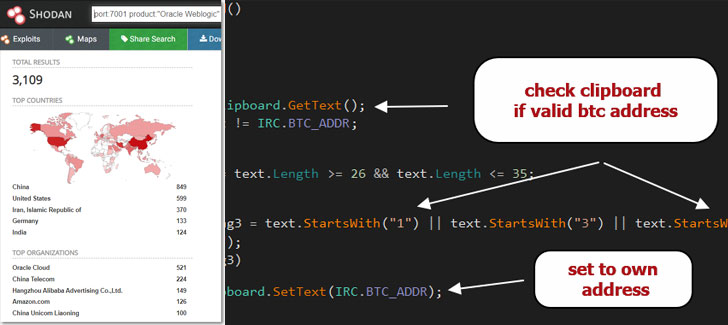
As of writing, about 3,000 Oracle WebLogic servers are
accessible on the Internet-based on stats from the Shodan search
engine.
Oracle WebLogic[3]
is a platform for developing, deploying, and running enterprise
Java applications in any cloud environment as well as
on-premises.
The flaw, which is tracked as CVE-2020-14882, has a CVSS score
of 9.8 out of a maximum rating of 10 and affects WebLogic Server
versions 10.3.6.0.0, 12.1.3.0.0, 12.2.1.3.0, 12.2.1.4.0, and
14.1.1.0.0.
Although the issue has been addressed, the release of proof-of-concept[4]
exploit code[5]
has made vulnerable Oracle WebLogic instances a lucrative target
for threat actors to recruit these servers into a botnet that
pilfers critical data and deploy second stage malware payloads.
According to Juniper Threat Labs[6], operators of the
DarkIRC botnet are exploiting this RCE vulnerability to spread
laterally across the network, download files, record keystrokes,
steal credentials, and execute arbitrary commands on compromised
machines.
The malware also acts as a Bitcoin clipper that allows them to
change bitcoin wallet addresses copied to the clipboard to the
operator’s bitcoin wallet address, allowing the attackers to
reroute Bitcoin transactions.
What’s more, a threat actor by the name of “Freak_OG” has been
selling the DarkIRC malware currently on hacking forums for $75
since August.
But it’s not just DarkIRC that’s exploiting the WebLogic Server
vulnerability. In a separate campaign—spotted by ‘0xrb[7]‘ and detailed by
researcher Tolijan Trajanovski[8]—evidence has emerged of
a botnet that propagates via the WebLogic flaw to deliver Monero
cryptocurrency miner and Tsunami[9]
binaries.
Besides using SSH for lateral movement, the botnet has been
found to achieve persistence through cron jobs, kill competing
mining tools, and even uninstall Endpoint detection and response
(EDR) tools from Alibaba and Tencent.
It’s recommended that users apply the October 2020 Critical
Patch Update and the updates associated with CVE-2020-14750 as soon
as possible to mitigate risks stemming from this flaw.
Oracle has also provided instructions to harden the servers[10] by preventing external
access to internal applications accessible on the Administration
port.
References
- ^
October
2020 Critical Patch Update (www.oracle.com) - ^
CVE-2020-14750
(www.oracle.com) - ^
WebLogic
(www.oracle.com) - ^
proof-of-concept
(testbnull.medium.com) - ^
exploit
code (twitter.com) - ^
Juniper
Threat Labs (blogs.juniper.net) - ^
0xrb
(twitter.com) - ^
Tolijan
Trajanovski (tolisec.com) - ^
Tsunami
(malpedia.caad.fkie.fraunhofer.de) - ^
harden
the servers (docs.oracle.com)