
Cybersecurity researchers today disclosed a new kind of modular
backdoor that targets point-of-sale (POS) restaurant management
software from Oracle in an attempt to pilfer sensitive payment
information stored in the devices.
The backdoor — dubbed “ModPipe” — impacts Oracle MICROS Restaurant Enterprise Series
(RES) 3700 POS[1]
systems, widely used software suite restaurants, and hospitality
establishments to efficiently handle POS, inventory, and labor
management, deployed in restaurant and hospitality sectors
primarily in the US.
“What makes the backdoor distinctive are its downloadable
modules and their capabilities, as it contains a custom algorithm
designed to gather RES 3700 POS database passwords by decrypting
them from Windows registry values,” ESET researchers said in an
analysis[2].
“Exfiltrated credentials allow ModPipe’s operators access to
database contents, including various definitions and configuration,
status tables and information about POS transactions.”
It’s worth noting that details such as credit card numbers and
expiration dates are protected behind encryption barriers in RES
3700, thus limiting the amount of valuable information viable for
further misuse, although the researchers posit that the actor
behind the attacks could be in possession of a second downloadable
module to decrypt the contents of the database.
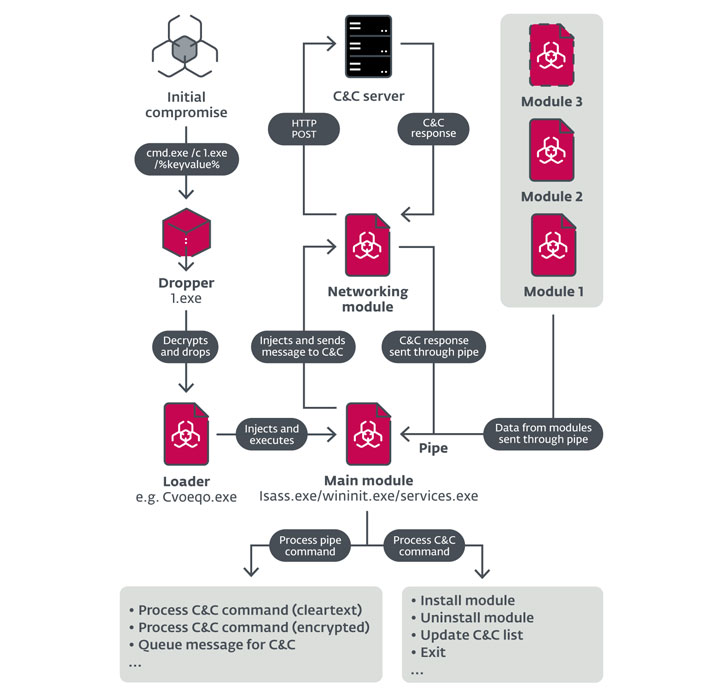
The ModPipe infrastructure consists of an initial dropper that’s
used to install a persistent loader, which then unpacks and loads
the next-stage payload — the main malware module that’s used to
establish communications with other “downloadable” modules and the
command-and-control (C2) server via a standalone networking
module.
Chief among the downloadable modules include “GetMicInfo,” a
component that can intercept and decrypt database passwords using a
special algorithm, which ESET researchers theorize could have been
implemented either by reverse-engineering the cryptographic
libraries or by making use of the encryption implementation
specifics obtained in the aftermath of a data breach[3]
at Oracle’s MICROS POS division in 2016.
A second module called “ModScan 2.20” is devoted to collecting
additional information about the installed POS system (e.g.,
version, database server data), while another module by the name of
“Proclist” gathers details about currently running processes.
“ModPipe’s architecture, modules and their capabilities also
indicate that its writers have extensive knowledge of the targeted
RES 3700 POS software,” the researchers said. “The proficiency of
the operators could stem from multiple scenarios, including
stealing and reverse engineering the proprietary software product,
misusing its leaked parts or buying code from an underground
market.”
Businesses in the hospitality sector that are using the RES 3700
POS are advised to update to the latest version of the software as
well as use devices that run updated versions of the underlying
operating system.
References
- ^
Oracle
MICROS Restaurant Enterprise Series (RES) 3700 POS
(www.oracle.com) - ^
analysis
(www.welivesecurity.com) - ^
data
breach (krebsonsecurity.com)