
campaign targeting media, construction, engineering, electronics,
and finance sectors in Japan, Taiwan, the U.S., and China.
Linking the attacks to Palmerworm (aka BlackTech) — likely
a China-based[1] advanced persistent
threat (APT) — Symantec’s Threat Hunter Team said[2] the first wave of
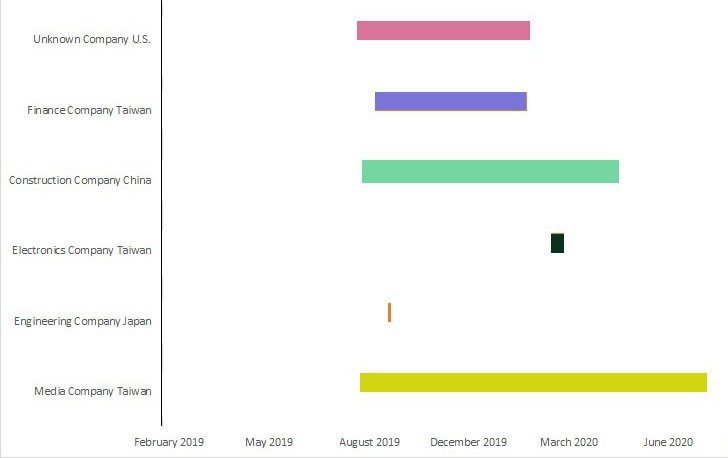
activity associated with this campaign began last year in August
2019, although their ultimate motivations still remain unclear.
“While we cannot see what Palmerworm is exfiltrating from these
victims, the group is considered an espionage group and its likely
motivation is considered to be stealing information from targeted
companies,” the cybersecurity firm said.
Among the multiple victims infected by Palmerworm, the media,
electronics, and finance companies were all based in Taiwan, while
an engineering company in Japan and a construction firm in China
were also targeted.
In addition to using custom malware to compromise organizations,
the group is said to have remained active on the Taiwanese media
company’s network for a year, with signs of activity observed as
recently as August 2020, potentially implying China’s continued
interest in Taiwan.
This is not the first time the BlackTech gang has gone after
business in East Asia. A 2017 analysis by Trend
Micro[3] found the group to
have orchestrated three campaigns — PLEAD, Shrouded Crossbow, and
Waterbear — with an intent to steal confidential documents and the
target’s intellectual property.
Stating that some of the identified malware samples matched with
PLEAD, the researchers said they identified four previously
undocumented backdoors (Backdoor.Consock, Backdoor.Waship,
Backdoor.Dalwit, and Backdoor.Nomri), indicating “they may be newly
developed tools, or the evolution of older Palmerworm tools.”
The brand new custom malware toolset alone would have made the
attribution difficult if it were not for the use of dual-use tools
(such as Putty, PSExec, SNScan, and WinRAR) and stolen code-signing
certificates to digitally sign its malicious payloads and thwart
detection, a tactic[4] that it has been
found to employ before.
Another detail that’s noticeably not too clear is the infection
vector itself, the method Palmerworm has used to gain initial
access to the victim networks. The group, however, has leveraged
spear-phishing emails in the past to deliver and install their
backdoor, either in the form of an attachment or through links to
cloud storage services.
“APT groups continue to be highly active in 2020, with their use
of dual-use tools and living-off-the-land tactics making their
activity ever harder to detect, and underlining the need for
customers to have a comprehensive security solution in place that
can detect this kind of activity,” Symantec said.
References
- ^
China-based
(www.reuters.com) - ^
said
(symantec-enterprise-blogs.security.com) - ^
Trend Micro
(www.trendmicro.com) - ^
tactic
(www.welivesecurity.com)