Cybersecurity researchers uncovered fresh evidence of an ongoing
cyberespionage campaign against Indian defense units and armed
forces personnel at least since 2019 with an aim to steal sensitive
information.
Dubbed “Operation SideCopy” by Indian cybersecurity
firm Quick Heal[1], the attacks have been
attributed to an advanced persistent threat (APT) group that has
successfully managed to stay under the radar by “copying” the
tactics of other threat actors such as the SideWinder[2].
Exploiting Microsoft Equation Editor Flaw
The campaign’s starting point is an email with an embedded
malicious attachment — either in the form of a ZIP file containing
an LNK file or a Microsoft Word document — that triggers an
infection chain via a series of steps to download the final-stage
payload.
Aside from identifying three different infection chains, what’s
notable is the fact that one of them exploited template injection
and Microsoft Equation Editor flaw (CVE-2017-11882[3]), a 20-year old memory
corruption issue in Microsoft Office, which, when exploited
successfully, let attackers execute remote code on a vulnerable
machine even without user interaction.
Microsoft addressed the issue in a patch released in November
2017[4].
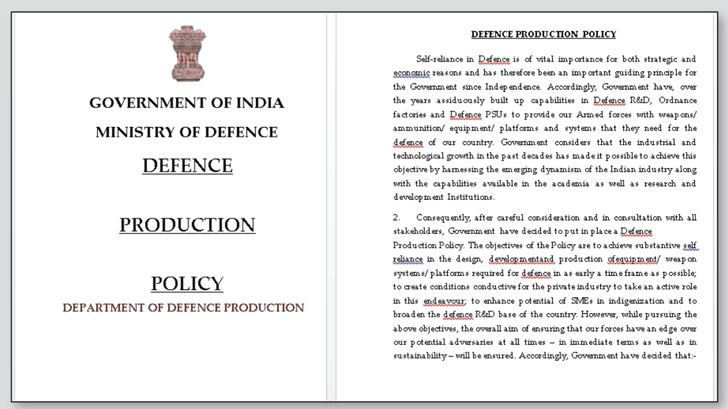
As is often the case with such malspam campaigns, the attack
relies on a bit of social engineering to bait the user into opening
a seemingly realistic Word document that claims to be about the
Indian government’s defense production policy.
What’s more, the LNK files have a double extension
(“Defence-Production-Policy-2020.docx.lnk”) and come with document
icons, thereby tricking an unsuspecting victim into opening the
file.
Once opened, the LNK files abuse “mshta.exe[5]” to execute malicious
HTA (short for Microsoft HTML Applications) files that are hosted
on fraudulent websites, with the HTA files created using an
open-sourced payload generation tool called CACTUSTORCH[6].
A Multi-stage Malware Delivery Process
The first stage HTA file includes a decoy document and a
malicious .NET module that executes the said document and downloads
a second-stage HTA file, which in turn checks for the presence of
popular antivirus solutions before copying Microsoft’s credential
back and restore utility (“credwiz.exe”) to a different folder on
the victim machine and modifying the registry to run the copied
executable every time upon startup.
Consequently, when this file gets executed, not only does it
side-load a malicious “DUser.dll” file, it also launches the RAT
module “winms.exe,” both of which are obtained from the stage-2
HTA.
“This DUser.dll will initiate the connection over this IP
address ‘173.212.224.110’ over TCP port 6102,” the researchers
said.
“Once successfully connected, it will […] then proceed for
performing various operations based on the command received from
C2. For example, if C2 sends 0, then it collects the Computer Name,
Username, OS version etc. and sends it back to C2.”

Stating the RAT shared code-level similarities with Allakore
Remote, an open-sourced remote-access software written in Delphi,
Quick Heal’s Seqrite team noted that the Trojan employed Allakore’s
RFB (remote frame buffer) protocol to exfiltrate data from the
infected system.
Possible Links to Transparent Tribe APT
In addition, a few attack chains are also said to have dropped a
previously unseen .NET-based RAT (called “Crimson RAT”
by Kaspersky[7] researchers) that
comes equipped with a wide range of capabilities, including access
files, clipboard data, kill processes, and even execute arbitrary
commands.
Although the modus operandi of naming DLL files shares
similarities with the SideWinder group, the APT’s heavy reliance on
the open-sourced toolset and an entirely different C2
infrastructure led the researchers to conclude with reasonable
confidence[8] that the threat
actor is of Pakistani origin — specifically the Transparent Tribe[9] group, which has
been recently linked to several attacks targeting the Indian
military and government personnel.
“Thus, we suspect that the actor behind this operation is a
sub-division under (or part of) Transparent-Tribe APT group and are
just copying TTPs of other threat actors to mislead the security
community,” Quick Heal said.
References
- ^
Quick Heal
(www.seqrite.com) - ^
SideWinder
(thehackernews.com) - ^
CVE-2017-11882
(portal.msrc.microsoft.com) - ^
November 2017
(thehackernews.com) - ^
mshta.exe
(attack.mitre.org) - ^
CACTUSTORCH
(github.com) - ^
Kaspersky
(securelist.com) - ^
reasonable confidence
(securelist.com) - ^
Transparent Tribe
(malpedia.caad.fkie.fraunhofer.de)
Read more http://feedproxy.google.com/~r/TheHackersNews/~3/LoOxwj96Dpo/cyberattack-indian-army.html