
Amnesty International today exposed details of a new
surveillance campaign that targeted Egyptian civil society
organizations with previously undisclosed versions of FinSpy
spyware designed to target Linux and macOS systems.
Developed by a German
company[1], FinSpy is extremely
powerful spying software that is being sold as a legal law
enforcement tool to governments around the world but has also been
found[2]
in use by oppressive and dubious regimes to spy on activists.
FinSpy, also known as FinFisher, can target both desktop
and mobile operating systems, including Android, iOS, Windows,
macOS, and Linux, to gain spying capabilities, including secretly
turning on their webcams and microphones, recording everything the
victim types on the keyboard, intercepting calls, and exfiltration
of data.
According to the human rights organization Amnesty
International[3], the newly discovered
campaign is not linked to ‘NilePhish,’ a hacking group known for
attacking Egyptian NGOs in a series of attacks, involving an older
version of FinSpy, phishing[4]
technique, and malicious Flash Player[5]
downloads.
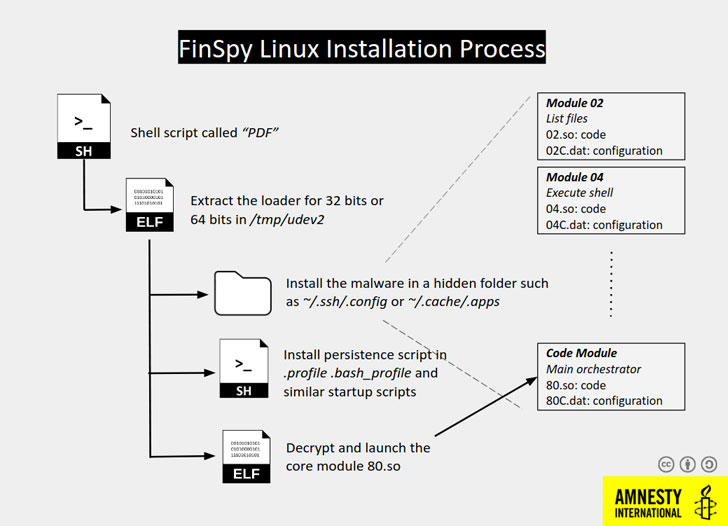
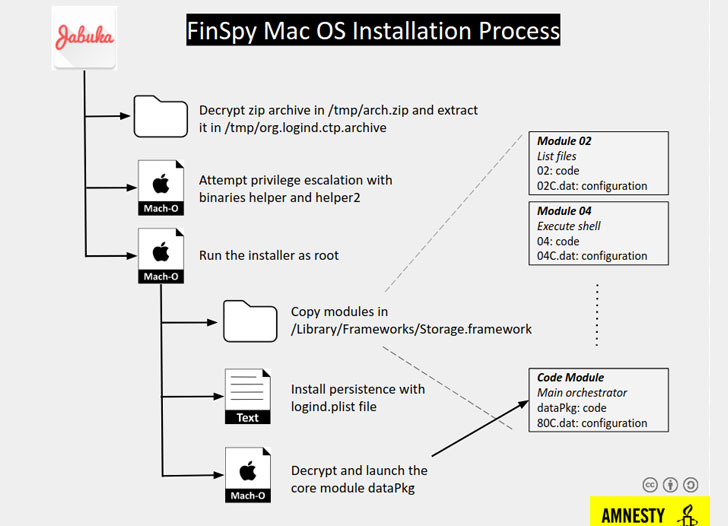
Instead, the new versions of FinSpy for Linux and macOS, along
with Android and Windows, were used by a new unknown hacking group,
which they believe is state-sponsored and active since September
2019.
Uploaded on VirusTotal, all new malware samples were discovered
as part of an ongoing effort by Amnesty International to actively
track and monitor NilePhish’s activities.
The new binaries are obfuscated and stop malicious activities
when it finds itself running on a virtual machine to make it
challenging for experts to analyze the malware.
Moreover, even if a targeted smartphone isn’t rooted, the
spyware attempts to gain root access using previously disclosed
exploits.
“The modules available in the Linux sample are almost identical
to the MacOS sample,” the researchers said.
“The modules are encrypted with the AES algorithm and compressed
with the aplib compression library. The AES key is stored in the
binary, but the IV is stored in each configuration file along with
a MD5 hash of the final decompressed file.”
“The spyware communicates with the Command & Control (C&C)
server using HTTP POST requests. The data sent to the server is
encrypted using functions provided by the 7F module, compressed
using a custom compressor, and base64 encoded.”
Meanwhile, the researchers have also provided indicators of
compromise (IoC[6]) to help researchers
further investigate these attacks and users check whether their
machines are among compromised ones.
Kaspersky researchers last year revealed a similar
cyber-espionage campaign where ‘then-new’ FinSpy
implants for iOS and Android[7]
were being used to spy on users from Myanmar.
References
- ^
German company
(thehackernews.com) - ^
found
(thehackernews.com) - ^
Amnesty International
(www.amnesty.org) - ^
phishing
(www.amnesty.org) - ^
malicious Flash Player
(thehackernews.com) - ^
IoC
(github.com) - ^
FinSpy implants for iOS and Android
(thehackernews.com)
Read more http://feedproxy.google.com/~r/TheHackersNews/~3/fhy144gxoUE/finspy-malware-macos-linux.html