
As ransomware attacks[1] against critical
infrastructure continue to spike in recent months, cybersecurity
researchers have uncovered a new entrant that has been actively
trying to conduct multistage attacks on large corporate networks of
medical labs, banks, manufacturers, and software developers in
Russia.
The ransomware gang, codenamed “OldGremlin” and believed to be a
Russian-speaking threat actor, has been linked to a series of
campaigns at least since March, including a successful attack
against a clinical diagnostics laboratory that occurred last month
on August 11.
“The group has targeted only Russian companies so far, which was
typical for many Russian-speaking adversaries, such as Silence[2] and Cobalt[3], at the beginning of
their criminal path,” Singaporean cybersecurity firm Group-IB said
in a report published today and shared with The Hacker News.
“Using Russia as a testing ground, these groups then switched to
other geographies to distance themselves from vicious actions of
the victim country’s police and decrease the chances of ending
behind the bars.”
OldGremlin’s modus operandi involves using custom backdoors —
such as TinyNode and TinyPosh to download additional payloads —
with the ultimate goal of encrypting files in the infected system
using TinyCryptor ransomware (aka decr1pt) and holding it hostage
for about $50,000.
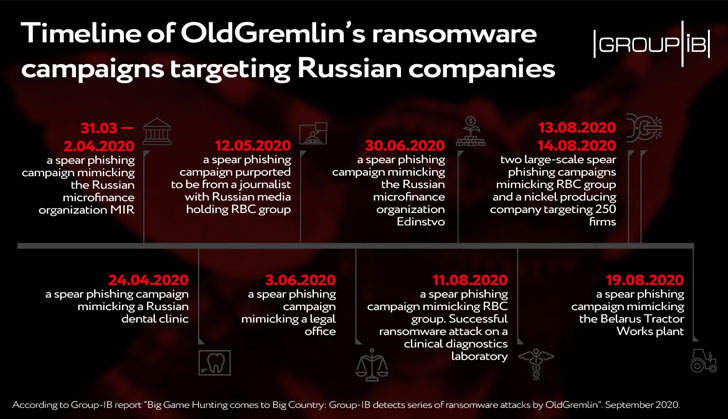
In addition, the operators gained an initial foothold on the
network using a phishing email sent on behalf of Russia’s RBC
Group, a Moscow-based major media group, with “Invoice” in the
subject line.
The message informed the recipient of their inability to contact
the victim’s colleague with regards to an urgent bill payment along
with a malicious link to pay the bill that, when clicked,
downloaded the TinyNode malware.
Upon finding their way in, the bad actor used remote access to
the infected computer, leveraging it to laterally move across the
network via Cobalt Strike and gather authentication data of the
domain administrator.
In a different variant of the attack observed in March and
April, the cybercriminals were found using COVID-themed phishing lures[4] to financial
enterprises that masqueraded as a Russian microfinance organization
to deliver the TinyPosh Trojan.
Subsequently, a separate wave of the campaign was detected on
August 19, when the cybercriminals sent out spear-phishing messages
exploiting the ongoing protests in
Belarus[5] decrying the
government, proving once again that threat actors are adept at
capitalizing world events to their advantage.
In all, OldGremlin has been behind nine campaigns between May
and August, according to Group-IB.
“What distinguishes OldGremlin from other Russian-speaking
threat actors is their fearlessness to work in Russia,” Oleg
Skulkin, a senior digital forensics analyst at Group-IB, said.
“This indicates that the attackers are either fine-tuning their
techniques benefiting from home advantage before going global, as
it was the case with Silence and Cobalt, or they are
representatives of some of Russia’s neighbors who have a strong
command of Russian.”
References
- ^
ransomware attacks
(thehackernews.com) - ^
Silence
(thehackernews.com) - ^
Cobalt
(malpedia.caad.fkie.fraunhofer.de) - ^
COVID-themed phishing lures
(thehackernews.com) - ^
ongoing protests in Belarus
(en.wikipedia.org)
Read more http://feedproxy.google.com/~r/TheHackersNews/~3/hDUxRNVE5zA/russian-ransomware-hack.html