with all recent patches issued by Microsoft, especially the one
that fixes a recently patched critical vulnerability that could
allow unauthenticated attackers to compromise the domain
controller.
Dubbed ‘Zerologon’ (CVE-2020-1472) and discovered by Tom
Tervoort of Secura[1], the privilege
escalation vulnerability exists due to the insecure usage of
AES-CFB8 encryption for Netlogon sessions, allowing remote
attackers to establish a connection to the targeted domain
controller over Netlogon Remote Protocol (MS-NRPC).
“The attack utilizes flaws in an authentication protocol that
validates the authenticity and identity of a domain-joined computer
to the Domain Controller. Due to the incorrect use of an AES mode
of operation, it is possible to spoof the identity of any computer
account (including that of the DC itself) and set an empty password
for that account in the domain,” researchers at cybersecurity firm Cynet[2] explain in a blog
post.
Though the vulnerability, with a CVSS score of 10.0, was first
disclosed to the public when Microsoft released a patch[3] for it in August,
it became a matter of sudden concern after researchers published
technical details and proof-of-concept of the flaw last week.
Along with Indian[4] and Australian[5] Government
agencies, the United States Cybersecurity and Infrastructure
Security Agency (CISA) also issued an emergency
directive[6] instructing federal
agencies to patch Zerologon flaws on Windows Servers
immediately.
“By sending a number of Netlogon messages in which various
fields are filled with zeroes, an unauthenticated attacker could
change the computer password of the domain controller that is
stored in the AD. This can then be used to obtain domain admin
credentials and then restore the original DC password,” the
advisories say.
According to Secura, the said flaw can be exploited in the
following sequence:
- Spoofing the client credential
- Disabling RPC Signing and Sealing
- Spoofing a call
- Changing Computer’s AD Password
- Changing Domain Admin Password
“CISA has determined that this vulnerability poses an
unacceptable risk to the Federal Civilian Executive Branch and
requires an immediate and emergency action.”
“If affected domain controllers cannot be updated, ensure they
are removed from the network,” CISA advised.
Moreover, Samba—an implementation of SMB networking protocol for
Linux systems—versions 4.7 and below are also vulnerable to the
Zerologon flaw. Now, a patch update for this software has also been
issued.
Besides explaining the root cause of the issue, Cynet also
released details for some critical artifacts that can be used to
detect active exploitation of the vulnerability, including a
specific memory pattern in lsass.exe memory and an abnormal spike
in traffic between lsass.exe.
“The most documented artifact is Windows Event ID 4742 ‘A
computer account was changed’, often combined with Windows Event ID
4672 ‘Special privileges assigned to new logon’.”
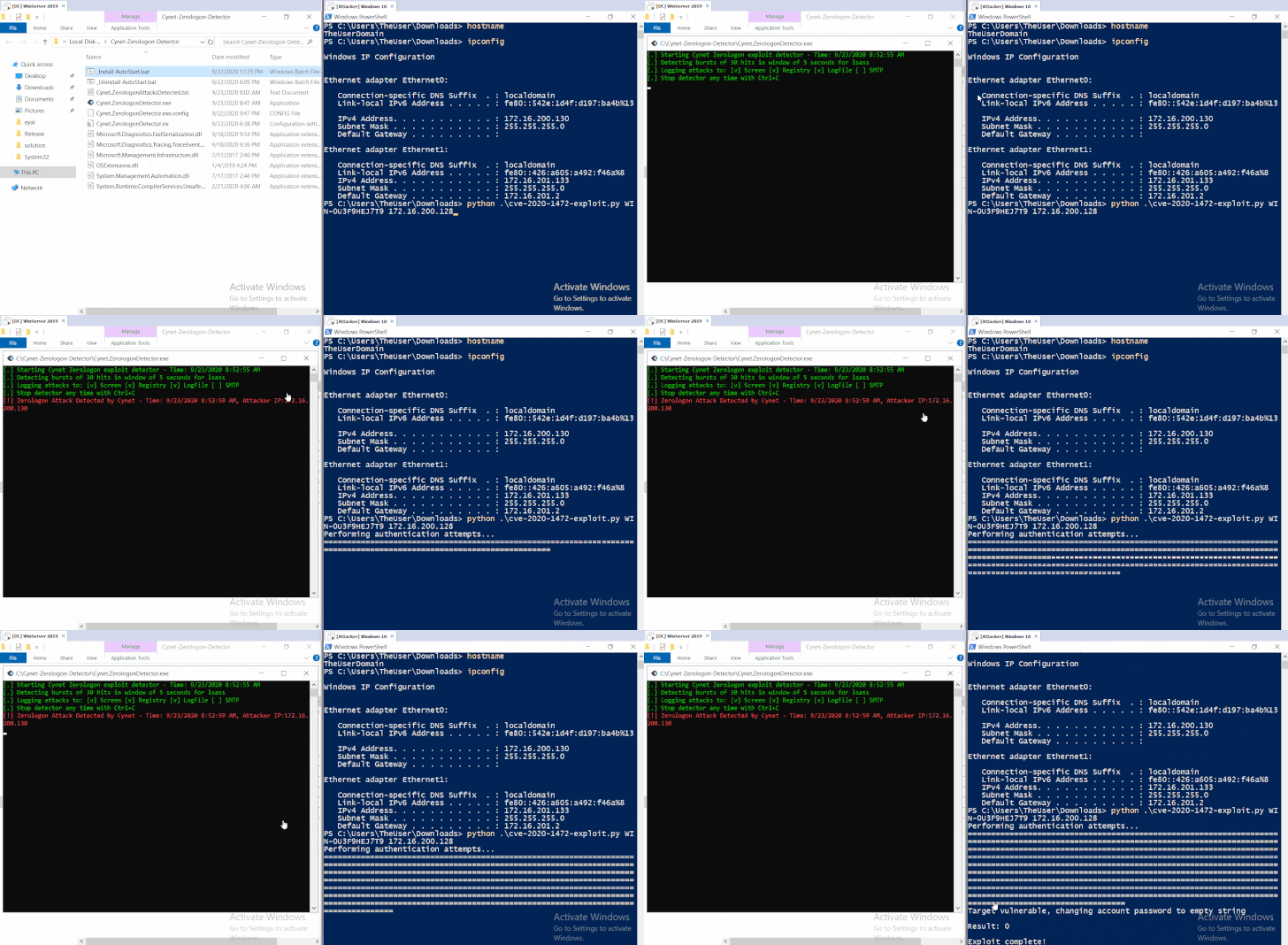
To let Windows Server users quickly detect related attacks,
experts also released the YARA rule that can detect attacks that
occurred prior to its deployment, whereas for realtime monitoring
is a simple tool is also available for
download[7].
However, to completely patch the issue, users still recommend
installing the latest software update from Microsoft as soon as
possible.
References
- ^
Secura
(www.secura.com) - ^
cybersecurity firm Cynet
(www.cynet.com) - ^
Microsoft released a patch
(thehackernews.com) - ^
Indian
(www.cert-in.org.in) - ^
Australian
(www.cyber.gov.au) - ^
emergency directive
(cyber.dhs.gov) - ^
available for download
(go.cynet.com)
Read more http://feedproxy.google.com/~r/TheHackersNews/~3/3QK32a2JmQU/detecting-and-preventing-critical.html