
in Transport Layer Security (TLS) protocol that could potentially
allow an attacker to break the encryption and read sensitive
communication under specific conditions.
Dubbed “Raccoon
Attack[1],” the server-side attack
exploits a side-channel in the cryptographic protocol (versions 1.2
and lower) to extract the shared secret key used for secure
communications between two parties.
“The root cause for this side channel is that the TLS standard
encourages non-constant-time processing of the DH secret,” the
researchers explained their findings in a paper. “If the server
reuses ephemeral keys, this side channel may allow an attacker to
recover the premaster secret by solving an instance of the Hidden
Number Problem.”
exploit and relies on very precise timing measurements and on a
specific server configuration to be exploitable.
A Timing Attack to Leak Secret Keys
Using time measurements to compromise a cryptosystem and leak
sensitive information has been the heart of many timing
attacks, and Raccoon employs the same strategy to the
Diffie-Hellman (DH) key exchange process during a TLS handshake,
which is crucial to trade data over a public network securely.
This shared secret key generated during the exchange enables
secure browsing on the Internet, allowing users to safely visit
websites by protecting the communications against eavesdropping and
man-in-the-middle (MitM) attacks.
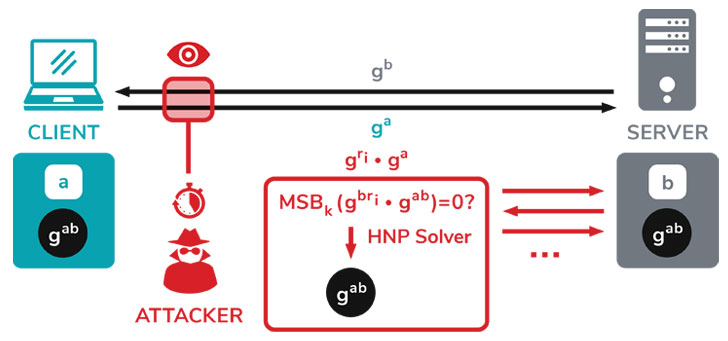
To break this security wall, the malicious party records the
handshake messages between a client and server, using to initiate
new handshakes to the same server, and subsequently measuring the
time it takes for the server to respond to the operations involved
in deriving the shared key.
in a faster server KDF computation, and
hence a shorter server response time.”
Assuming the attacker can identify this edge case, it allows the
bad actor to decipher the secret key of the original handshake and
ultimately decrypt the TLS traffic to recover its contents in
plaintext.
But the attack has its constraints. It necessitates that the server
reuses the same DH ephemeral key (a mode called DHE) across
sessions and that the attacker is as close to the target server as
possible to perform high precision timing measurements.
F5, Microsoft, Mozilla, and OpenSSL Release Security
Updates
While Raccoon may be hard to replicate in the real world, several
F5 products were found to be vulnerable to a “special” version of
the attack (CVE-2020-5929) without resorting to timing measurements
by directly observing the contents of server responses.
F5, Microsoft, Mozilla, and OpenSSL[5] have all released
patches to thwart the attack by addressing the concern with
ephemeral key reuse. For its part, Mozilla has turned off DH and
DHE cipher suites in its Firefox browser, and Microsoft’s advisory[6] recommends customers to
disable TLS_DHE.
With ephemeral keys crucial for ensuring forward
secrecy[7], the research is another
reason why reusing cryptographic keys can undermine security.
“Our attack exploits the fact that servers may reuse the secret
DH exponent for many sessions, thus forgoing forward secrecy,” the
researchers concluded.
“In this context, Raccoon teaches a lesson for protocol
security: For protocols where some cryptographic secrets can be
continuously queried by one of the parties, the attack surface is
made broader. The Raccoon attack showed that we should be careful
when giving attackers access to such queries.”
References
- ^
Raccoon Attack
(raccoon-attack.com) - ^
many timing attacks
(thehackernews.com) - ^
TLS handshake
(www.cloudflare.com) - ^
KDF
(en.wikipedia.org) - ^
OpenSSL
(www.openssl.org) - ^
advisory
(portal.msrc.microsoft.com) - ^
forward secrecy
(en.wikipedia.org)
Read more http://feedproxy.google.com/~r/TheHackersNews/~3/zwWadhRLYNM/raccoon-ssl-tls-encryption.html