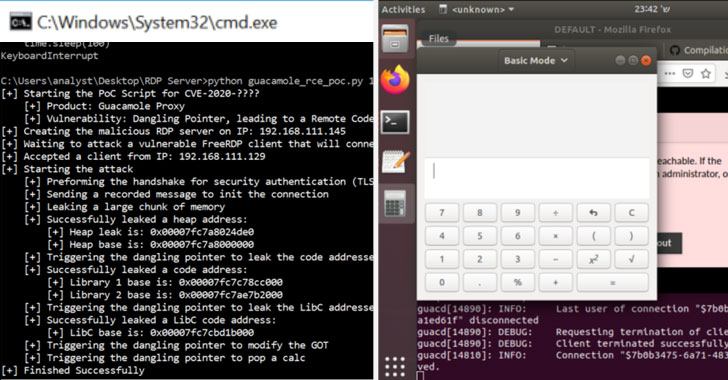
vulnerabilities in Apache Guacamole, a popular remote
desktop application used by system administrators to access and
manage Windows and Linux machines remotely.
The reported flaws could potentially let bad actors achieve full
control over the Guacamole server, intercept, and control all other
connected sessions.
According to a report[2] published by Check Point
Research and shared with The Hacker News, the flaws grant “an
attacker, who has already successfully compromised a computer
inside the organization, to launch an attack on the Guacamole
gateway when an unsuspecting worker tries to connect to an infected
machine.”
After the cybersecurity firm responsibly disclosed its findings
to Apache, the maintainers of Guacamole, on March 31, the company
released a patched version in
June 2020.
[3]
Apache Guacamole is
a popular open-source clientless remote desktop gateways solution.
When installed on a company’s server, it allows users to remotely
connect to their desktops simply using a web browser post an
authentication process.
Notably, Apache Guacamole remote desktop application has amassed
over 10 million
downloads[5] to date on Docker
Hub.
Memory Corruption Flaw to RCE
The attacks stem one of the two possible ways the gateway can be
taken over: either by a compromised machine inside the corporate
network that leverages an incoming benign connection to attack the
Apache gateway or a rogue employee who uses a computer inside the
network to hijack the gateway.
Check Point team said it identified the flaws as part of
Guacamole’s recent security audit, which also added support for
FreeRDP 2.0.0 towards the end of January 2020.
It’s worth pointing out that FreeRDP[6], an open-source RDP
client, had its own fair share of remote code
execution flaws[7], which were disclosed
early last year following the release of 2.0.0-rc4.
“Knowing that vulnerabilities in FreeRDP were only patched on
version 2.0.0-rc4, this means that all versions that were released
before January 2020 are using vulnerable versions of FreeRDP,”
Check Point researcher Eyal Itkin said.
Here’s a quick summary of all flaws discovered:
- Information disclosure vulnerabilities
(CVE-2020-9497) — Two separate flaws were identified
in the developers’ custom implementation of an RDP channel used to
handle audio packets from the server (“rdpsnd”). The first of the
two flaws permits an attacker to craft a malicious rdpsnd message
that could lead to an out-of-bounds read similar to Heartbleed[8]. A second bug in the
same channel is a data leak that transmits the out-of-bounds data
to a connected client.
The third information disclosure bug is a variant of the
aforementioned flaw that resides in a different channel called
“guacai,” responsible for audio input and is disabled by default.
- Out-of-bounds reads in FreeRDP — Looking to
find a memory corruption vulnerability that could be leveraged to
exploit the above data leaks, Check Point said they uncovered two
additional instances of out-of-bounds reads that take advantage of
a design flaw in FreeRDP.
- Memory Corruption flaw in Guacamole
(CVE-2020-9498) — This flaw, present in an
abstraction layer (“guac_common_svc.c”) laid over rdpsnd and rdpdr
(Device Redirection) channels, arises from a memory safety
violation, resulting in a dangling
pointer[9] that allows an attacker
to achieve code execution by combining the two flaws.
Use-after-free vulnerabilities are memory corruption bugs that
typically occur when an application tries to use memory space that
is no longer assigned to it. This usually causes a program to crash
but can also sometimes lead to other unintended consequences, such
as code execution that can be exploited by malicious actors.
By using vulnerabilities CVE-2020-9497 and CVE-2020-9498, “a
malicious corporate computer (our RDP ‘server’) can take control of
the guacd process
when a remote user requests to connect to his (infected) computer,”
Itkin said.
A Case of Privilege Escalation
More concerning, Check Point found it was possible to seize control
of all of the connections in the gateway from only a single guacd
process, which runs on the Guacamole server to handle remote
connections to the corporate network.
In addition to controlling the gateway, this privilege
escalation allows an attacker to eavesdrop on all incoming
sessions, record the credentials used, and even start new sessions
to control the rest of the organization’s computers.
“While the transition to remote work from home is a necessity in
these tough times of the COVID-19 pandemic, we can’t neglect the
security implications of such remote connections,” Itkin concluded.
“When most of the organization is working remotely, this foothold
is
equivalent to gaining full control over the entire organizational
network.”
“We strongly recommend that everyone makes sure that all servers
are up-to-date, and that whatever technology used for working from
home is fully patched to block such attack attempts.”
References
- ^
reverse RDP vulnerabilities
(thehackernews.com) - ^
report
(blog.checkpoint.com) - ^
patched version
(guacamole.apache.org) - ^
Apache Guacamole
(guacamole.apache.org) - ^
10
million downloads (hub.docker.com) - ^
FreeRDP
(www.freerdp.com) - ^
remote code execution flaws
(research.checkpoint.com) - ^
Heartbleed
(thehackernews.com) - ^
dangling pointer
(en.wikipedia.org) - ^
guacd process
(guacamole.apache.org)
Read more http://feedproxy.google.com/~r/TheHackersNews/~3/-nNoxoBeS9I/apache-guacamole-hacking.html