
of an elusive threat group that hacks into the high-profile
military and diplomatic entities in Eastern Europe for espionage.
The findings are part of a collaborative analysis by
cybersecurity firm ESET and the impacted firms, resulting in an
extensive look into InvisiMole’s operations and the group’s
tactics, tools, and procedures (TTPs).
“ESET researchers conducted an investigation of these attacks in
cooperation with the affected organizations and were able to
uncover the extensive, sophisticated tool-sets used for delivery,
lateral movement, and execution of InvisiMole’s backdoors,” the
company said in a report[1] shared with The Hacker
News.
Cooperation with the Gamaredon Group
First discovered in
2018, InvisiMole has been active at least since 2013 in
connection with targeted cyber-espionage operations in Ukraine and
Russia. After slipping under the radar, the threat actor returned
late last year with an updated toolset and previously unreported
tactics to obfuscate malware.
“InvisiMole has a modular architecture, starting its journey with a
wrapper DLL, and performing its activities using two other modules
that are embedded in its resources,” ESET researchers had
previously noted in a June 2018 report. “Both of the modules are
feature-rich backdoors, which together give it the ability to
gather as much information about the target as possible.”
The feature-rich spyware, dubbed RC2FM and RC2CL, was found to
be capable of making system changes, scanning wireless networks to
track the geolocation of victims, gathering user information, and
even uploading sensitive files located in the compromised machine.
But the exact mechanism of malware delivery remained unclear until
now.
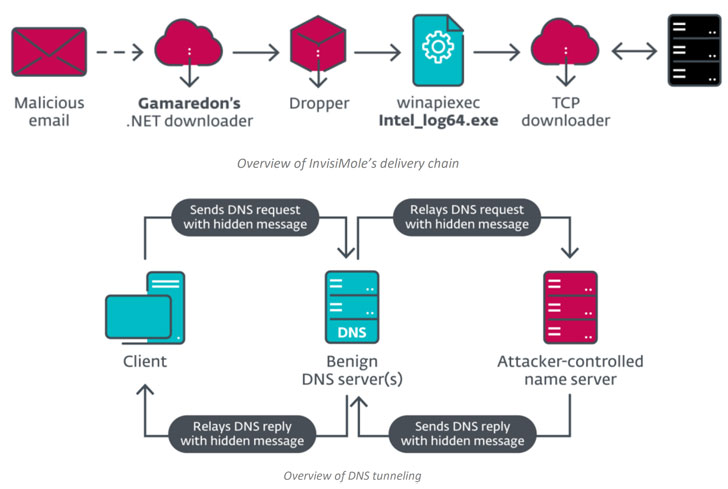
land” techniques that exploited legitimate applications to
stealthily carry out malicious operations, but they also discovered
ties to a second threat actor called the Gamaredon group, which has
a long history of
cyberattacks against Ukrainian institutions.
“Gamaredon is used to pave the way for a far stealthier payload
– according to our telemetry, a small number of Gamaredon’s targets
are ‘upgraded’ to the advanced InvisiMole malware, likely those
deemed particularly significant by the attackers,” the researchers
said, adding the malware is deployed only after the attackers
gained administrative privileges, as many of InvisiMole’s execution
methods require elevated permissions.
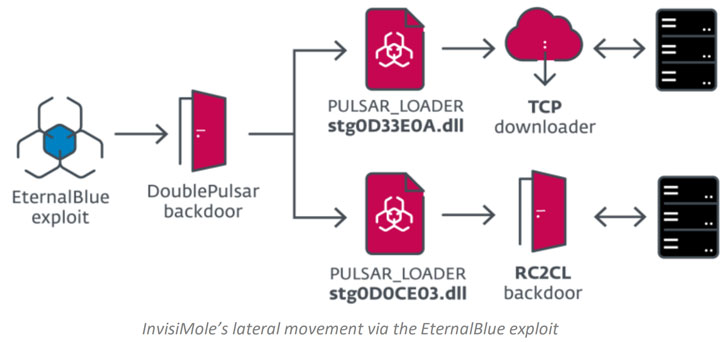
Once the initial compromise takes place, InvisiMole exploits
BlueKeep[5] (CVE-2019-0708) and
EternalBlue[6]
(CVE-2017-0144) vulnerabilities in RDP and SMB protocols or makes
use of trojanized documents and software installers to propagate
laterally across the network.
In addition to employing updated versions of the RC2CL and RC2FM
backdoors, the malware leverages a new TCS downloader to download
additional modules and a DNS downloader, which, in turn, leverages
DNS tunneling
to mask communications to an attacker-controlled server.
[7]
“With DNS tunneling, the compromised client does not directly
contact the C&C server; it only communicates with the benign
DNS server(s) the victim machine would normally communicate with,
where it sends requests to resolve a domain to its IP address,” the
researchers said. “The DNS server then contacts the name server
responsible for the domain in the request, which is an
attacker-controlled name server, and relays its response back to
the client.”
RC2CL and RC2FM: Fully-Featured Spyware
What’s more, the final payloads, RC2CL and RC2FM, were delivered
via no less than four different execution chains that were put
together by combining malicious shellcode with legitimate tools and
vulnerable executables.
capabilities to turn on webcam and microphone devices to take
photos, record video, and sound, capture screenshots, collect
network information, list installed software, and monitor recently
accessed documents by the victim. Although not used prominently,
RC2FM comes with its own set of document exfiltration commands,
along with new features to log keystrokes and bypass user access
control (UAC).
Furthermore, the new versions of both RC2CL and RC2FM come with
their own means to escape antivirus detection, including injecting
themselves into other innocuous processes and suppressing specific
features, such as keylogging.
“The targets considered particularly significant by the
attackers are upgraded from relatively simple Gamaredon malware to
the advanced InvisiMole malware,” ESET researcher Zuzana Hromcová
said. This previously unknown cooperation between the two groups
“allows the InvisiMole group to devise creative ways of operating
under the radar,” she added.
References
- ^
report
(www.welivesecurity.com) - ^
discovered in 2018
(www.welivesecurity.com) - ^
living off the land
(logrhythm.com) - ^
long history of cyberattacks
(www.welivesecurity.com) - ^
BlueKeep
(thehackernews.com) - ^
EternalBlue
(thehackernews.com) - ^
DNS tunneling
(unit42.paloaltonetworks.com)
Read more http://feedproxy.google.com/~r/TheHackersNews/~3/FYDckKKjFFw/invisimole-hackers.html