
a new flaw impacting DNS protocol that can be exploited to launch
amplified, large-scale distributed denial-of-service (DDoS) attacks
to takedown targeted websites.
Called NXNSAttack[1], the flaw hinges on the
DNS delegation mechanism to force DNS resolvers to generate more
DNS queries to authoritative servers of attacker’s choice,
potentially causing a botnet-scale disruption to online
services.
“We show that the number of DNS messages exchanged in a typical
resolution process might be much higher in practice than what is
expected in theory, mainly due to a proactive resolution of
name-servers’ IP addresses,” the researchers
said[2] in the paper.
“We show how this inefficiency becomes a bottleneck and might be
used to mount a devastating attack against either or both,
recursive resolvers and authoritative servers.”
Following responsible disclosure of NXNSAttack, several of the
companies in charge of the internet infrastructure, including
PowerDNS (CVE-2020-10995), CZ.NIC
(CVE-2020-12667), Cloudflare, Google, Amazon, Microsoft,
Oracle-owned Dyn, Verisign, and IBM Quad9, have patched their
software to address the problem.
[3][4]
The DNS infrastructure has been previously at the receiving end of
a rash of DDoS attacks through the infamous Mirai botnet,
including those against Dyn DNS service in 2016, crippling some of
the world’s biggest sites, including Twitter, Netflix, Amazon, and
Spotify.
The NXNSAttack Method
A recursive DNS
lookup happens when a DNS server communicates with multiple
authoritative DNS servers in a hierarchical sequence to locate an
IP address associated with a domain (e.g., www.google.com) and
return it to the client.
This resolution typically starts with the DNS resolver
controlled by your ISPs or public DNS servers, like Cloudflare
(1.1.1.1) or Google (8.8.8.8), whichever is configured with your
system.
The resolver passes the request to an authoritative DNS name
server if it’s unable to locate the IP address for a given domain
name.
But if the first authoritative DNS name server also doesn’t hold
the desired records, it returns the delegation message with
addresses to the next authoritative servers to which DNS resolver
can query.
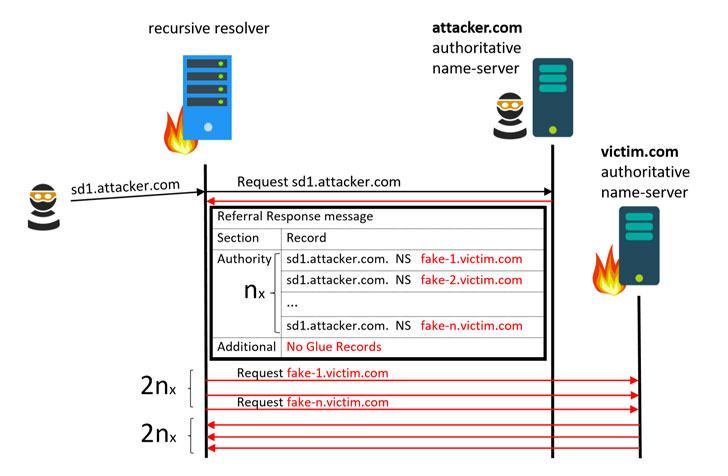
resolver: “I do not know the answer, go and query these and these
name servers, e.g., ns1, ns2, etc., instead”.
This hierarchical process goes on until the DNS resolver reaches
the correct authoritative server that provides the domain’s IP
address, allowing the user to access the desired website.
Researchers found that these large undesired overheads can be
exploited to trick recursive resolvers into forcefully continuously
sending a large number of packets to a targeted domain instead of
legitimate authoritative servers.
In order to mount the attack through a recursive resolver, the
attacker must be in possession of an authoritative server, the
researchers said.
“This can be easily achieved by buying a domain name. An
adversary who acts as an authoritative server can craft any NS
referral response as an answer to different DNS queries,” the
researchers said.
The NXNSAttack works by sending a request for an
attacker-controlled domain (e.g., “attacker.com”) to a vulnerable
DNS resolving server, which would forward the DNS query to the
attacker-controlled authoritative server.
Instead of returning addresses to the actual authoritative
servers, the attacker-controlled authoritative server responds to
the DNS query with a list of fake server names or subdomains
controlled by the threat actor that points to a victim DNS
domain.
The DNS server, then, forwards the query to all the nonexistent
subdomains, creating a massive surge in traffic to the victim site.
The researchers said the attack can amplify the number of
packets exchanged by the recursive resolver by as much as a factor
of more than 1,620, thereby overwhelming not only the DNS resolvers
with more requests they can handle, but also flood the target
domain with superfluous requests and take it down.
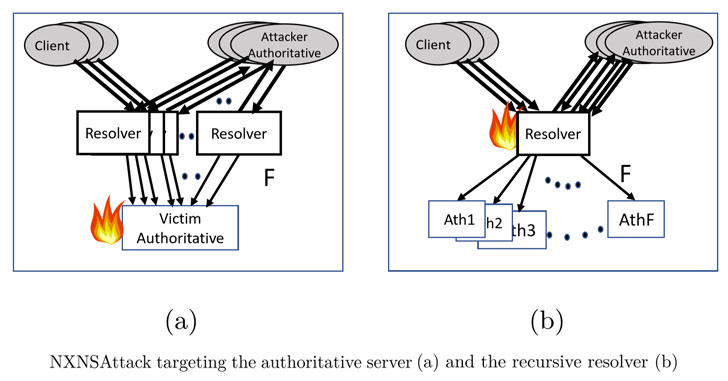
further augment the scale of the attack.
“Controlling and acquiring a huge number of clients and a large
number of authoritative NSs by an attacker is easy and cheap in
practice,” the researchers said.
“Our initial goal was to investigate the efficiency of recursive
resolvers and their behavior under different attacks, and we ended
up finding a new seriously looking vulnerability, the NXNSAttack,”
the researchers concluded.
“The key ingredients of the new attack are (i) the ease with
which one can own or control an authoritative name server, and (ii)
the usage of nonexistent domain names for name servers and (iii)
the extra redundancy placed in the DNS structure to achieve fault
tolerance and fast response time,” they added.
It’s highly recommended that network administrators who run
their own DNS servers update their DNS resolver software to the
latest version.
References
- ^
NXNSAttack
(www.nxnsattack.com) - ^
researchers said
(www.nxnsattack.com) - ^
CVE-2020-10995
(docs.powerdns.com) - ^
CZ.NIC
(www.knot-resolver.cz) - ^
Mirai botnet
(thehackernews.com) - ^
recursive DNS lookup
(docs.microsoft.com)
Read more http://feedproxy.google.com/~r/TheHackersNews/~3/sokrg1_SIcw/dns-server-ddos-attack.html