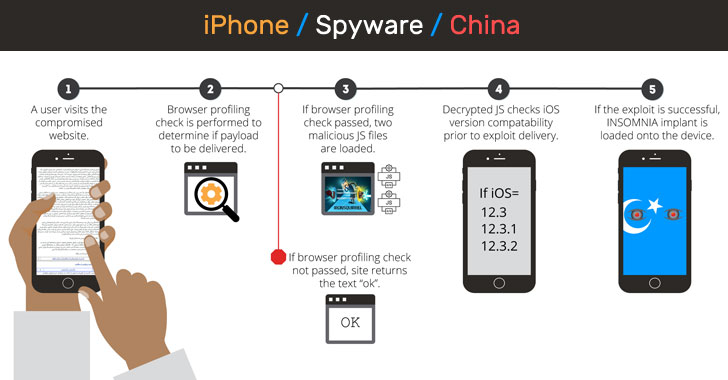
exploit chain in iOS devices to install a spyware implant targeting
the Uyghur Muslim minority in China’s autonomous region of
Xinjiang.
The findings, published by digital forensics firm Volexity,
reveal that the exploit — named “Insomnia” — works against iOS
versions 12.3, 12.3.1, and 12.3.2 using a flaw in WebKit that was
patched by Apple with the release of iOS 12.4 in July 2019.
[1][2]
Volexity said the attacks were carried out by a state-sponsored
hacking group it calls Evil Eye, the
same threat actor that it said was behind a series of attacks
against the Uyghurs last September following a bombshell disclosure
by Google’s Project Zero
team.
Watering Holes Attacks Targeting Uyghur Websites
The malware campaign previously exploited as many as 14 vulnerabilities
spanning from iOS 10 all the way through iOS 12 over a period of at
least two years via a small collection of malicious websites that
were used as a watering hole to hack into the devices.
According to Volexity, Insomnia was loaded on the iOS devices of
users using the same tactic, granting the attackers root access,
thereby allowing them to steal contact and location information,
and plaintext messages from various instant messaging and email
clients, including Signal and ProtonMail.
In its report, the company said that in the aftermath of last
year’s exposé, the Evil Eye actor removed malicious code from the
compromised websites and took down its command-and-control (C2)
server infrastructure, until it began observing “new activity
across multiple previously compromised Uyghur websites” starting in
January 2020.
It’s worth pointing out that the open-source browser engine
WebKit is the basis for Safari and other third-party web browsers
on iOS such as Google Chrome and Firefox due to restrictions
imposed by Apple’s App Store Review
Guidelines[6] (Section 2.5.6).
“Volexity was able to confirm successful exploitation of a phone
running 12.3.1 via the Apple Safari, Google Chrome, and Microsoft
Edge mobile browsers,” the research team said.
The new watering hole attacks compromised six different websites
(e.g., the Uyghur Academy website or akademiye[.]org), which, when
visited, loaded the Insomnia implant on the device.
The Spyware Now targets ProtonMail and Signal
As for the Spyware, it appears to be an updated version of
the implant detailed by Google’s Project Zero security group,
but with support for HTTPS communication and added capabilities to
transmit information about each app that’s installed on the device
as well as exfiltrate data from secure email and messaging apps
like ProtonMail and Signal.
“As noted in September 2019, Volexity suspected that the Evil
Eye attackers had also targeted iPhones based on the attackers’ C2
servers going offline shortly after Project Zero’s findings were
made public,” the researchers concluded.
“These more recent findings confirm the suspicion that the
attackers were indeed likely the same. It can now be confirmed that
in the past six months, Uyghur sites have led to malware for all
major platforms, representing a considerable development and upkeep
effort by the attackers to spy on the Uyghur population.”
References
- ^
Volexity
(www.volexity.com) - ^
iOS 12.4
(support.apple.com) - ^
Evil Eye
(www.volexity.com) - ^
Project Zero team
(googleprojectzero.blogspot.com) - ^
14 vulnerabilities
(support.apple.com) - ^
App Store Review Guidelines
(developer.apple.com) - ^
updated version of the implant
(googleprojectzero.blogspot.com)
Read more http://feedproxy.google.com/~r/TheHackersNews/~3/BslYHgvaExo/iphone-zero-day-exploit.html