exfiltrate sensitive data from your computer by simply changing the
brightness of the screen, new cybersecurity research shared with
The Hacker News revealed.
In recent years, several cybersecurity researchers demonstrated
innovative ways to covertly exfiltrate data from a physically
isolated air-gapped computer that can’t connect wirelessly or
physically with other computers or network devices.
These clever ideas rely on exploiting little-noticed emissions
of a computer’s components, such as light, sound[1], heat[2], radio
frequencies[3], or ultrasonic
waves[4], and even using the
current
fluctuations[5] in the power lines.
For instance, potential attackers could sabotage supply chains
to infect an air-gapped computer, but they can’t always count on an
insider to unknowingly carry a USB with the data back out of a
targeted facility.
When it comes to high-value targets, these unusual techniques,
which may sound theoretical and useless to many, could play an
important role in exfiltrating sensitive data from an infected but
air-gapped computer.
How Does the Brightness Air-Gapped Attack Work?
In his latest research with fellow academics, Mordechai
Guri[6], the head of the
cybersecurity research center at Israel’s Ben Gurion University,
devised a new covert optical channel using which attackers can
steal data from air-gapped computers without requiring network
connectivity or physically contacting the devices.
“This covert channel is invisible, and it works even while the
user is working on the computer. Malware on a compromised computer
can obtain sensitive data (e.g., files, images, encryption keys,
and passwords), and modulate it within the screen brightness,
invisible to users,” the researchers said.
The fundamental idea behind encoding and decoding of data is
similar to the previous cases, i.e., malware encodes the collected
information as a stream of bytes and then modulate it as ‘1’ and
‘0’ signal.
In this case, the attacker uses small changes in the LCD screen
brightness, which remains invisible to the naked eye, to covertly
modulate binary information in morse-code like patterns
“In LCD screens each pixel presents a combination of RGB colors
which produce the required compound color. In the proposed
modulation, the RGB color component of each pixel is slightly
changed.”
“These changes are invisible, since they are relatively small
and occur fast, up to the screen refresh rate. Moreover, the
overall color change of the image on the screen is invisible to the
user.”
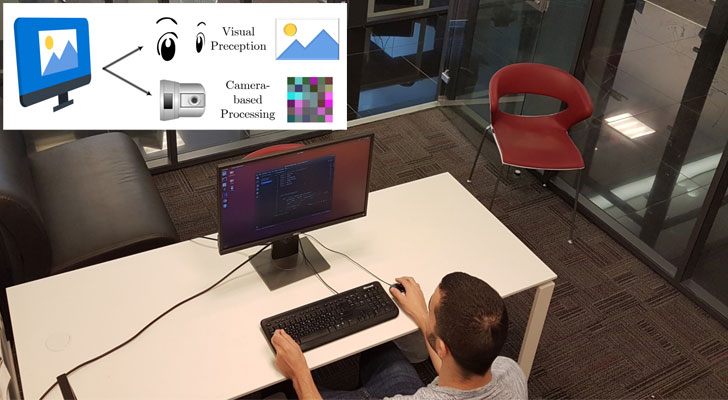
The attacker, on the other hand, can collect this data stream
using video recording of the compromised computer’s display, taken
by a local surveillance camera, smartphone camera, or a webcam and
can then reconstruct exfiltrated information using image processing
techniques.
As shown in the video demonstration shared with The Hacker News,
researchers infected an air-gapped computer with specialized
malware that intercepts the screen buffer to modulate the data in
ASK by modifying the brightness of the bitmap according to the
current bit (‘1’ or ‘0’).
paper [PDF[7]] titled, ‘BRIGHTNESS:
Leaking Sensitive Data from Air-Gapped Workstations via Screen
Brightness,’ published yesterday by Mordechai Guri, Dima Bykhovsky
and Yuval Elovici.
Air-Gapped Popular Data Exfiltration Techniques
It’s not the first time Ben-Gurion researchers came up with a
covert technique to target air-gapped computers. Their previous
research of hacking air-gap machines include:
- PowerHammer[8]
attack to exfiltrate data from air-gapped computers through power
lines. - MOSQUITO[9] technique using
which two (or more) air-gapped PCs placed in the same room can
covertly exchange data via ultrasonic waves. - BeatCoin[10] technique that could
let attackers steal private encryption keys from air-gapped
cryptocurrency wallets. - aIR-Jumper[11] attack that takes
sensitive information from air-gapped computers with the help of
infrared-equipped CCTV cameras that are used for night vision. - MAGNETO and
ODINI[12] techniques use
CPU-generated magnetic fields as a covert channel between
air-gapped systems and nearby smartphones. - USBee[13] attack that
can be used to steal data from air-gapped computers using radio
frequency transmissions from USB connectors. - DiskFiltration[14] attack that can
steal data using sound signals emitted from the hard disk drive
(HDD) of the targeted air-gapped computer; - BitWhisper[15] that relies on heat
exchange between two computer systems to stealthily siphon
passwords or security keys; - AirHopper[16] that turns a
computer’s video card into an FM transmitter to capture
keystrokes; - Fansmitter[17] technique that uses
noise emitted by a computer fan to transmit data; and - GSMem[18] attack that relies
on cellular frequencies.
References
- ^
sound
(thehackernews.com) - ^
heat
(thehackernews.com) - ^
radio frequencies
(thehackernews.com) - ^
ultrasonic waves
(thehackernews.com) - ^
current fluctuations
(thehackernews.com) - ^
Mordechai Guri
(cyber.bgu.ac.il) - ^
PDF (arxiv.org) - ^
PowerHammer
(thehackernews.com) - ^
MOSQUITO
(thehackernews.com) - ^
BeatCoin
(thehackernews.com) - ^
aIR-Jumper
(thehackernews.com) - ^
MAGNETO and ODINI
(thehackernews.com) - ^
USBee
(thehackernews.com) - ^
DiskFiltration
(thehackernews.com) - ^
BitWhisper
(thehackernews.com) - ^
AirHopper
(thehackernews.com) - ^
Fansmitter
(arxiv.org) - ^
GSMem
(www.usenix.org)
Read more http://feedproxy.google.com/~r/TheHackersNews/~3/9JYAkYaYzRY/hacking-air-gapped-computers.html