Compilers play an important role in the development of modern
software and systems. They’re computer programs that transform
source codes into binary executables. When you write a program
using a high-level language such as C or Pascal, you need the
compiler to interpret your code and turn it into a machine-readable
binary. Usually, modern Linux IDEs take care of this
using in-built compiler frontends. On the other hand, many systems
programmer like me writes their code using a simple editor and
compiles the program using the appropriate Linux compilers. Since
Linux offers a plethora of compelling compilers, we’ve curated this
guide to help you choose the best one for your needs. [1]
Powerful Linux
Compilers
Compilers are used for turning programs written in compiled
language into executables. Interpreted languages like Python and
Perl don’t require us to compile the code since programs written in
these languages are executed inside a standalone runtime. However,
compiled languages offer exceptional performance and are thus used
for building advanced applications such as your favorite Linux distros[2].
1. GCC
The GNU Compiler Collection or GCC is, without any doubt, the
most powerful compiler. It is a cornerstone of the open-source GNU
platform and has been used to build almost every modern machine in
one way or another. GCC offers a suite of compilers for standard
compiled languages, including C, C++, Objective C, Ada, Pascal,
Fortran, and many more. Most Linux distributions should have GCC
installed by default. It supports both the ANSI C and the K&R
variant. If you’re a starting programmer, stick with GCC.

Features of GCC
- GCC is known for its portability and can produce executables
for a wide range of platforms, including most ARM-based embedded
devices. - It implements robust link-time optimization techniques for
speeding up the output binary by a significant factor. - GCC is extremely extendable and allows developers to use custom
plugins for adding newer functionalities as required by the
project. - It is written using C++ and provides support for fast
enumeration, protocol methods, cross-compilation, class extensions,
and so on.
2. AOCC
The AOCC or AMD Optimizing C/C++ Compiler is a free but
compelling optimization compiler for 32-bit and 64-bit Linux AMD
platforms. It’s a specialized compiler that allows developers to
utilize the most performance out of their latest CPUs. This is one
of the best Linux compilers for game developers due to its vast
array of optimization capabilities. Moreover, AOCC is an
open-source project. So, developers can view the source for a
better understanding of the underlying workings.
Features of AOCC
- AMD Optimizing C/C++ Compiler is specifically tuned for the AMD
17h processor family and provides better optimization for AMD EPYC
7xx2-series. - This compiler is written using the Fortran language and is
tested on Ubuntu 18.04, Ubuntu 19.04, and Red Hat Enterprise
Linux. - It provides binary installations for both Debian and RPM-based
systems and also allows installation from the source. - This is the best optimization compiler for Linux users who
possess modern AMD Ryzen-based microprocessors.
3. Intel C++
Compiler
The Intel C++ Compiler is an extremely powerful proprietary
compiler that runs seamlessly in Linux and other Unix-based
machines. It is essentially a compiler suite with the ability to
produce high-performance executables using advanced techniques and
hardware optimizations. Also known as icc, this modern-day compiler
is aimed at professionals working in high availability computing
and game development. Developers can quickly write code that takes
advantage of additional cores available on Intel-based Linux
environments.
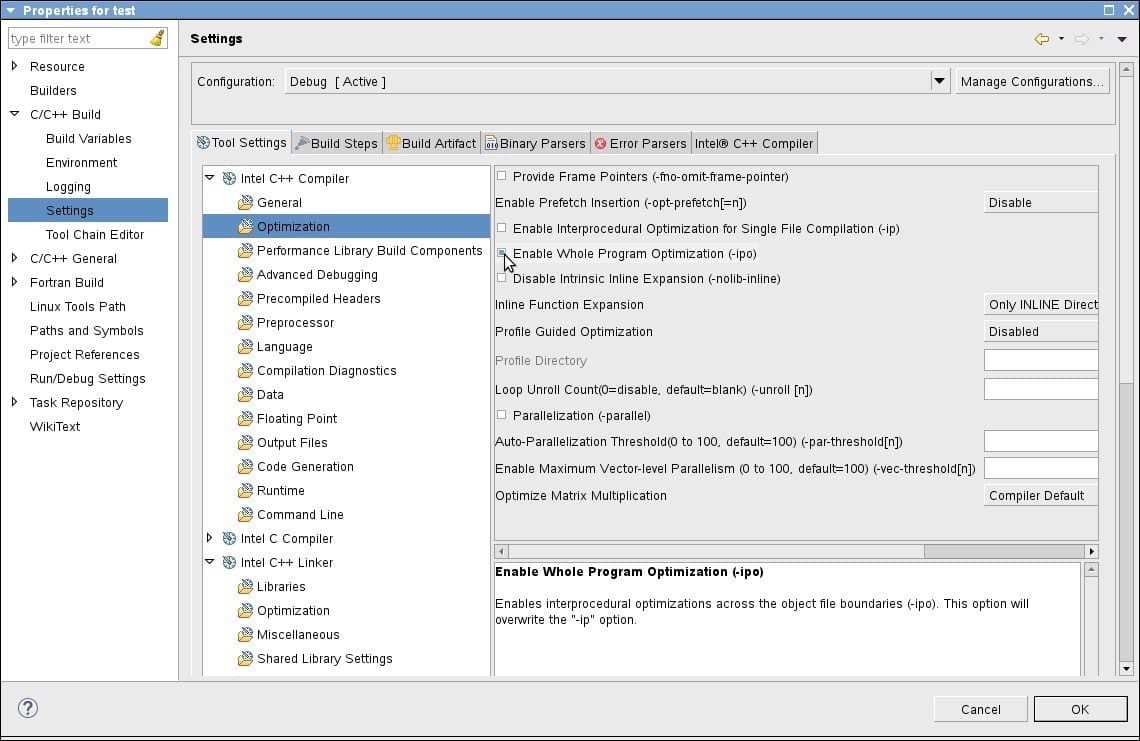
Features of Intel C++ Compiler
- Intel C++ Compiler can be easily integrated with traditional
IDEs, including Eclipse, Visual Studio[5], Xcode, and Android
Studio. - Developers can heavily optimize programs written for various
Intel families such as Intel Core, Atom, and Xeon-based
micro-processors. - Intel C++ Compiler provides exceptional support for SIMD
parallelization with tools like the SIMD Data Layout Template
library. - This Linux compiler supports OpenMP programming models, lambda
improvements, embedded applications, and the Intel® VTune™
Profiler.
Download Intel C++
Compiler[6]
4. LLVM
The Low-Level Virtual Machine or LLVM is a collection of
compiler technologies that offers powerful libraries and tools for
creating compilers and optimizers. It’s a sophisticated project
that has been used by many modern compilers such as the AMD
Optimizing C/C++ Compiler. The simple design principle of LLVM
makes it easy to understand for beginners while still providing the
tools required for creating advanced development tools. Moreover,
LLVM offers excellent support for a wide range of architecture,
including X86, X86-64, ARM, MIPS, and PowerPC.
Features of LLVM
- It provides very stable online and offline code representations
alongside readers and writers for assembly & bytecode. - The LLVM Clang project allows compelling frontends for C, C++,
Fortran, and Objective C based on the GCC 4.2 parsers. - LLVM offers powerful Just in Time(JIT) compilations[7] alongside a C-based
backend for building target-specific native codes. - It also offers an outstanding profiling system for
optimization, testing framework, life-long compilation model, and
robust debugging tools for Linux.
5. Netwide Assembler
Netwide Assembler or NASM is an extremely powerful assembler and
disassembler for Intel x86 machines. It runs on all major Linux distributions[9] as well as on Windows
and Mac OS. NASM is widely considered as the best Linux assembler
due to its rich feature set and ease of use. It is being maintained
actively and is used in a lot of areas. If you’re looking for the
best assembler for your x86 Linux system, we suggest you go with
NASM.
Features of Netwide Assembler
- It can be used for assembling outputs in several formats such
as ELF, Mach-O, a.out, COFF, OMF, and other binary files. - The free and open-source BSD 2-clause license of this assembler
makes NASM extremely easy to modify or customize. - NASM can be used for re-targeting programs to almost any x86
system due to is a wide array of output formats. - It can generate automatic segment overrides, create flat
binaries, write ROM images, and Linux boot loaders[10].
6. GFortran
GFortran or GNU Fortran is a full-fledged Fortran compiler
frontend based on GCC. It is a FOSS project which offers a plethora
of robust functionalities, including great debugging features and
support for legacy codebases. GFortran is compatible with Fortran
95 while also offering most features of Fortran 2003 and Fortran
2008. Additionally, the open-source nature of this project
encourages developers to extend the compiler code themselves. So
take a look at GFortran if you’re working with Fortran for either
personal projects or maintaining legacy enterprise products.
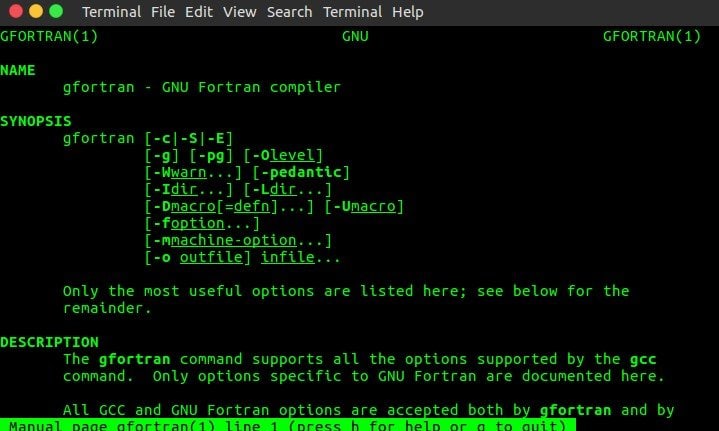
Features of GFortran
- GFortran is developed for replacing the historical g77 Fortran
compiler and ensures successful compilation of all legacy g77
code. - It is known for its reasonable compilation speed and the
ability to compile codes developed for a different machine. - GFortran provides seamless compilation accuracy and maintains a
handy Linux ticketing system[12] for fixing or outlining
bugs. - This Fortran compiler is very well maintained and rolls out
newer features as well as bug fixes pretty often.
7. GHC
GHC or the Glasgow Haskell Compiler is a free but powerful
native code compiler for the Haskell programming language. It is
available on all X86, X86-64, and ARM-based machines and supports
Linux alongside traditional Unix systems. Haskell is a compelling
functional programming language[14] that is gaining
tremendous momentum due to its advanced feature set. GHC is one of
the best Linux compilers for Haskell programmers and offers
everything required for building modern-day research and industrial
projects.
Features of GHC
- GHC implements a cross-platform system that enables developers
to write and test Haskell programs in a formidable manner. - This Haskell compiler supports a massive list of libraries,
extensions, and optimization techniques for speeding up large-scale
applications. - GHC can generate faster codes for concurrent programs and
supports various parallelization techniques like Software Transactional Memory
(STM)[15]. - It is very much portable and can be used for generating C code
as an intermediate target for a different platform.
8. Tiny C Compiler
The Tiny C Compiler is a small but extremely efficient C
compiler developed by Fabrice Bellard. It is built for older
hardware with various resource constraints. Tiny C Compiler is
written using a combination of C and assembly, which reduces the
overall memory footprint of the compiler and makes it an ideal
choice for small, embedded platforms. It is a cross-platform
compiler that runs seamlessly in Linux, BSD, and Windows operating
systems. We suggest this compiler to developers working in projects
that have limited CPU resources.
Features of Tiny C Compiler
- Tiny C Compiler supports all features of ANSI C (C89/C90) as
well as most of the C99 ISO standard alongside traditional GNU
extensions. - It is very lightweight at around 100 KB and can be run within
systems that have as low as 1.44 MB of free memory space. - The convenient command-line switch enables developers to run
programs automatically at compile-time and within Linux shell
scripts. - Tiny C Compiler can be run on X86, X86-64, and ARM-based
devices and compiles almost nine times faster than GCC.
9. Free Pascal
Compiler
The Free Pascal Compiler or FPC is a simple and efficient
compiler for Pascal and Object Pascal. It supports all major
operating systems as well as 16, 32, and 64-bit machines. FPC is an
open-source software so developers can view the source and make
modifications without any problem. This helps programmers to write
more optimized codes and reduce the runtime of older, legacy
applications. Moreover, Free Pascal Compiler is one of the best
Linux compilers for programming retro game emulators[18] such as Nintendo NDS
and Game Boy Advance.
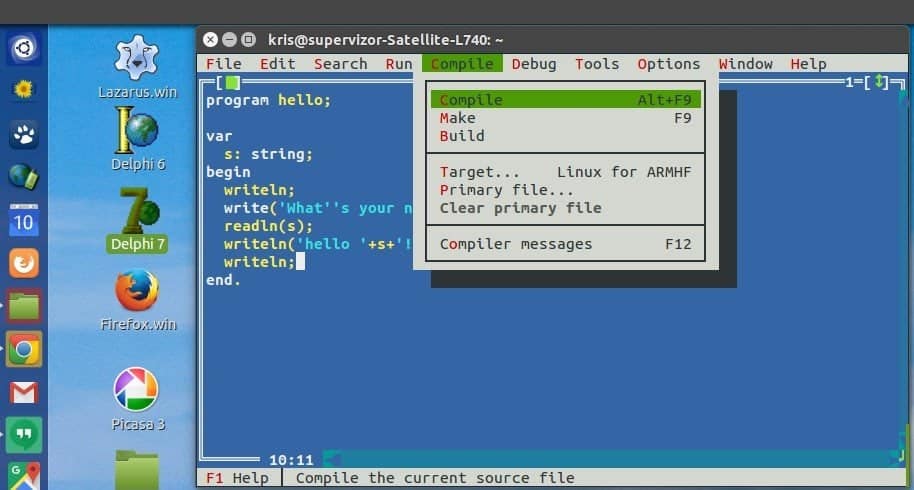
Features of Free Pascal
Compiler
- Free Pascal Compiler takes a “write once, compile anywhere”
approach, which enables developers to write more flexible
codes. - The Lazarus integrated development environment
(IDE)[19] provides an excellent
graphical interface to this Pascal compiler. - It can successfully generate LLVM Bitcodes for several
platforms, including x86-64, AArch64, and ARMHF. - The official website provides excellent documentation to help
beginners get started with Free Pascal Compiler.
Download Free Pascal
Compiler [20]
10. Babel
Babel is a compelling, modern-day compiler for JavaScript. It is
a feature-rich compiler used to transpile ECMAScript 2015+ code
into an older but backward-compatible version of JavaScript. This
is often required for adding new features into an existing
JavaScript application. This ensures that your new code also runs
effectively on older runtimes. Babel can transform source code and
syntax, polyfill missing features, even convert JSX syntax.
Moreover, it is an open-source project. So developers can easily
obtain the source and extend it as needed.
Features of Babel
- Babel is developed using a modular, plugin-based design, which
makes customization extremely easier for JavaScript
developers. - The convenient source map support of this transpiler makes it
easy to debug errors in compiled programs. - Babel comes with a custom regenerator runtime for producing
polyfill codes for including missing features. - It offers excellent, in-depth documentation that introduces
developers with its core features and usage.
11. Clang
Clang is another powerful compiler frontend for C-styled
programming languages. It also supports OpenMP, OpenCL,
RenderScript, and NVIDIA CUDA frameworks. Clang is developed using
LLVM as the backend and provides numerous tooling infrastructure
that ensures enterprise quality programs. It has seen a steep rise
in popularity due to its simple yet hackable codebase, which makes
customization much easier. Moreover, Clang offers exceptional
diagnostics alongside seamless integration with modern Linux code editors[22] like Atom and Sublime
Text.
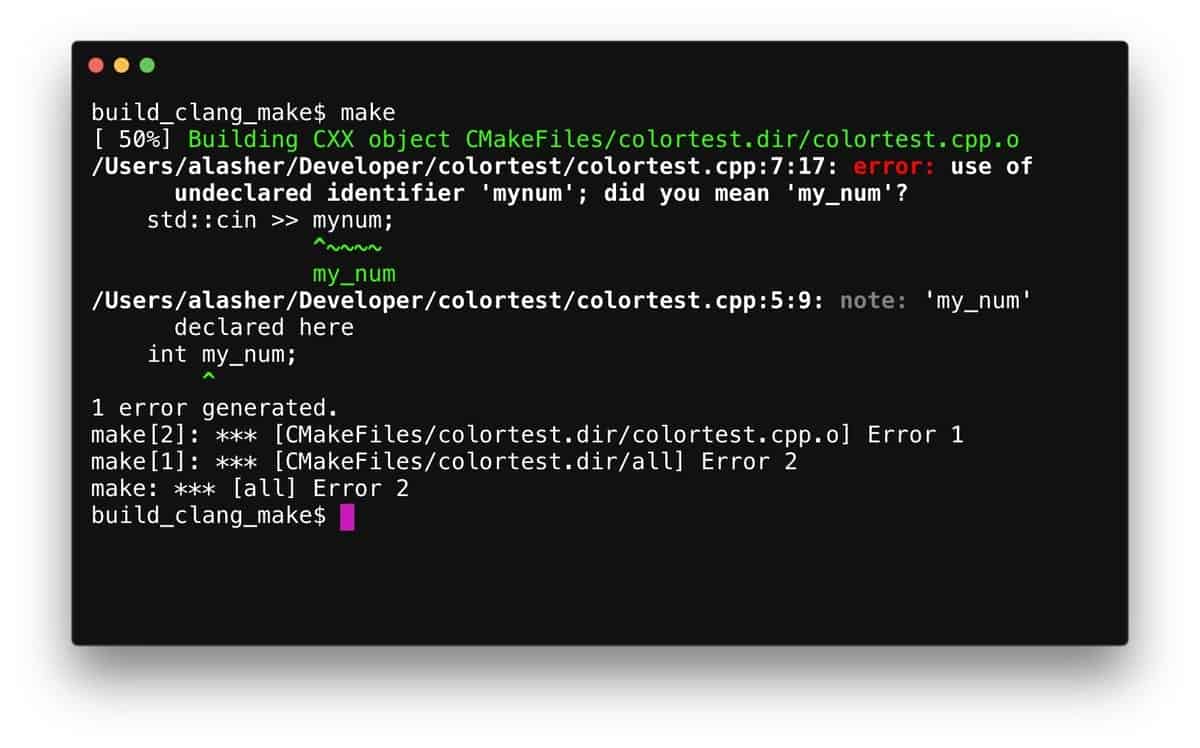
Features of Clang
- Clang is known for its fast compilation time and superior
performance compared to traditional Linux compilers. - The modular, plugin-based architecture of this project makes
Clang extremely customizable and requires limited CPU
resources. - It comes out with an LLVM-BSD license that is compatible with
enterprise products while still providing the source freely. - The lightweight memory footprint of Clang makes it a perfect
choice for creating programs in resource-constrained machines.
12. Intel Fortran
Compiler
The Intel Fortran Compiler or simply IFORT is a family of
extremely powerful Fortran compiler for Intel hardware. It comes
with many lucrative feature sets that make program optimization
very easy. Most of these Fortran compilers can pre-process,
compile, assemble, and link Fortran applications very effectively
on both IA-32 and Intel 64 systems. No matter if you’re a
researcher or a developer is maintaining legacy codebase, IFORT is
certainly one of the best Linux Compilers you can get.
Features of Intel Fortran
Compiler
- It is a cross-platform Fortran compiler and offers excellent
integration with traditional Unix IDEs like Eclipse & Xcode. - IFORT is designed for leveraging multicore architecture
features like SIMD vectorization, automatic parallelism, and
co-arrays. - The compliant compiler of this suite supports all features of
Fortran 66, 77, 90, 95, 2003, and 2008 alongside many 2018
functionalities. - Most of these Fortran compilers can work with Windows API,
POSIX, OpenGL, Component Object Model(COM), and GDB.
Download Intel Fortran
Compiler [24]
13. FreeBASIC
BASIC was a popular language of its time known for its ease of
use. Many legacy applications still utilize this multi-paradigm
programming language. FreeBASIC is a simple yet feature-rich
compiler for the BASIC and QBasic programming languages. It is an
open-source project that comes under the GNU GPL license and
supports all major Unix platforms, including Linux and FreeBSD[25]. This BASIC compiler is
also used to develop programs for the MS-DOS and Xbox platforms.
However, official support for Xbox has been deprecated.
Features of FreeBASIC
- This 32-bit BASIC compiler also provides the necessary
assembler, linker, archiver, and utilizes the GNU Binutils
toolchain as its backend. - FreeBASIC is a self-hosting compiler and provides many popular
libraries such as SDL, OpenGL, GTK, and the C standard
library. - Developers can quickly build graphical programs by utilizing
DirectX in Windows or OpenGL in Linux-based machines. - FreeBASIC offers a command-only interface by default but can be
used from within traditional Linux IDEs like.
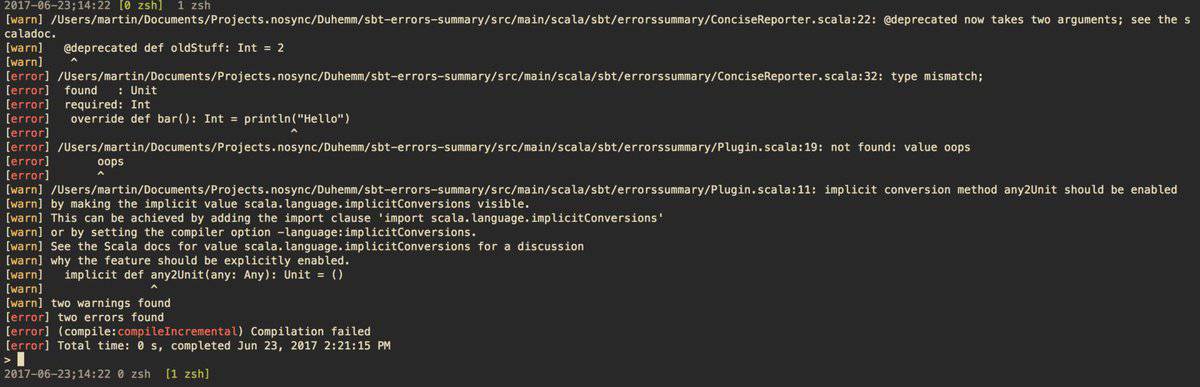
14. Scala Native
Scala Native is a simple but extremely effective compiler for
the functional programming language Scala. It is an
AoT(Ahead-of-Time) compiler that can optimize your code to a great
extent. Scala Native is a fairly modern compiler that has in-built
support for higher-level abstractions, type checking, and immutable
data structures. This makes it a very safe compiler for developing
modern-day software solutions at ease. Instead of providing native
Java or Scala libraries, Scala Native implements its personalized
implementation of JDK.
Features of Scala Native
- Scala Native offers excellent out of the box support for
existing Scala IDEs and seamless integration with standard build
tools. - This Scala compiler utilizes the LLVM backend for generating
intermediate representations, which increases performance based on
machines. - It is built as a cross-publishing infrastructure against the
JVM(Java Virtual Machine), JavaScript runtime, and Native
platforms. - The open-source nature of this compiler allows developers to
extend the software or make essential modifications as they
require.
15. CodeChef Online
IDE
Online Linux compilers provide a handy way of testing programs
without installing language-specific compilers. CodeChef is a
popular website that hosts competitive programming contests and
provides a compelling online compilation suite. The CodeChef online
IDE makes it very easy to test newer technologies from the comfort
of your home machine, without even installing the bare minimum. The
IDE loads up pretty fast and offers a seamless graphical experience
to Linux users. So, we highly suggest you check this online IDE if
you like to try newer programming languages.
Features of CodeChef Online
IDE
- The CodeChef Online IDE supports many different runtimes and
compilers, including GCC, GHC, Rust, Scala, GFortran, Bash, and so
on. - Developers can upload existing program codes very easily using
the intuitive file upload feature of this online Linux
compiler. - Most of the compilers of this online suite provide skeleton
codes for saving the time of developers and helping new users. - Users can configure the graphical experience they’re seeing by
changing the fonts, tabs, themes as well as soft wraps.
16. Steel Bank Common
Lisp
The Steel Bank Common Lisp or SBCL is a high-performance Linux
compiler for the ANSI Common Lisp language. It is an outstanding
compiler with features for debugging, optimization, profiling, and
many more. If you’re a Lisp developer working with
resource-intensive enterprise applications, SBCL is certainly a
feasible choice for you. This Lisp compiler is available on all
major platforms that support Linux, such as x86, AMD64, and
ARM-based machines. PC users can also run this compiler in most BSD
systems.
Features of Steel Bank Common
Lisp
- SBCL provides both the runtime and compiler for the ANSI Common
Lisp dialect and is a direct fork of the Carnegie Mellon University
Common Lisp. - This is an entirely open-source project with a permissive
license that enables further modification of the compiler without
any hassle. - SBCL offers excellent debugging features, which make it easy to
track down bugs in your code and optimize programs. - The official documentation provides an in-depth knowledge of
this Lisp compiler and available functionalities.
17. Portable C
Compiler
The PCC or Portable C Compiler is an old-school C compiler for
Unix-like operating systems. It was developed in the Bell Labs and
aimed to solve common portability issues present in many Linux
compilers of that generation. The PCC can be thought of like an
extended version of the Kernighan and Ritchie C compiler. Portable
C Compiler is known for its blazing fast speed, which is roughly
5-10 times faster than GCC. You can try out this compiler if you’re
working on legacy programs.
Features of Portable C
Compiler
- PCC is a simple but lightweight C compiler for Linux that runs
effectively on older, legacy hardware. - It provides excellent support for Minix, recursive
macro-expansions, optimized MIPS instructions, and so on. - The open-source BSD license featured by this C compiler is
attractive to both open source enthusiasts and enterprises. - PCC is a viable alternative to GCC for various BSD distributions[30] like OpenBSD, NetBSD,
FreeBSD, and DragonFly.
Download Portable C
Compiler[31]
18. CHICKEN
CHICKEN is a modern-day Linux compiler for the Scheme
programming language. It is essentially a compiler and interpreter
that implements many useful features of Scheme programmers. CHICKEN
can convert Scheme source to C code very effectively and is
extremely portable. This is a fairly lightweight Scheme compiler
that is fully compliant to the R5RS and partially compliant to the
R7RS standard. If you’re looking for a simple Scheme compiler with
a plethora of standard features, we highly suggest you test
CHICKEN.
Features of CHICKEN
- CHICKEN can produce portable & efficient C code for a number of
platforms and runs on Linux, BSD, OS X, and Windows. - The compiler is pretty lightweight due to its limited
dependencies and only requires the GNU make and a C toolchain. - Developers can create their own extensions or choose from a
wide selection of ready-made libraries and extensions. - CHICKEN comes with an empowering BSD license that allows
restriction-free modification of the compiler.
19. Small Device C
Compiler
The Small Device C Compiler is a handy Linux compiler program
that allows developers to build programs for 8-bit
microcontrollers. It contains a simulator, assembler, linker, and
debugger for the ease of development. This is, without any doubt,
one of the best Linux compilers for Intel 8051-compatible
microcontrollers. It already supports a robust set of
microcontroller architectures and is adapting newer hardware quite
often. So if you are looking for a simple but effective compiler
for your embedded projects, this can be an ideal solution.
Features of Small Device C
Compiler
- It supports Linux, Mac OS, and Windows hosts and can be used
for targeting derivatives of Intel MCS51, Freescale, Padauk, and
STMicroelectronics STM8 devices. - Small Device C Compiler provides in-built support for a wide
selection of automated regression tests and monitoring
features. - The adaptable MCU specific backend allows greater optimization
of your code based on the target device. - Small Device C Compiler is very well-maintained and offers
excellent documentation for starting microcontroller
programmers.
Download Small Device C
Compiler[33]
20. javac
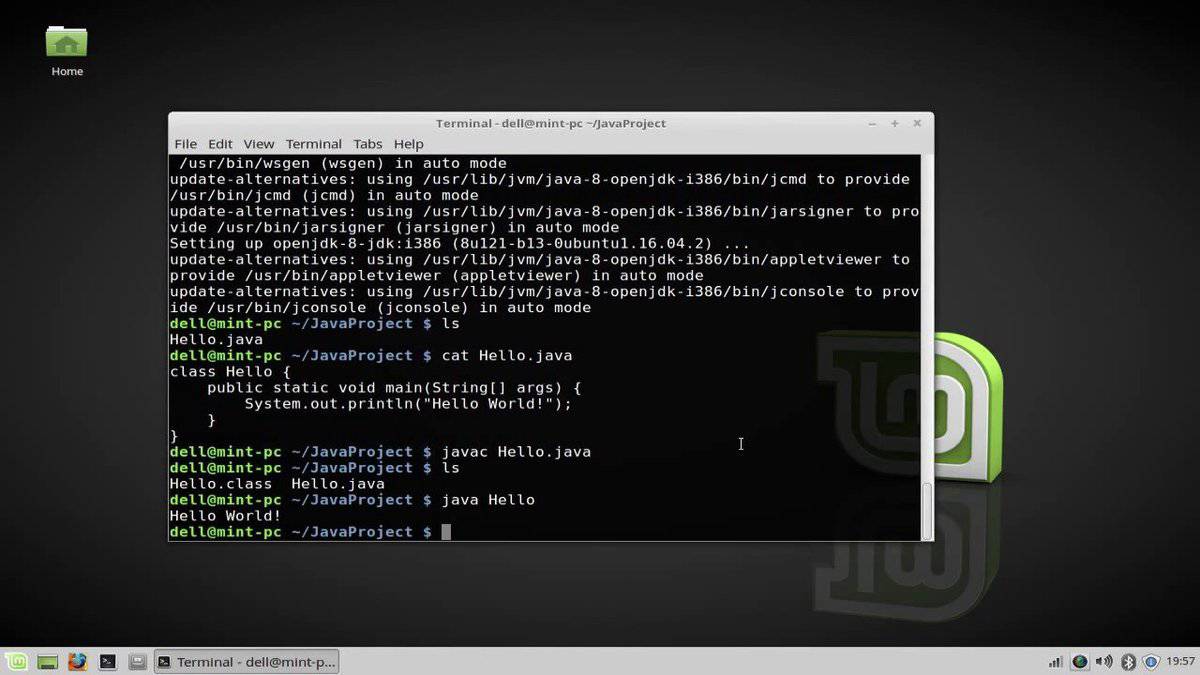
javac is the de-facto compiler for the Java programming language
and is a core component of the standard Java Development Kit(JDK)[34]. It accepts programs
that are adhered to the Java language specification (JLS) and
produces bytecodes using the Java Virtual Machine Specification
(JVMS). The compiler itself is written using Java and allows
developers to invoke this from their applications. This has become
a widely accepted tool for Java programmers due to its robust
feature set and powerful command-line controls.
Features of javac
- javac compiles .java source files into intermediate Java
bytecodes, which are used for generating machine-dependent native
code. - This Java compiler supports a wide range of standard and
cross-compilation options to help produce more optimized bytecode
representations. - It can be found as a standard feature in most Java development
tools like the Netbeans IDE and IntelliJ IDEA. - Developers can quickly adapt to the javac compilers by
utilizing high-quality official documentation.
21. Online GDB
Online GDB is an awesome online Linux compiler for a wide range
of programming languages. It also works as an online debugger and
allows developers to write optimized code. Onliner compilers like
this often come in handy when you’re on a different system or
simply don’t want to install development tools for some reason. You
can easily write good programs using Online GDB and run programs in
both interactive and console modes. So definitely check out this
compiler if you’re after online IDEs.
Features of Online GDB
- Developers can write codes, compile them, run and debug
programs as well as share the source with their friends or
colleagues. - It allows users to supply any command-line arguments for their
program using an interactive form and supports interactive
console. - Online GDB now supports a lot of popular programming
languages[36] like C, C++, PHP,
Python, Perl, Java, C#, Fortran, Haskell, Assembly, and so on. - It enables programmers to upload existing code using its file
upload feature and also download any code written by them.
22. FASM
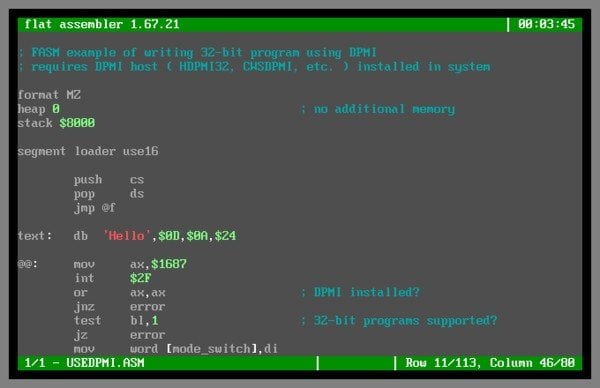
FASM or Flat Assembler is an old-school Linux assembler that is
still relevant due to its robust feature set and fast performance.
This assembler is aimed at X86-based microprocessors and can deal
with Intel-style assembly language on the X86-64 platform very
well. Developers like FASM due to its simple design but tremendous
power. It allows them to gain extreme size optimizations without
increasing the runtime at all. If you’re working with legacy
assembly programs that require further optimizations, give this one
a try.
Features of FASM
- It is a multi-pass assembler which provides extensive size
optimizations and limitless forward referencing. - Since FASM itself is written using assembly, you can use this
tool to bootstrap or reverse engineer itself. - FASM allows developers to create custom macros for integrating
multiple instructions into a single larger instruction. - It runs on Linux, BSD, and DOS systems and supports traditional
SIMD extensions such as MMX, AVX, and SSE.
23. Bigloo Compiler
Bigloo is a scheme runtime which contains a competitive Linux
compiler for the programming language Scheme. It is a family of
Lisp dialects that are in common use today. The Bigloo compiler can
generate C code and bytecodes for the JVM and .NET. It provides an
extended C interface that allows developers to leverage powerful C
libraries at ease. On the other hand, Bigloo can be used for
pointing to Java structures and provides a robust object-oriented
layer on top of it.
Features of Bigloo Compiler
- Bigloo is compliant to the R5RS standard and implements
features like hygienic macros, script interpreter, dynamic
protectors. - The object-oriented layer of Bigloo enables developers to
access and implement mutation functions in instances using their
classes. - Bigloo utilizes well-known tools like lex and yacc to control
the input/output of your programs more practically. - It comes with ready-made support for SQL databases and provides
a C-based SQLite binding.
24. ispc
The Intel SPMD Program Compiler or ispc is one of the best Linux
compilers for SPMD(Single Program Multiple Data) programming. This
is an advanced technique for implementing parallelism in your
programs and make better utilization of the extra number of cores
present in modern Intel chipsets. Developers can write C programs
for SPMD and leverage ispc for producing high-performing binaries.
You can also use this compiler for optimizing programs
effortlessly. Overall, ispc is an excellent solution to programmers
who deal with SPMD programs.
Features of ispc
- Intel SPMD Program Compiler uses LLVM as its backend and can
run on most systems on the x86/x86-64 platform. - It comes with pre-built support for the instruction sets AVX1,
AVX2, AVX512, SSE2, SSE4, and Xeon Phi. - The open-source BSD license of ispc encourages developers to
extend or modify the source code as they see fit. - It increases program performance by scaling core numbers and
the size of vector units effectively.
25. JDoodle
JDoodle is another excellent online Linux compiler for home
users. It offers support for a massive range of languages as well
as databases. JDoodle supports peer programming, so it’s a great
choice for teams that work remotely. Programmers can very quickly
write or compile their code and share their programs with the
community. Moreover, this online application has an intuitive web
interface, which makes it effortless to use and navigate. So you
should check certainly check out JDoodle if you’re looking for a
simple online compiler.
Features of JDoodle
- JDoodle supports more than 70 different programming languages
such as C, C++, Java, Python, Perl, Ruby, Haskell, Kotlin,
JavaScript, and so on. - Programmers can choose from a number of compiler and their
versions, including GCC 9.1.0, 8.1.0, 7.2.0, 5.3.0, and Zapcc
5.0.0. - It is easy to download the codes you write, and you can also
embed them in blog posts or share them via a simple, shareable
link. - Developers can integrate JDoodle to their project using the
robust REST APIs provided by this online compiler.
Ending Thoughts
Since many powerful Linux compilers are available, developers
often find it hard to choose the best one for their project. We
have outlined the 25 best offline and online Linux compilers here
to help you choose the appropriate solution for your development
tasks. You will need to take many things into consideration, like
the target platform of your program, availability of resources,
level of optimization, and so on. Some of the tools mentioned in
this guide are used universally for a wide range of development
jobs. The GNU Compiler Collection alongside the LLVM, Clang, and
Babel compilers are some of the most popular.
References
- ^
Best
Linux Code Editor: Top 10 Reviewed and Compared
(www.ubuntupit.com) - ^
favorite
Linux distros (www.ubuntupit.com) - ^
Download GCC
(gcc.gnu.org) - ^
Download AOCC
(developer.amd.com) - ^
Top 20
Best Visual Studio Code Extensions For Programmers
(www.ubuntupit.com) - ^
Download
Intel C++ Compiler (software.intel.com) - ^
Just in
Time(JIT) compilations (en.wikipedia.org) - ^
Download LLVM
(llvm.org) - ^
Best
Linux Distro: Top 10 Recommendation To Boost Up Your Linux
Experience (www.ubuntupit.com) - ^
Linux
boot loaders (www.ubuntupit.com) - ^
Download NASM
(www.nasm.us) - ^
handy
Linux ticketing system (www.ubuntupit.com) - ^
Download GFortran
(gcc.gnu.org) - ^
Top 15
Best Embedded Systems Programming Languages
(www.ubuntupit.com) - ^
Software Transactional Memory
(STM) (en.wikipedia.org) - ^
Download GHC
(www.haskell.org) - ^
Download Tiny C Compiler
(bellard.org) - ^
retro
game emulators (www.ubuntupit.com) - ^
Lazarus integrated development
environment (IDE) (www.lazarus-ide.org) - ^
Download Free Pascal Compiler
(sourceforge.net) - ^
Download Babel
(github.com) - ^
modern
Linux code editors (www.ubuntupit.com) - ^
Download Clang
(clang.llvm.org) - ^
Download Intel Fortran Compiler
(software.intel.com) - ^
Linux
and FreeBSD (www.ubuntupit.com) - ^
Download FreeBASIC
(www.freebasic.net) - ^
Scala Native
(scala-native.org) - ^
CodeChef Online IDE
(www.codechef.com) - ^
Download SBCL
(www.sbcl.org) - ^
BSD
distributions (www.ubuntupit.com) - ^
Download Portable C Compiler
(pcc.ludd.ltu.se) - ^
Download CHICKEN
(www.call-cc.org) - ^
Download Small Device C
Compiler (sdcc.sourceforge.net) - ^
Java
Development Kit(JDK) (www.oracle.com) - ^
Download javac
(www.oracle.com) - ^
a lot
of popular programming languages
(www.ubuntupit.com) - ^
Online GDB
(www.onlinegdb.com) - ^
Download FASM
(flatassembler.net) - ^
Download Bigloo Compiler
(www-sop.inria.fr) - ^
Download ispc
(ispc.github.io) - ^
JDoodle
(www.jdoodle.com)
Read more https://www.ubuntupit.com/best-linux-compilers-for-modern-developers/