
execution vulnerability[1]
found in Intel processors.
If your computer is running any modern Intel CPU built before
October 2018, it’s likely vulnerable to a newly discovered hardware
issue that could allow attackers to leak sensitive data from the OS
kernel, co-resident virtual machines, and even from Intel’s secured SGX
enclave[2].
Dubbed CacheOut a.k.a. L1 Data Eviction Sampling
(L1DES) and assigned CVE-2020-0549, the new
microarchitectural attack allows an attacker to choose which data
to leak from the CPU’s L1 Cache, unlike previously demonstrated
MDS
attacks[3] where attackers need to
wait for the targeted data to be available.
According to a team of academic researchers, the
newly-discovered speculative execution attacks can leak information
across multiple security boundaries, including those between
hyper-threads, virtual machines, and processes, and between user
space and the operating system kernel, and from SGX
enclaves.
“CacheOut can leak information from other processes running on the
same thread, or across threads on the same CPU core,” the
researchers said[4]. “CacheOut violates the
operating system’s privacy by extracting information from it that
facilitates other attacks, such as buffer overflow attacks.”
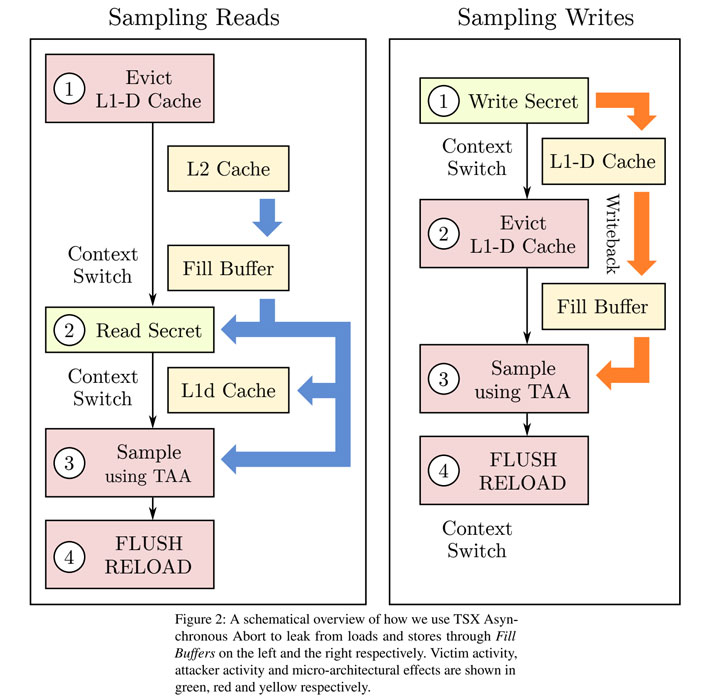
More precisely, the attack enables a malicious program to force
the victim’s data out of the L1-D Cache into leaky buffers after
the operating system clears them, and then subsequently leak the
contents of the buffers and obtain the victim’s data.
demonstrated:
- the effectiveness of CacheOut in violating process isolation by
recovering AES keys and plaintexts from an OpenSSL-based
victim, - practical exploits for completely de-randomizing Linux’s kernel
ASLR, and for recovering secret stack canaries from the Linux
kernel, - how CacheOut effectively violates the isolation between two
virtual machines running on the same physical core, - how CacheOut could also be used to breach the confidentiality
SGX guarantees by reading out the contents of a secure
enclave, - how some of the latest Meltdown-resistant Intel CPUs are still
vulnerable, despite all of the most recent patches and
mitigations.
Besides this, according to researchers, it’s currently unlikely for
Antivirus products to detect and block CacheOut attacks, and since
the exploit does not leave any traces in the traditional log file,
it’s also “very unlikely” to identify whether someone has exploited
the flaw or not.
To be noted, CacheOut flaw can’t be exploited remotely from a web
browser and also doesn’t affect AMD processors.
Based on researchers findings, Intel yesterday released new microcode
updates[5] for affected
processors[6] that eventually turns
off Transactional Memory Extension (TSX) on the CPUs.
“Software [update] can mitigate these issues at the cost of
features and/or performance. We hope that somewhere in the future,
Intel will release processors with in-silicon fixes against this
issue,” the researchers said.
Though most cloud providers have rolled out patches to their
infrastructures, other users can also mitigate the cross-thread
leakage by disabling Intel hyper-threading for systems where
security is more important.
Furthermore, neither Intel nor the researchers have released
exploit code, which indicates there’s no direct and immediate
threat.
References
- ^
speculative execution vulnerability
(thehackernews.com) - ^
Intel’s secured SGX enclave
(thehackernews.com) - ^
MDS attacks
(thehackernews.com) - ^
said
(cacheoutattack.com) - ^
new microcode updates
(www.intel.com) - ^
affected processors
(software.intel.com)