
should take into account when designing their 2020 breach
protection?
To answer this, we polled 1,536 cybersecurity professionals in
The State of Breach Protection 2020 survey (Download the full
survey here[1]) to understand the
common practices, prioritization, and preferences of the
organization today in protecting themselves from breaches.
Security executives face significant challenges when confronting
the evolving threat landscape.
For example:
- What type of attacks pose the greatest risk, and what security
products would best address them? - Is it better to build a strong team in-house, outsource the
entire security operation, or search for a sweet spot between the
two? - What type and level of automation should be introduced into the
breach protection workflows?
The State of Breach
Protection 2020 survey provides insights into these questions
and others.
Here are a few of the insights the survey unveils:
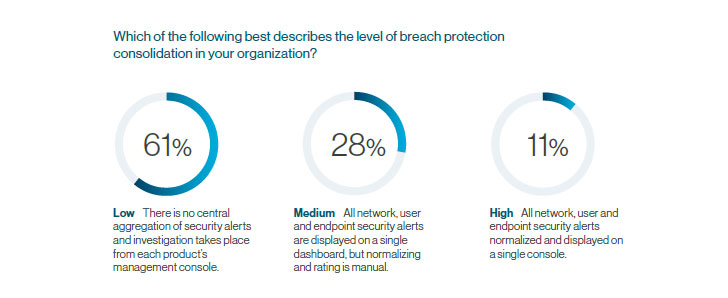
1) Lack of consolidation is a protection
inhibitor — Organizations that currently
deploy advanced security products report that maintaining a
multi-product security stack (especially in advanced security
product groups) is the main obstacle in reaching the desired
protection.
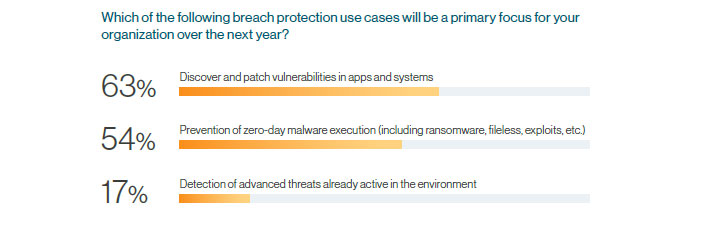
projects in 2020 — The majority of
organizations that currently deploy a basic security stack of AV,
firewall, and email protection plan to add EDR/EPP, Network Traffic
Analysis, or SIEM and are planning to do so in 2020.
protection — Only a small portion of
organizations reported on deploying EDR/EPP on more than 85% of
their endpoints with no deployment or maintenance issues. Because
in many cases, EPP/EDR is regarded as the main mean against
advanced attacks, this is an alarming figure.
4) Advanced threat protection still involves a high volume of
attended alerts — All organizations that
deploy SIEM, EDR/EPP, Network Traffic Analysis, UEBA, or Deception
products state that over 25% percent of alerts are left unattended
on a daily basis.
5) Response orchestration beats
automation — While a significant number
of the organizations we polled orchestrate their IR operations from
a centralized interface, only a small portion introduce automation
to their remediation workflows.
6) Organizations have mixed feelings regarding security
outsourcing — While the security skills
gap compels organizations to outsource the more advanced portion of
their security operations, there is still a strong inclination to
keep things in-house, especially in regard to active attack
remediation in their environment.
The State of Breach Protection 2020 survey crowdsources the
wisdom of numerous security professionals and decision-makers,
enabling CISOs to make better informed and data-driven decisions,
by zooming out to see the wide perspective of breach protection’s
best practices and major trends.
Download The State of Breach
Protection 2020 survey report[3]
here.
References
- ^
Download the full survey here
(go.cynet.com) - ^
State of Breach Protection 2020
survey (go.cynet.com) - ^
State of
Breach Protection 2020 survey report (v)
Read more http://feedproxy.google.com/~r/TheHackersNews/~3/62-orL73Nuk/data-breach-protection-survey.html