owner of breach protection. His or her task is to oversee and
govern the process of design, build, maintain, and continuously
enhance the security level of the organization.
Title-wise, this person is most often either the CIO, CISO, or
Directory of IT. For convenience, we’ll refer to this individual as
the CISO.
This person is the subject-matter expert in understanding the
standard set of active cyber risks, benchmarking to what degree the
organization’s exposure influences potential impact. They then take
appropriate steps to ensure the major risks are addressed.
On top of being engaged 24/7 in the organization’s actual breach
protection activity, the CISO has another critical task: to
articulate the risks, potential impacts and appropriate steps to
take to the company’s management – or in other words, they must
effectively translate security issues for non-security-savvy
executives in a clear and business-risk oriented manner.
The rationale for this task is simple – the more resources you
invest, the more secure you are. The CISO holds the knowledge of
what’s needed, but the key to unleashing resources is in turning
this knowledge into action – which lies in the management’s hands.
And management tends to think in terms of operational loss and
calculated risk, more than in terms of malware, exploits, and
network traffic.
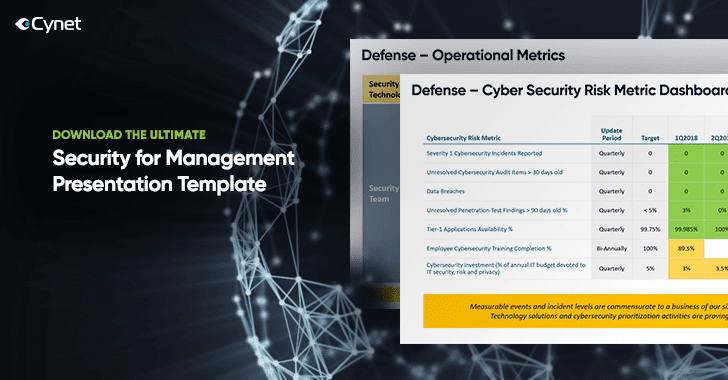
To address this need, Cynet introduces the ultimate ‘Security for Management’ PPT
template[1]: a first-of-its-kind
tool to capture and sustain management mindshare and drive their
proactive understanding and commitment.
This is achieved through a concise presentation of the security
issues that matter, presented in a way that is easily understood by
a non-technical audience.

template[2] follows the commonly
accepted NIST Cyber Security Framework as an overall outline and
includes open sections that are to be completed with respect to
each organization’s unique security state.
Overall, the template assists in the following:
Transforming cybersecurity from vague risk to concrete action
items – map and quantize the potential outcomes of cyber events to
the actual people and roles in the organization, to secure the
organization against a clearly tangible loss.
Creating a common language to make security needs more
digestible. The management’s security grasp is paramount in moving
the needle in the right direction. The NIST framework pillars –
identify, protect, detect, respond, and recover – are intuitive to
understand, regardless of prior security knowledge, and are ideal
for this type of communication.
Changing cybersecurity internal branding from a budgetary issue
to an ongoing strategic journey – this is extremely important.
Understanding that being secure is a continuous process is critical
to any long-term planning.
Introducing actionable metrics to measure current state and
future progress – eventually, everything boils down to numbers.
Either we have succeeded in reaching our defined objectives, or we
have failed. In each case, transparency in presenting the results
of deployed security products and the work of the security team
creates and enhances trust.
The definitive ‘Security for Management’ presentation template
is tailor-made for anyone who invests effort in achieving
organizational security and strives to communicate its actual
value.
Download the ultimate ‘Security for Management’
presentation template here.
[3]
References
- ^
ultimate
‘Security for Management’ PPT template
(go.cynet.com) - ^
ultimate
‘Security for Management’ PPT template
(go.cynet.com) - ^
ultimate
‘Security for Management’ presentation template
(go.cynet.com)
Read more http://feedproxy.google.com/~r/TheHackersNews/~3/aLb8dV-R1RM/cybersecurity-management.html