
Attention Linux Users!
A vulnerability has been discovered in Sudo—one of the
most important, powerful, and commonly used utilities that comes as
a core command installed on almost every UNIX and Linux-based
operating system.
The vulnerability in question is a sudo security policy bypass
issue that could allow a malicious user or a program to execute
arbitrary commands as root on a targeted Linux system even when the
“sudoers configuration” explicitly disallows the root
access.
Sudo, stands for “superuser do,” is a system command that allows a
user to run applications or commands with the privileges of a
different user without switching environments—most often, for
running commands as the root user.
By default on most Linux distributions, the ALL keyword in RunAs
specification in /etc/sudoers file, as shown in the screenshot,
allows all users in the admin or sudo groups to run any command as
any valid user on the system.
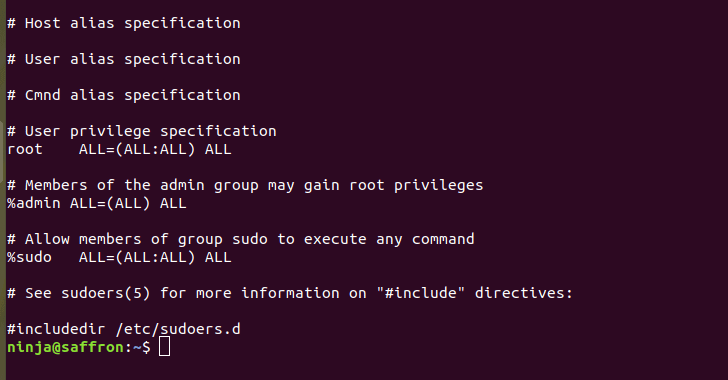
security paradigms in Linux, administrators can configure a sudoers
file to define which users can run what commands as to which users.
So, even if a user has been restricted to run a specific, or
any, command as root, the vulnerability could allow the user to
bypass this security policy and take complete control over the
system.
“This can be used by a user with sufficient sudo privileges to run
commands as root even if the Runas specification explicitly
disallows root access as long as the ALL keyword is listed first in
the Runas specification,” the Sudo
developers[1] say.
How to Exploit this Bug? Just Sudo User ID -1 or
4294967295
The vulnerability, tracked as CVE-2019-14287 and discovered by Joe
Vennix of Apple Information Security, is more concerning because
the sudo utility has been designed to let users use their own login
password to execute commands as a different user without requiring
their password.
attacker to run commands as root just by specifying the user ID
“-1” or “4294967295.”
That’s because the function which converts user id into its
username incorrectly treats -1, or its unsigned equivalent
4294967295, as 0, which is always the user ID of root user.

“Additionally, because the user ID specified via the -u option does
not exist in the password database, no PAM session modules will be
run.”
released version 1.8.28, which has been released today, a few hours
ago and would soon be rolled out as an update by various Linux
distributions to their users.
So, if you use Linux, you are highly recommended to update sudo
package manually to the latest version as soon as it is
available.
References
- ^
Sudo
developers (www.sudo.ws)
Read more http://feedproxy.google.com/~r/TheHackersNews/~3/_zTbOwZXHSo/linux-sudo-run-as-root-flaw.html