There’s a new strain of malware making rounds on the Internet
that has already infected thousands of computers worldwide and most
likely, your antivirus program would not be able to detect it.
Why? That’s because, first, it’s an advanced fileless
malware[1] and second, it leverages
only legitimate built-in system utilities and third-party tools to
extend its functionality and compromise computers, rather than
using any malicious piece of code.
The technique of bringing its own legitimate tools is effective
and has rarely been spotted in the wild, helping attackers to blend
in their malicious activities with regular network activity or
system administration tasks while leaving fewer footprints.
Independently discovered by cybersecurity researchers at
Microsoft and Cisco Talos, the malware — dubbed “Nodersok”
and “Divergent” — is primarily being distributed via
malicious online advertisements and infecting users using a
drive-by download attack.
First spotted in mid-July this year, the malware has been designed
to turn infected Windows computers into proxies, which according to
Microsoft, can then be used by attackers as a relay to hide
malicious traffic; while Cisco Talos believes the proxies are used
for click-fraud to generate revenue for attackers.
Multi-Stage Infection Process Involves Legitimate Tools
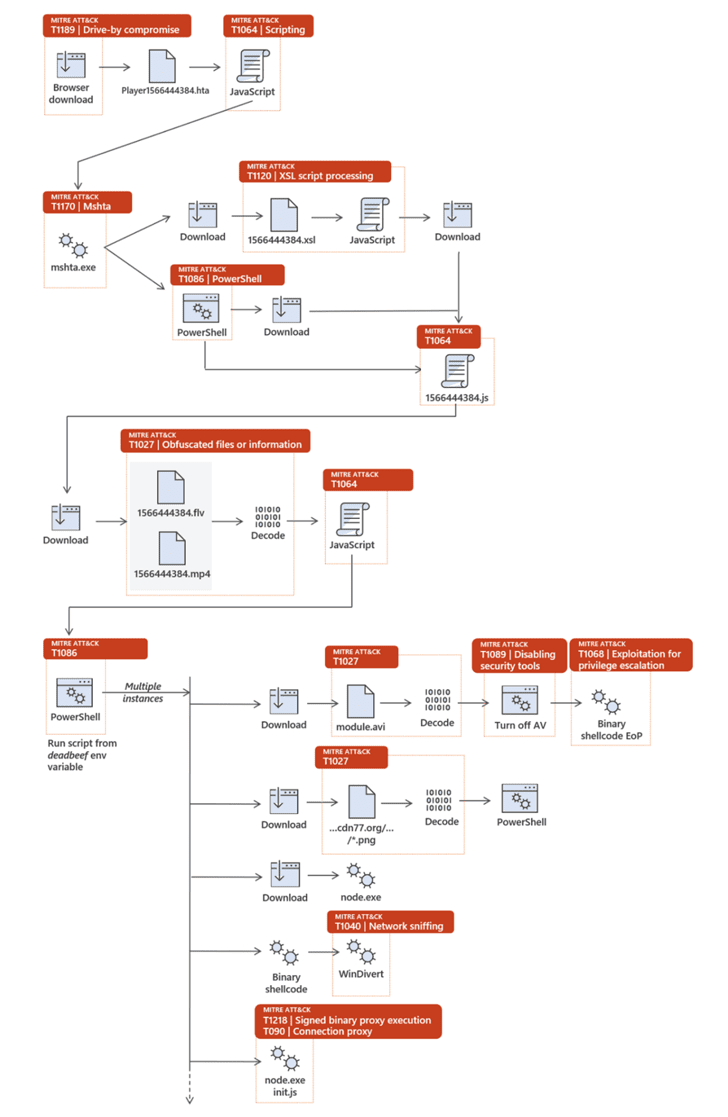
(HTA) file on users’ computers, which, when clicked, executes a
series of JavaScript payloads and PowerShell scripts that
eventually download and install the Nodersok malware.
“All of the relevant functionalities reside in scripts and
shellcodes that are almost always coming in encrypted, are then
decrypted, and run while only in memory. No malicious executable is
ever written to the disk,” Microsoft explains[2].
As illustrated in the diagram, the JavaScript code connects to
legitimate Cloud services and project domains to download and run
second-stage scripts and additional encrypted components,
including:
- PowerShell Scripts — attempt to disable Windows Defender
antivirus and Windows update. - Binary Shellcode — attempts to escalate privileges using
auto-elevated COM interface. - Node.exe — Windows implementation of the popular Node.js
framework, which is trusted and has a valid digital signature,
executes malicious JavaScript to operate within the context of a
trusted process. - WinDivert (Windows Packet Divert) — a legitimate,
powerful network packet capture and manipulation utility that
malware uses to filter and modify certain outgoing packets.
At last, the malware drops the final JavaScript payload written for
the Node.js framework that converts the compromised system into a
proxy.
“This concludes the infection, at the end of which the network
packet filter is active, and the machine is working as a potential
proxy zombie,” Microsoft explains.
“When a machine turns into a proxy, it can be used by attackers as
a relay to access other network entities (websites, C&C
servers, compromised machines, etc.), which can allow them to
perform stealthy malicious activities.”
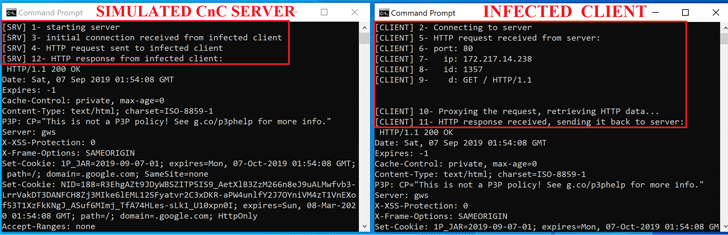
engine currently has two primary purposes—first, it connects the
infected system back to a remote, attacker-controlled
command-and-control server, and second, it receives HTTP requests
to proxy back to it.

concludes that the attackers are using this proxy component to
command infected systems to navigate to arbitrary web pages for
monetization and click fraud purposes.
Nodersok Infected Thousands of Windows Users
According to Microsoft, the Nodersok malware has already infected
thousands of machines in the past several weeks, with most targets
located in the United States and Europe.
While the malware primarily focuses on targeting Windows home
users, researchers have seen roughly 3% of attacks targeting
organization from industry sectors, including education,
healthcare, finance, retail, and business and professional
services.
Since the malware campaign employs advanced fileless techniques and
relies on elusive network infrastructure by making use of legit
tools, the attack campaign flew under the radar, making it harder
for traditional signature-based antivirus programs to detect it.
“If we exclude all the clean and legitimate files leveraged by the
attack, all that remains are the initial HTA file, the final
Node.js-based payload, and a bunch of encrypted files. Traditional
file-based signatures are inadequate to counter sophisticated
threats like this,” Microsoft says.
visible footprint that stands out clearly for anyone who knows
where to look.”
In July this year, Microsoft also discovered and reported
another fileless malware
campaign[4], dubbed Astaroth,
that was designed to steal users’ sensitive information, without
dropping any executable file on the disk or installing any software
on the victim’s machine.
Microsoft said its Windows Defender ATP next-generation
protection detects this fileless malware attacks at each infection
stage by spotting anomalous and malicious behaviors, such as the
execution of scripts and tools.
References
- ^
fileless malware
(thehackernews.com) - ^
explains
(www.microsoft.com) - ^
Cisco Talos
(blog.talosintelligence.com) - ^
fileless malware campaign
(thehackernews.com)
Read more http://feedproxy.google.com/~r/TheHackersNews/~3/zCcCqTO8Tmg/windows-fileless-malware-attack.html