
of cybercrime for years, most common being DDoS and spam campaigns.
But cybercriminals have now shifted toward a profitable scheme
where botnets do not just launch DDoS or spam—they mine
cryptocurrencies as well.
Smominru, an infamous cryptocurrency-mining and
credential-stealing botnet, has become one of the rapidly spreading
computer viruses that is now infecting over 90,000 machines each
month around the world.
Though the campaigns that are hacking computers with the Smominru
botnet[1] have not been designed
to go after targets with any specific interest, the latest report[2] from Guardicore Labs
researchers shed light on the nature of the victims and the attack
infrastructure.
According to the researchers, just last month, more than 4,900
networks were infected by the worm without any discrimination, and
many of these networks had dozens of internal machines
infected.
Infected networks include US-based higher-education
institutions, medical firms, and even cybersecurity companies, with
the largest network belonging to a healthcare provider in Italy
with a total of 65 infected hosts.
Active since 2017, Smominru botnet compromises Windows machines
primarily using EternalBlue[3], an exploit that was
created by the U.S. National Security Agency but later got leaked
to the public by the Shadow Brokers hacking
group[4] and then most famously
used by the hard-hitting WannaCry
ransomware[5] attack in 2016.
The botnet has also been designed to gain initial access on
vulnerable systems by simply brute-forcing weak credentials for
different Windows services, including MS-SQL, RDP, and
Telnet.
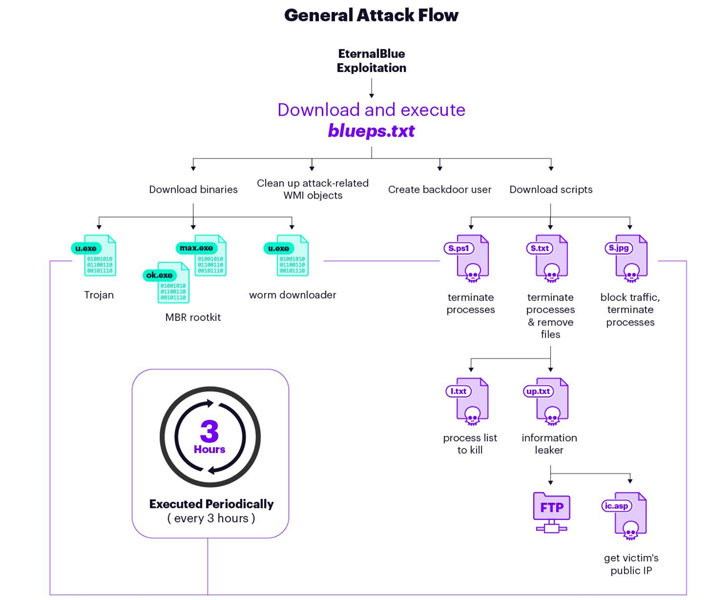
installs a Trojan module and a cryptocurrency miner and propagates
inside the network to harness CPU power of victims’ PCs to mine
Monero and send it to a wallet owned by the malware’s operator.
A month ago, it was also revealed that the operators behind the
botnet upgraded Smominru to add a data harvesting module and Remote
Access Trojan (RAT) to their botnet’s cryptocurrency mining
code.
The latest variant of Smominru downloads and runs at least 20
distinct malicious scripts and binary payloads, including a worm
downloader[6], a Trojan horse and an
MBR rootkit.
“The attackers create many backdoors on the machine in different
phases of the attack. These include newly-created users, scheduled
tasks, WMI objects and services set to run at boot time,” the
researchers say.
managed to gain access to one of the attackers’ core servers, which
stores victim information and their stolen credentials, and took a
closer look at the nature of the victims.
“The attackers’ logs describe each infected host; they include its
external and internal IP addresses, the operating system it runs
and even the load on the system’s CPU(s). Furthermore, the
attackers attempt to collect the running processes and steal
credentials using Mimikatz,” the researchers say.
“Guardicore Labs has informed identifiable victims and provided
them with the details of their infected machines.”
The botnet is infecting vulnerable machines—the majority of
which are running Windows 7 and Windows Server 2008—at a rate of
4,700 machines per day with several thousands of infections
detected in countries including China, Taiwan, Russia, Brazil, and
the U.S.
Majority of the infected machines discovered were primarily
small servers, with 1-4 CPU cores, leaving most of them unusable
due to overutilization of their CPUs with the mining
process.

the Smominru victims was reinfected by the worm, suggesting that
they “attempted to clean up their systems without fixing the root
cause issue that left them vulnerable in the first place.”
Unlike previous variants of Smominru, the new variant also
removes infections from compromised systems, if any, that are added
by other cyber-criminal groups, along with blocking TCP ports (SMB,
RPC) in an attempt to prevent other attackers from breaching its
infected machines.
Guardicore researchers have also released a complete list of IoCs
(indicators of compromise) and a free Powershell script
on GitHub[7] that you can run from
your Windows command-line interface to check if your system is
infected with the Smominru worm or not.
Since the Smominru worm leverages the EternalBlue
exploit[8] and weak passwords,
users are advised to keep their systems and software updated and
stick to strong, complex and unique passwords to avoid being a
victim of such threats.
Besides this, for an organization, it is also essential to have
additional security measures, such as “applying network
segmentation and minimizing the number of internet-facing
servers.
References
- ^
Smominru botnet
(thehackernews.com) - ^
report
(www.guardicore.com) - ^
EternalBlue
(thehackernews.com) - ^
Shadow Brokers hacking group
(thehackernews.com) - ^
WannaCry ransomware
(thehackernews.com) - ^
worm downloader
(thehackernews.com) - ^
Powershell script on GitHub
(github.com) - ^
EternalBlue exploit
(thehackernews.com)
Read more http://feedproxy.google.com/~r/TheHackersNews/~3/7lLmulSq8ms/smominru-botnet.html