
is growing faster than ever with tens of billions of connected
devices streaming and sharing data wirelessly over the Internet,
but how secure is it?
As we connect everything from coffee maker to front-door locks
and cars to the Internet, we’re creating more potential—and
possibly more dangerous—ways for hackers to wreak havoc.
Believe me, there are over 100 ways a hacker can ruin your life
just by compromising your wireless
router—a device that controls the traffic between your local
network and the Internet, threatening the security and privacy of a
wide range of wireless devices, from computers and phones to IP
Cameras, smart TVs and connected appliances.
[2]
In its latest study titled “SOHOpelessly Broken
2.0,” Independent Security Evaluators (ISE) discovered a total
of 125 different security vulnerabilities across 13 small
office/home office (SOHO) routers and Network Attached
Storage (NAS) devices, likely affecting millions.
List of Affected Router Vendors
SOHO routers and NAS devices tested by the researchers are from the
following manufacturers:
- Buffalo
- Synology
- TerraMaster
- Zyxel
- Drobo
- ASUS and its subsidiary Asustor
- Seagate
- QNAP
- Lenovo
- Netgear
- Xiaomi
- Zioncom (TOTOLINK)
According to the security researchers, all of these 13 widely-used
devices they tested had at least one web application vulnerability
that could allow a remote attacker to gain remote shell access or
access to the administrative panel of the affected device.
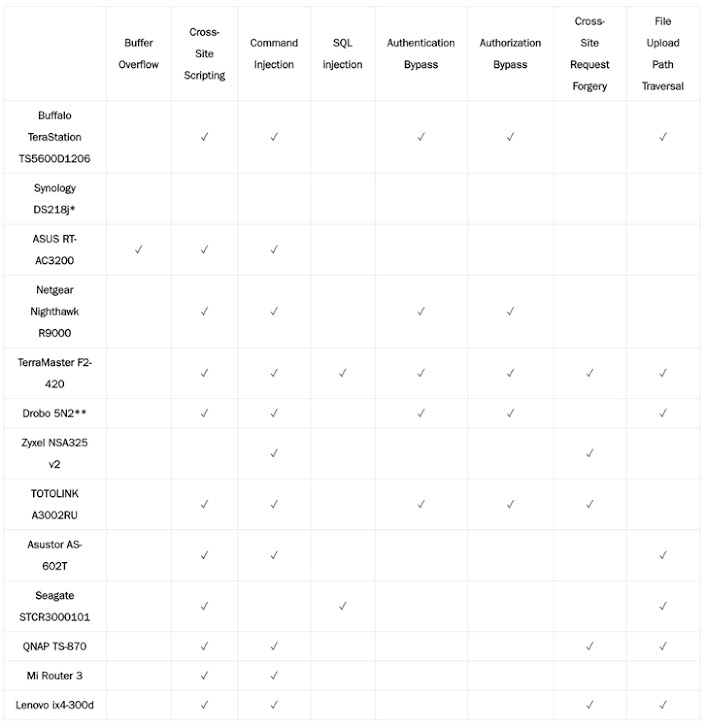
cross-site request forgery (CSRF), buffer overflow, operating
system command injection (OS CMDi), authentication bypass, SQL
injection (SQLi), and file upload path traversal vulnerabilities.
Full Control Over Devices Without Authentication
Researchers said they successfully obtained root shells on 12 of
the devices, allowing them to have complete control over the
affected devices, 6 of which contained flaws that would enable
attackers to gain full control over a device remotely and without
authentication.
These affected business and home routers are Asustor AS-602T,
Buffalo TeraStation TS5600D1206, TerraMaster F2-420, Drobo 5N2,
Netgear Nighthawk R9000, and TOTOLINK A3002RU.
This new report, SOHOpelessly Broken 2.0, is a follow-up study,
SOHOpelessly Broken
1.0[5], published by the ISE
security firm in 2013, when they disclosed a total of 52
vulnerabilities in 13 SOHO routers and NAS devices from vendors
including TP-Link, ASUS, and Linksys.
Since SOHOpelessly Broken 1.0, researchers said they found a few
newer IoT devices implementing some useful security mechanisms in
place, like address-space layout randomization (ASLR),
functionalities that hinder reverse engineering, and integrity
verification mechanisms for HTTP requests.
However, some things have not changed since SOHOpelessly Broken
1.0, like many IoT devices still lack basic web application
protection features, like anti-CSRF tokens and browser security
headers, which can greatly enhance the security posture of web
applications and the underlying systems they interact with.
ISE researchers responsibly reported all of the vulnerabilities
they discovered to affected device manufacturers, most of which
promptly responded and already took security measures to mitigate
these vulnerabilities, which have already received CVE Ids.
However, some device manufacturers, including Drobo, Buffalo
Americas, and Zioncom Holdings, did not respond to the researchers’
findings.
References
- ^
smart devices
(thehackernews.com) - ^
wireless router
(thehackernews.com) - ^
SOHOpelessly Broken 2.0
(www.securityevaluators.com) - ^
Network Attached Storage
(thehackernews.com) - ^
SOHOpelessly Broken 1.0
(www.securityevaluators.com)
Read more http://feedproxy.google.com/~r/TheHackersNews/~3/0tUFPxcnTVY/hacking-soho-routers.html