advertising, and analytics company drives through tracking users
across the Internet to identify them and learn their interests to
provide targeted ads.
Most of these solutions rely on 3rd-party cookies, a cookie set
on a domain other than the one you are browsing, which allows
companies including Google and Facebook to fingerprint you in order
to track your every move across multiple sites.
However, if you’re using Kaspersky Antivirus, a vulnerability in
the security software had exposed a unique identifier associated
with you to every website you visited in the past 4 years, which
might have allowed those sites and other third-party services to
track you across the web even if you have blocked or erased
third-party cookies timely.
The vulnerability, identified as CVE-2019-8286 and
discovered by independent security researcher Ronald Eikenberg,
resides in the way a URL scanning module integrated into the
antivirus software, called Kaspersky URL Advisor, works.
By default, Kaspersky Internet security solution injects a
remotely-hosted JavaScript file directly into the HTML code of
every web page you visit—for all web browsers, even in incognito
mode—in an attempt to check if the page belongs to the list of
suspicious and phishing web addresses.
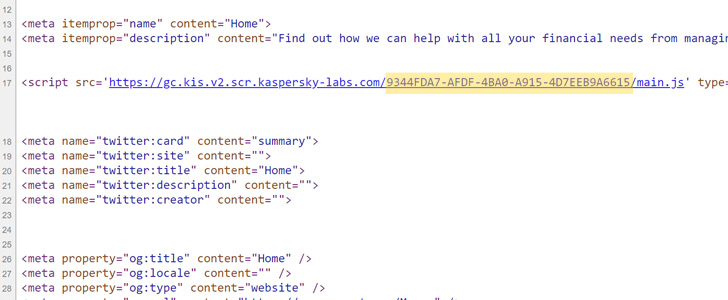
the same way to monitor web pages for malicious content.
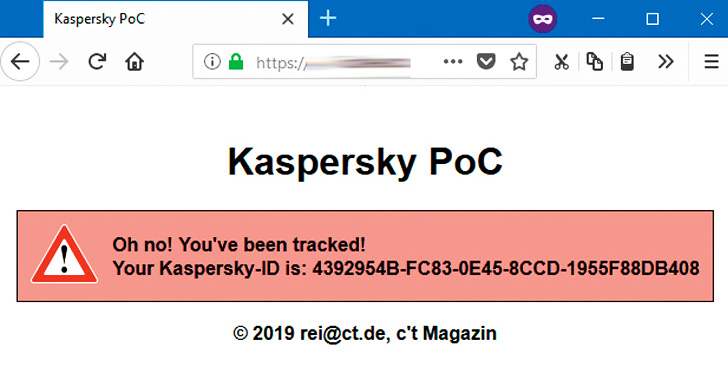
However, Eikenberg finds that the URL of this JavaScript file
contains a string which is unique to every Kaspersky user, sort of
a UUID (Universally Unique Identifier) that can easily be captured
by websites, other third-party advertising and analytics services,
putting its users privacy at risk.
“That’s a bad idea because other scripts that run in the context of
the website domain can access the HTML code at any time—and thus
the injected Kaspersky ID. This means in plain language that any
website can simply read the Kaspersky ID of the user and misuse it
for tracking,” the researcher
says.
“The IDs were persistent and did not change after several days.
This made it clear that an ID can be permanently assigned to a
specific computer.”
issue and patched it just last month by assigning a constant value
(FD126C42-EBFA-4E12-B309-BB3FDD723AC1) for all users instead
of using UUID in the JavaScript URL.
“Kaspersky has fixed a security issue (CVE-2019-8286) in its
products that could potentially compromise user privacy by using
unique product id which was accessible to third parties,” the
company says in its advisory.
“This issue was classified as User Data disclosure. The attacker
has to prepare and deploy a malicious script on the web servers
from where he will track the user.”
websites and third-party services to find out if a visitor has
Kaspersky software installed on his system, which the researcher
believes can be abused by scammers and cybercriminals indirectly.
“An attacker could use this information to redistribute a pest
tailored to the protection software or redirect it to a suitable
scam page, with the slogan: Your Kaspersky license has expired.
Please enter your credit card number to renew the subscription,”
Eikenberg warned.
Total Security, Free Antivirus, and Small Office Security products
have already been delivered to affected users.
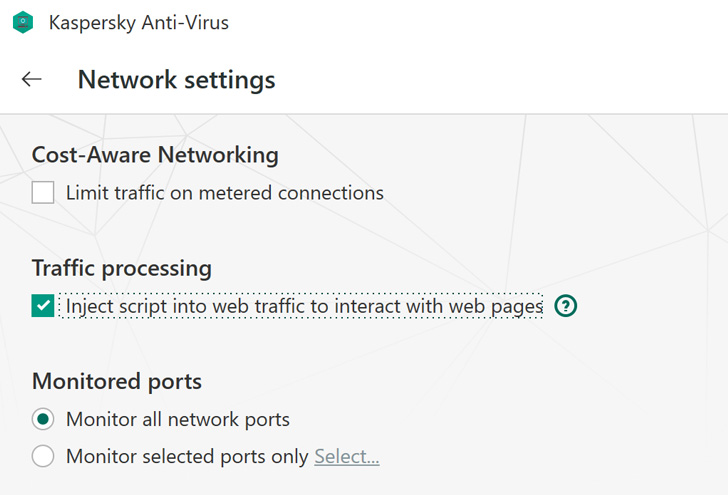
But, users who want to disable this tracking altogether can
manually disable the URL Advisor feature from settings→ additional→
network→ un-check traffic processing box, as shown in the above
screenshot.
References
- ^
researcher says
(www.heise.de) - ^
advisory
(support.kaspersky.com)