
WatchBog, a Linux-based cryptocurrency mining malware
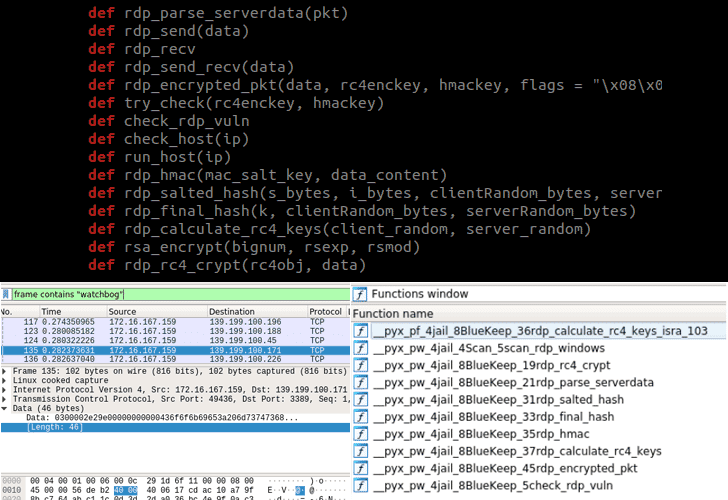
botnet, which now also includes a module to scan the Internet for
Windows RDP servers vulnerable to the Bluekeep flaw.
BlueKeep is a highly-critical, wormable, remote code execution
vulnerability in the Windows Remote Desktop Services that could
allow an unauthenticated remote attacker to take full control over
vulnerable systems just by sending specially crafted requests over
RDP protocol.
Though the patches for the
BlueKeep vulnerability (CVE–2019-0708) was already released by
Microsoft in May this year, more than 800,000 Windows
machines accessible over the Internet are still vulnerable to
the critical flaw.
[2][3]
Fortunately, even after many individuals in the security community
developed working remote code exploits for BlueKeep, there is no
public proof-of-concept (PoC) exploit available till the date,
potentially preventing opportunistic hackers from wreaking havoc.
However, it appears the attackers behind WatchBog are using
their botnet network to prepare “a list of vulnerable systems to
target in the future or to sell to third party vendors for profit,”
warned the researchers from Intezer
Lab[4], who discovered the new
WatchBog variant.
“The incorporation of the BlueKeep scanner by a Linux botnet may
indicate WatchBog is beginning to explore financial opportunities
on a different platform,” the researchers said.
then submits the list of newly discovered RDP hosts, as a
hexadecimal data string encrypted using RC4, to the
attacker-controlled servers.
already compromised more than 4,500 Linux machines in the last two
months.
Although WatchBog is operating since late last year, attackers
are distributing its new variant in an ongoing campaign active
since early June this year.
The newly-discovered WatchBog variant includes a new spreading
module along with exploits for some recently patched
vulnerabilities in Linux applications, allowing attackers to find
and compromise more Linux systems rapidly.
The WatchBog Linux botnet malware contains several modules, as
structurally briefed below, which leverages recently patched
vulnerabilities in Exim, Jira, Solr, Jenkins, ThinkPHP and Nexus
applications to compromise Linux machines.
Pwn Module
- CVE-2019-11581 (Jira)
- CVE-2019-10149 (Exim)
- CVE-2019-0192 (Solr)
- CVE-2018-1000861 (Jenkins)
- CVE-2019-7238 (Nexus Repository Manager 3)
Scanning Module
- BlueKeep Scanner
- Jira Scanner
- Solr Scanner
Brute-forcing Module
- CouchDB instances
- Redis instances
Spreading Module
- Apache ActiveMQ (CVE-2016-3088)
- Solr (CVE-2019-0192)
- Code Execution over Redis
After scanning and brute-forcing modules discover a Linux machine
running the vulnerable application, WatchBog deploys a script on
the targeted machine to download Monero miner modules from Pastebin
website.
The malicious script then also gains persistence on the infected
system via crontab and further downloads a new spreader module,
which comes in the form of a dynamically linked Cython-compiled ELF
executable.
Researchers have recommended Linux and Windows administrators to
keep their software and operating systems up-to-date against known
vulnerabilities in order to prevent themselves from being a victim
of such attack campaigns.
You can find if WatchBog has infected your Linux machine by
checking the existence of the
“/tmp/.tmplassstgggzzzqpppppp12233333” file or the “/tmp/.gooobb”
file on your system.
References
- ^
Bluekeep flaw
(thehackernews.com) - ^
patches for the BlueKeep
(thehackernews.com) - ^
800,000 Windows machines
(www.bitsight.com) - ^
Intezer Lab
(www.intezer.com)
Read more http://feedproxy.google.com/~r/TheHackersNews/~3/jYznBHNmHmU/linux-malware-windows-bluekeep.html