
service without installing a certificate, you’re not alone.
The Kazakhstan government has once again issued an advisory to
all major local Internet Service Providers (ISPs) asking them to
make it mandatory for all their customers to install
government-issued root certificates on their devices in order to
regain access to the Internet services.
The root certificate in question, labeled as “trusted
certificate” or “national security certificate,” if
installed, allows ISPs to intercept and monitor users’ encrypted
HTTPS and TLS connections, helping the government spy on their
citizens and censor content.
In other words, the government is essentially launching a “man
in the middle” attack on every resident of the country.
Starting from April this year, Kazakh ISPs began informing their
users about the “national security certificate” that would be
mandatory to install in order to continue uninterrupted access to a
list of “allowed” HTTPS websites.
Now, Tele2[1], one of the major Kazakh
ISPs, has finally started redirecting all HTTPS connections of its
customers to a web page containing certificate files and
instructions[2] on how to install it on
Windows, macOS, Android, and iOS devices.
One of the most significant security issues we can easily
spot here is that — since users can only browse non-HTTPS sites
before installing the certificates, the Cert files are available
for download only over insecure HTTP connections, which can easily
allow hackers to replace Certificate files using MiTM
attacks.
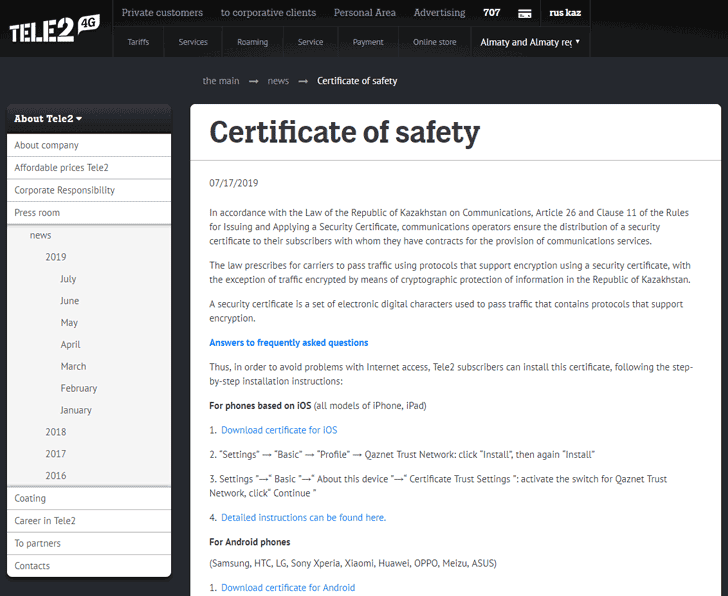
forcing their Internet users into installing the root certificate
shortly to comply with the law.
The controversial advisory has been issued with respect to
amendments to the Law on Communications 2004 (the
“Communications Law“) that the Kazakhstan government passed
in November 2015.
According to Clause 11 of Article 26, the “Rules for Issuing and
Applying a Security Certificate,” all national communications
service providers are obliged to monitor the encrypted Internet
traffic of their customers using government-issued security
certificates.
The law was intended to come in force starting 1 January 2016, but
the Kazakhstan government failed to force the local ISPs following
a series of lawsuits.
It seems now the Kazakhstan government is making another attempt
to force the amendments, putting privacy and security of millions
of its citizens at risk from both hackers and the government itself
by breaking the fundamentals of Internet security protocol.
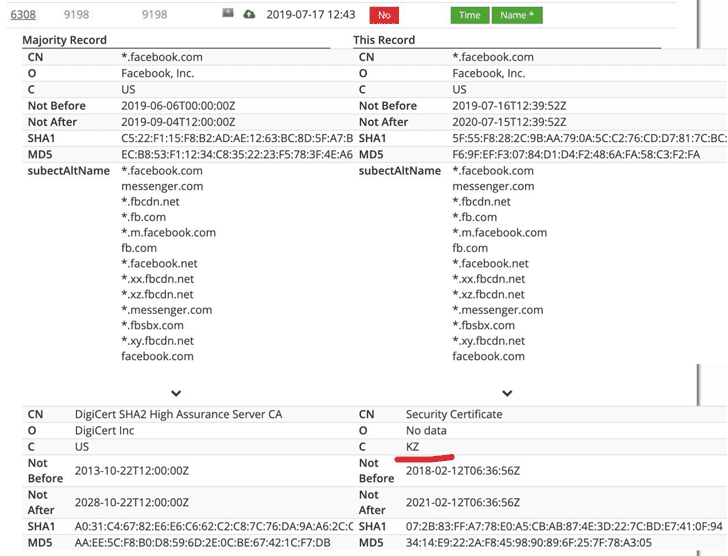
amendments have been forced “in connection with the frequent cases
of theft of personal and credential data, as well as money from
bank accounts of Kazakhstan.”
“A security certificate has been introduced that will become an
effective tool for protecting the country’s information space from
hackers, Internet fraudsters and other types of cyber threats,” the
note reads.
“The introduction of a security certificate will also help in
the protection of information systems and data, as well as
identifying hackers and Internet fraudsters before they can cause
damage.”
“It will also allow Kazakhstan Internet users to be protected
from hacker attacks and viewing illegal content.”
wants to take control over what content their citizens should be
allowed to view on the Internet and also to turn Kazakhstan into a
deep surveillance state.
Besides this, intercepting HTTPS communications will also allow
ISPs to inject advertisements or tracking scripts on all web pages
users visit.
At this moment, it is not clear how major tech companies and
web browsers will
respond[3] to this new privacy
infringement of the Kazakh citizens. We’ll update the story with
more information as soon as they are available.
References
- ^
Tele2
(old2018.tele2.kz) - ^
certificate files and instructions
(qca.kz) - ^
web browsers will respond
(bugzilla.mozilla.org)