York, the MongoDB team announced the latest version of its database
management software that includes a variety of advanced features,
including Field Level Encryption, Distributed Transactions, and
Wildcard Indexes.
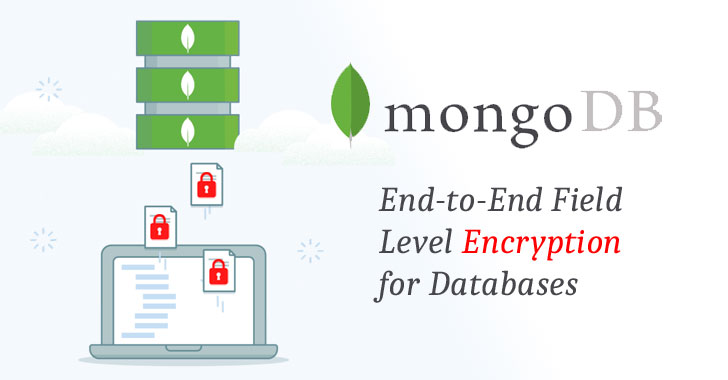
The newly introduced Field Level Encryption (FLE), which
will be available in the upcoming MongoDB 4.2
release, is an end-to-end encryption feature that encrypts and
decrypts sensitive users’ data on the client-side, preventing
hackers from accessing plaintext data even if the database instance
left exposed online or the server itself gets compromised.
Almost every website, app, and service on the Internet today
usually encrypt only users’ passwords before storing them into the
databases, but unfortunately left other sensitive information
unencrypted, including users’ online activity data and their
personal information.
Moreover, even if there is an encryption mechanism to store data
securely on the server, the private keys to unlock it and
decryption operation also remain available on the server, which if
get compromised, can be used by hackers to decrypt the data.

“With the rigor required by compliance to modern legal
requirements, there comes the new need to ingest, query and store
encrypted data securely in the database without the database having
the ability to read it,” the company says.
access to the database server itself can also access users’
data—unencrypted or even server-side encrypted—without requiring
any privilege from the clients.
MongoDB’s Client-Side Field Level Encryption
However, MongoDB’s new field-level encryption allows websites to
solve this issue quickly as it does not involve performing
cryptographic operations or storing encryption keys on the server.
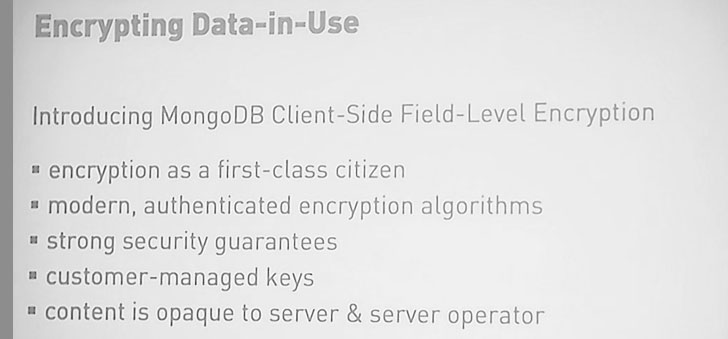
Instead, FLE is a transparent client-side mechanism that relies
on the MongoDB client library to act as a driver and handles the
encryption and decryption operations on the users’ devices to
protect specific fields in a document against everyone except the
user.
application’s server can only be decrypted and accessed on the
client-side using the right key/password which only belongs to the
user.
“With this option, the server has no knowledge of the fields being
encrypted. All the encryption and decryption is done at the driver
level,” the company[1] said.
“It’s the driver that when it sees an encrypted field is involved
in a write or query command, gets appropriate keys from the key
manager, encrypts the data, and sends it to the server.”
“The server then only sees ciphertext and has no knowledge of the
keys. When results are returned from the server, that ciphertext is
sent by the server to the driver, and it’s there that the driver,
which already has the keys, decrypts it.”
Service (KMS) service to make it easier for users to create and
manage their keys to control the use of encryption across a
service.
However, the company will soon make it compatible with Microsoft
Azure Key Vault and Google Cloud services as well.
It should also be noted that MongoDB’s field-level encryption
doesn’t prevent a data breach, but blocks hackers from accessing
the sensitive data in plaintext when it is stolen, thus mitigating
the risk.
In worst case scenarios, attackers can access limited data of
only those targeted users whose systems somehow get compromised and
leak the encryption key to the attackers.
Read more http://feedproxy.google.com/~r/TheHackersNews/~3/3NlMLRRxIow/mongodb-fle-data-encryption.html