the Carbanak malware—yes, this time it’s for real.
Carbanak—sometimes referred as FIN7, Anunak or Cobalt—is one of
the most full-featured, dangerous malware that belongs to an
APT-style cybercriminal group involved in several attacks against
banks, financial institutions, hospitals, and restaurants.
In July last year, there was a rumor that the source code of
Carbanak was leaked to the public, but researchers at Kaspersky Lab
later confirmed that the leaked code was not the Carbanak
Trojan.
[1]
Now cybersecurity researchers from FireEye revealed that they found
Carbanak’s source code, builders, and some previously unseen
plugins in two RAR archives [1, 2] that were uploaded on the VirusTotal malware
scanning engine two years ago from a Russian IP address.
“CARBANAK source code was 20MB comprising 755 files, with 39
binaries and 100,000 lines of code,” researchers say. “Our goal was
to find threat intelligence we missed in our previous analyses.”
of articles detailing CARBANAK features and analysis based upon its
source code and reverse engineering.
the most successful malware attacks in the world launched by a
highly organized group that continually evolved
its tactics to carry out cybercrime while avoiding detection by
potential targets and the authorities.
The hacker group started its activities almost six years ago by
launching a series of malware attacks using Anunak and Carbanak to
compromise banks and ATM networks worldwide, and thereby stealing
over a billion euros from more than 100
banks across the globe.
[4]
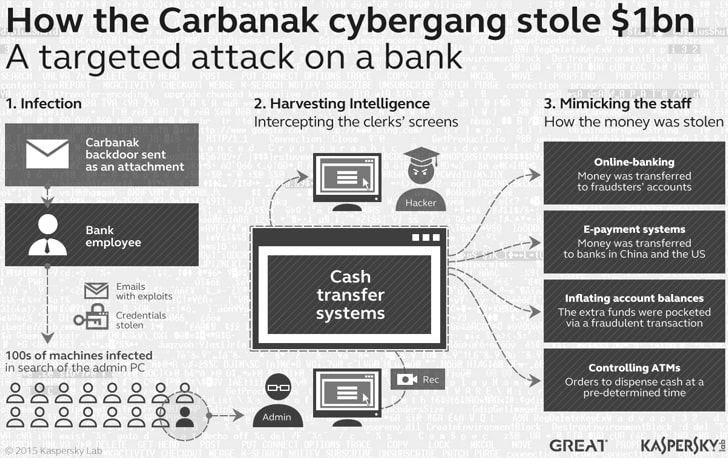
To compromise banks, hackers sent malicious spear-phishing emails
to hundreds of employees at different banks, which infected
computers with Carbanak malware if opened, allowing attackers to
transfer money from affected banks to fake accounts or ATMs
monitored by them.
According to the European authorities, the criminal group later
developed a sophisticated heist-ready banking trojan called Cobalt[5], based on the
Cobalt-Strike penetration testing software, which was in use until
2016.
The group was first exposed in 2015 as financially-motivated
cybercriminals, and three suspects—Dmytro Fedorov, 44, Fedir
Hladyr, 33, and Andrii Kopakov, 30—all from Ukraine were arrested last year
in Europe[6] between January and
June.
All the three suspects, one of which (Kopakov) is believed to be
the alleged leader of the organised criminal group, were indicted and
charged[7] with a total of 26
felony counts in August 2018.
References
- ^
Carbanak Trojan
(thehackernews.com) - ^
4-part series
(www.fireeye.com) - ^
continually evolved its tactics
(thehackernews.com) - ^
more than 100 banks
(thehackernews.com) - ^
Cobalt
(thehackernews.com) - ^
arrested last year in Europe
(thehackernews.com) - ^
indicted and charged
(thehackernews.com)
Read more http://feedproxy.google.com/~r/TheHackersNews/~3/F64L40ch2D8/carbanak-malware-source-code.html