
exploiting a recently patched critical code execution vulnerability in
WinRAR[1], a popular Windows file
compression application with 500 million users worldwide.
Why? Because the WinRAR software doesn’t have an auto-update
feature, which, unfortunately, leaves millions of its users
vulnerable to cyber attacks.
The critical vulnerability (CVE-2018-20250) that was patched
late last month by the WinRAR team with the release of WinRAR
version 5.70 beta 1 impacts all prior versions of WinRAR released
over the past 19 years.
For those unaware, the vulnerability is “Absolute Path Traversal”
bug that resides in the old third-party library UNACEV2.DLL of
WinRAR and allows attackers to extract a compressed executable file
from the ACE archive to one of the Windows Startup folders, where
the malicious file would automatically run on the next reboot.
Therefore, to successfully exploit this vulnerability and take
full control over the targeted computers, all an attacker needs to
do is just convincing users into opening a maliciously-crafted
compressed archive file using WinRAR.
exploit code went public, malicious attackers started exploiting
the vulnerability[2]
in a malspam email campaign to install malware on users’ computers
running the vulnerable version of the software.
Now, security researchers from McAfee reported that they
identified more than “100 unique exploits and counting” in the
first week since the vulnerability was publicly disclosed, with
most of the initial targets residing in the United States.
One recent campaign spotted[3] by the researchers
piggybacks on a bootlegged copy of an Ariana Grande’s hit album,
which is currently being detected as malware by only 15 security
products, whereas 55 antivirus products fail to alert their users.
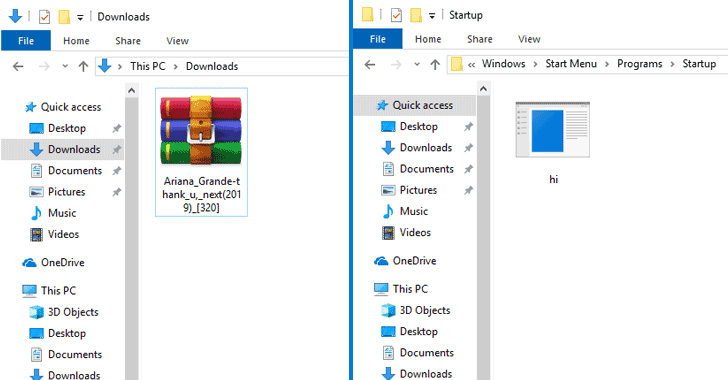
The malicious RAR file
(Ariana_Grande-thank_u,_next(2019)_[320].rar) detected by McAfee
extracts a list of harmless MP3 files to the victim’s download
folder but also drops a malicious EXE file to the startup folder,
which has been designed to infect the targeted computer with
malware.
“When a vulnerable version of WinRAR is used to extract the
contents of this archive, a malicious payload is created in the
Startup folder behind the scenes,” the researchers explain.
“User Access Control (UAC) is bypassed, so no alert is displayed
to the user. The next time the system restarts, the malware is
run.”
to protect yourself from such attacks is to update your system by
installing the latest version of the WinRAR software as soon as
possible and avoid opening files received from unknown
sources.
References
- ^
vulnerability in WinRAR
(thehackernews.com) - ^
started exploiting the
vulnerability (thehackernews.com) - ^
spotted
(securingtomorrow.mcafee.com)
Read more http://feedproxy.google.com/~r/TheHackersNews/~3/oo7KoEr7b6Y/winrar-hacking-malware.html