
version of the web browsing application.
Security researcher Clement Lecigne of Google’s Threat
Analysis Group discovered and reported a high severity
vulnerability in Chrome late last month that could allow remote
attackers to execute arbitrary code and take full control of the
computers.
The vulnerability, assigned as CVE-2019-5786,
affects the web browsing software for all major operating systems
including Microsoft Windows, Apple macOS, and Linux.
[1]
Without revealing technical details of the vulnerability, the
Chrome security team only says the issue is a use-after-free
vulnerability in the FileReader component of the Chrome browser,
which leads to remote code execution attacks.
What’s more worrisome? Google warned that this zero-day RCE
vulnerability is actively being exploited in the wild by attackers
to target Chrome users.
“Access to bug details and links may be kept
restricted[2] until a majority of
users are updated with a fix,” the Chrome security
team notes[3]. “We will also retain
restrictions if the bug exists in a third party library that other
projects similarly depend on, but haven’t yet fixed.”
applications to asynchronously read the contents of files (or raw
data buffers) stored on a user’s computer, using ‘File’ or ‘Blob’
objects to specify the file or data to read.
corruption bug that allows corruption or modification of data in
memory, enabling an unprivileged user to escalate privileges on an
affected system or software.
The use-after-free vulnerability in the FileReader component could
enable unprivileged attackers to gain privileges on the Chrome web
browser, allowing them to escape sandbox protections and run
arbitrary code on the targeted system.
It appears to exploit this vulnerability, all an attacker needs
to do is tricking victims into just opening, or redirecting them
to, a specially-crafted webpage without requiring any further
interaction.
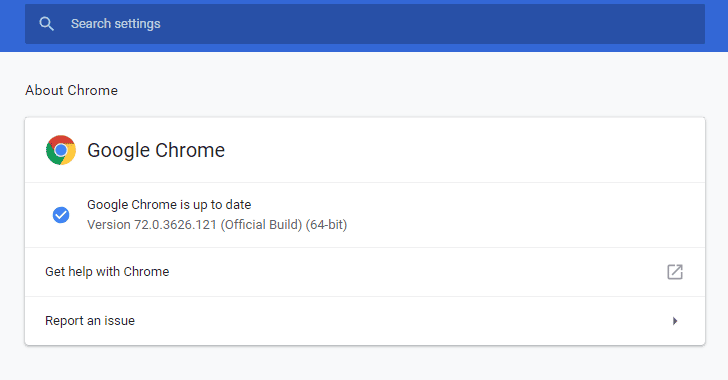
The patch for the security vulnerability has already been rolled
out to its users in a stable Chrome update 72.0.3626.121 for
Windows, Mac, and Linux operating systems, which users may have
already receive or will soon receive in coming days.
So, make sure your system is running the updated version of the
Chrome web browser.
We will update the article, as soon as Google releases technical
details of this vulnerability.
References
- ^
CVE-2019-5786
(cve.mitre.org) - ^
kept restricted
(bugs.chromium.org) - ^
notes
(chromereleases.googleblog.com)
Read more http://feedproxy.google.com/~r/TheHackersNews/~3/BSH1fZNXszE/update-google-chrome-hack.html