
linked a previously discovered global cyber espionage campaign
targeting critical infrastructure around the world to a North
Korean APT hacking group.
Thanks to the new evidence collected by researchers after
analyzing a command-and-control (C2) server involved in the
espionage campaign and seized by law enforcement.
Dubbed Operation Sharpshooter, the cyber espionage
campaign targeting government, defense, nuclear, energy, and
financial organizations around the world was initially uncovered in
December 2018 by security researchers at McAfee.
At that time, even after finding numerous technical links to the
North Korean Lazarus hacking
group[1], researchers were not
able to immediately attribute the campaign due to a potential for
false flags.
Researchers Analysed Sharpshooter’s Command Server
Now, according to a press
release[2] shared with The Hacker
News, a recent analysis of the seized code and command-and-control
(C2) server allowed researchers to understand the inner working of
the global cyber espionage campaign, concluding that the North
Korean state-sponsored hacking group is behind Operation
Sharpshooter.
Lazarus Group, also known as Hidden
Cobra[3] and Guardians of Peace,
is believed to be backed by the North Korean government and had
reportedly been associated with the 2017 global WannaCry ransomware
attack[4], the 2016 SWIFT Banking
hack[5], as well as the 2014
Sony Pictures
hack[6].
The analysis also revealed that the global espionage campaign
began as early as September 2017, a year earlier than previously
thought and is still ongoing.
While previous attacks were primarily targeting
telecommunications, government and financial sectors in the United
States, Switzerland, and Israel, and other English-speaking
countries, newly-discovered evidence suggests that Sharpshooter has
expanded its focus to critical infrastructure, with the most recent
attacks targeting Germany, Turkey, the United Kingdom, and the
United States.
Operation Sharpshooter: Global Cyber-Espionage Campaign
The global espionage campaign spreads by sending malicious
documents containing a weaponized macro to targets via Dropbox.
Once opened and downloaded, the macro leverages embedded shellcode
to inject the Sharpshooter downloader into the memory of Microsoft
Word.
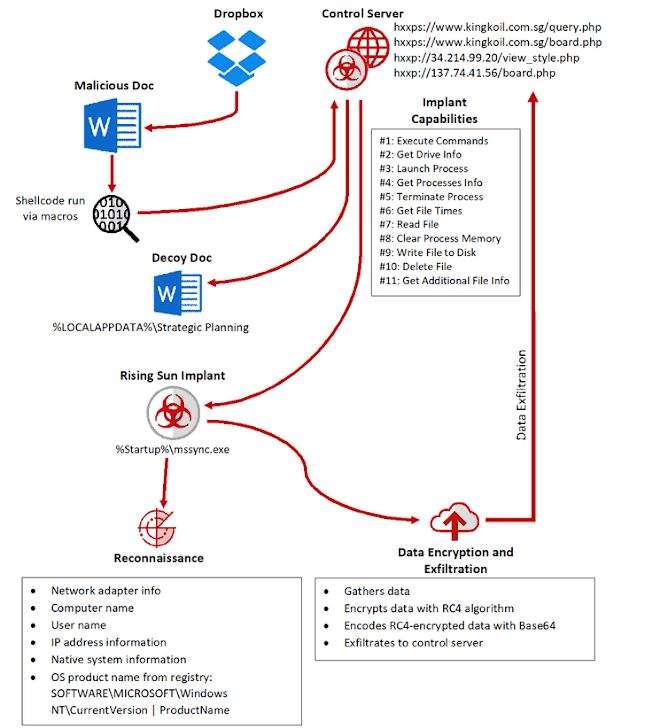
downloads the second-stage Rising Sun malware, which uses
source code from the Lazarus Group’s backdoor Trojan Duuzer,
malware first circulated in 2015 targeting organizations in South
Korea.
The Rising Sun malware then performs reconnaissance on the
victim’s network by gathering and encrypting data, including victim
devices’ computer name, IP address data, native system information
and more.
“Access to the adversary’s command-and-control server code is a
rare opportunity. These systems provide insights into the inner
workings of cyber attack infrastructure, are typically seized by
law enforcement, and only rarely made available to private sector
researchers,” said Christiaan Beek, McAfee senior principal
engineer, and lead scientist.
“The insights gained through access to this code are indispensable
in the effort to understand and combat today’s most prominent and
sophisticated cyber attack campaigns.”
African connection, as the researchers uncovered a network block of
IP addresses originating from a city located in the African nation
of Namibia.
“This led McAfee Advanced Threat Research analysts to suspect that
the actors behind Sharpshooter may have tested their implants and
other techniques in this area of the world prior to launching their
broader campaign of attacks,” the researchers say.
written in Hypertext Preprocessor (PHP), and Active Server Pages
(ASP), which “appears to be custom and unique to the group” and has
been part of the Lazarus operations since 2017.
References
- ^
Lazarus hacking group
(thehackernews.com) - ^
press release
(www.mcafee.com) - ^
Hidden Cobra
(thehackernews.com) - ^
WannaCry ransomware attack
(thehackernews.com) - ^
SWIFT Banking hack
(thehackernews.com) - ^
Sony Pictures hack
(thehackernews.com)
Read more http://feedproxy.google.com/~r/TheHackersNews/~3/OPSt5YdR6Xg/north-korea-hacking.html