being forced to remove its Onavo VPN app from Apple’s App Store,
then you are mistaken.
It turns out that Facebook is paying teenagers around $20 a
month to use its VPN app that aggressively monitors their
smartphone and web activity and then sends it back to Facebook.
The social media giant was previously caught collecting some of
this data through Onavo Protect, a Virtual Private
Network (VPN) service that it acquired in 2013.
However, the company was forced to pull the app from
the App Store in August 2018 after Apple found that Facebook
was using the VPN service to track its user activity and data
across multiple apps, which clearly violates its App Store
guidelines on data collection.
Onavo Protect became a data collection tool for Facebook helping
the company track smartphone users’ activities across multiple
different apps to learn insights about how Facebook users use
third-party apps.
Facebook’s Paid Market Research
Now according to a report published by
TechCrunch, Facebook has been doing much more than just collecting
some data on its users—this time in the name of an app called
“Facebook Research” for iOS and Android since at least 2016.
In some documentation, this program has been referred to as
“Project Atlas.” Facebook has also confirmed the existence of the
app to the publication.
The report said the company has been paying people aged between
13 and 35 as much as $20 per month along with referral fees in
exchange for installing Facebook Research on their iPhone or
Android devices, saying it’s a “paid social media research
study.”
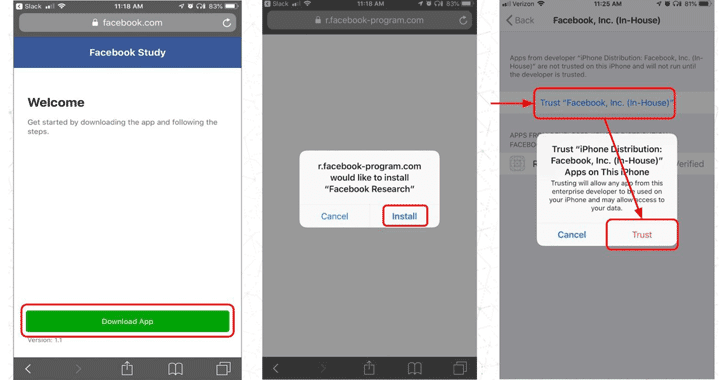
Instead of downloading the app via any app store, Facebook has
been using third-party beta testing services—Applause, BetaBound
and uTest—that specifically runs ads on Instagram and Snapchat
recruiting participants to install Facebook Research.
Facebook Research App Collects Troves of User Data
The app requires users to install a custom root enterprise
certificate, which gives the social media giant the level of access
that can allow it to see users’ private messages in social media
apps, non-e2e chats from instant messaging apps, emails, web
searches, web browsing activity, and ongoing location information.
Although it is not clear if Facebook is accessing this data, but
if the company wants it could, according to security researcher
Will Strafach, who was commissioned by the publication.
In some instances, the Facebook Research app also asked users to
take screenshots of their Amazon order histories and send it back
to Facebook.
According to the Facebook Research’s terms of service, installing
the app gives the company permission to collect information about
other mobile apps on a participant’s smartphone as well as how and
when those apps are used.
“This means you are letting our client collect information such as
which apps are on your phone, how and when you use them, data about
your activities and content within those apps, as well as how other
people interact with you or your content within those apps,” the
terms read.
“You’re also letting our client collect information about your
internet browsing activity (including the websites you visit and
data is exchanged between your device and those websites) and your
use of other online services. There’re some instances when our
client will collect this information even where the app uses
encryption, or from within secure browser sessions.”
Facebook Acknowledges the Existence of the Program
While acknowledging the existence of this program, Facebook said,
“like many companies, we invite people to participate in research
that helps us identify things we can be doing better.”
Since Facebook Research is aimed at “helping Facebook understand
how people use their mobile devices, we have provided extensive
information about the type of data we collect and how they can
participate. We do not share this information with others, and
people can stop participating at any time.”
Though Facebook’s spokesperson claimed that the app was in line
with Apple’s Enterprise Certificate program, but since Apple
requires developers to only use this certificate system for
distributing internal corporate apps to their own employees,
“recruiting testers and paying them a monthly fee appears to
violate the spirit of that rule,” the report reads.
Apple is “aware” of the issue, but it is unclear if the iPhone
maker might ban Facebook from using its Enterprise Developer
Certificates or not.
In response to the report, Facebook said the company is planning
to shut down the iOS version of its Research app. BetaBound, uTest,
and Applause have not yet responded to the report.
References
- ^
pull the app from the App Store
(thehackernews.com) - ^
published
(techcrunch.com)
Read more http://feedproxy.google.com/~r/TheHackersNews/~3/5GgTWVyadEs/facebook-research-app.html