Secure Copy Protocol (SCP) implementation of many client
applications that can be exploited by malicious servers to
overwrite arbitrary files in the SCP client target directory
unauthorizedly.
Session Control Protocol (SCP), also known as secure copy, is a
network protocol that allows users to securely transfer files
between a local host and a remote host using RCP (Remote Copy
Protocol) and SSH protocol.
In other terms, SCP, which dates back to 1983, is a secure
version of RCP that uses authentication and encryption of SSH
protocol to transfer files between a server and a client.
Discovered by Harry Sintonen, one of F-Secure’s Senior Security
Consultants, the vulnerabilities exist due to poor validations
performed by the SCP clients, which can be abused by malicious
servers or man-in-the-middle (MiTM) attackers to drop or overwrite
arbitrary files on the client’s system.
“Many scp clients fail to verify if the objects returned by the scp
server match those it asked for. This issue dates back to 1983 and
rcp, on which scp is based. A separate flaw in the client allows
the target directory attributes to be changed arbitrarily. Finally,
two vulnerabilities in clients may allow server to spoof the client
output,” Sintonen explained.
can drop .bash_aliases file to the victim’s home directory, which
will trick the system into executing malicious commands within it
as soon as the Linux user launches a new shell.
As explained by the researcher, “the transfer of extra files is
hidden by sending ANSI control sequences via stderr.”
Multiple SCP Client Vulnerabilities
According to the advisory[1], the following-mentioned
vulnerabilities were discovered in August last year, which were
then responsibly reported to developers of vulnerable clients,
including OpenSSH, PuTTY, and WinSCP.
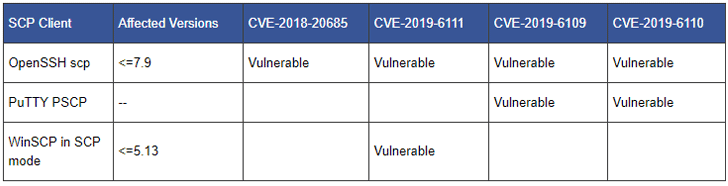
- SCP client improper directory name validation
(CVE-2018-20685)—a vulnerable scp client could allow a remote
SCP server to modify permissions of the target directory by using
empty (‘D0777 0 \n’) or dot (‘D0777 0 .\n’) directory name. - SCP client missing received object name validation
(CVE-2019-6111)—This vulnerability could allow a malicious SCP
server to overwrite arbitrary files in the SCP client target
directory. If a recursive operation (-r) is performed, the server
can manipulate sub-directories as well (for example overwrite
.ssh/authorized_keys).” - SCP client spoofing via object name (CVE-2019-6109)—Due
to missing character encoding in the progress display, the client
output can be manipulated using ANSI code to hide additional files
being transferred. - SCP client spoofing via stderr (CVE-2019-6110)—This
issue is also similar to the above one, allowing a malicious server
to manipulate the client output.
Since the vulnerabilities impact the implementation of the SCP
protocol, all SCP client applications, including OpenSSH, PuTTY,
and WinSCP, which uses SCP as a standard to transfer files are
affected.
WinSCP addressed the issues with the release of version 5.14 last
October, and the patch is also included in the current version
5.14.4.
[2]
in OpenSSH’s implementation of the SCP protocol in November, though
the fix has not been formally released by the vendor yet. The rest
three vulnerabilities remain unpatched in version
7.9[4], the latest version
released in October.
However, if you are worried of malicious SCP server pwning you, you
can configure your systems to use SFTP (Secure FTP) if possible.
Alternatively, Sintonen has also provided a fix to harden SCP
against most server-side manipulation attempts, which you can apply
directly, though it may cause some problems.
It seems like PuTTY has not fixed the vulnerabilities yet, since
the last PuTTY release was version 0.7 in July 2017.
Users who think the vulnerabilities might impact them are
recommended to keep an eye on the patches and apply them as soon as
they become available for your client applications.
References
- ^
advisory
(sintonen.fi) - ^
version 5.14
(winscp.net) - ^
patched
(github.com) - ^
version 7.9
(www.chiark.greenend.org.uk)
Read more http://feedproxy.google.com/~r/TheHackersNews/~3/VBuJc-AA2is/scp-software-vulnerabilities.html