
November 13-14, white hat hackers once again demonstrated that even
the fully patched smartphones running the latest version of
software from popular smartphone manufacturers can be hacked.
Three major flagship smartphones—iPhone X, Samsung Galaxy S9,
and Xiaomi Mi6—were among the devices that successfully got hacked
at the annual mobile hacking contest organized by Trend Micro’s
Zero Day Initiative (ZDI), earning white hat hackers a total of
$325,000 in reward.
Teams of hackers participated from different countries or
representing different cybersecurity companies disclosed a total of
18 zero-day vulnerabilities in mobile devices made by Apple,
Samsung, and Xiaomi, as well as crafted exploits that allowed them
to completely take over the targeted devices.
Apple iPhone X Running iOS 12.1 — GOT HACKED!
A team of two researchers, Richard Zhu and Amat Cama, who named
themselves Fluoroacetate, discovered and managed to exploit a pair
of vulnerabilities in a fully patched Apple iPhone X over
Wi-Fi.
The duo combined a just-in-time (JIT) vulnerability in the iOS web
browser (Safari) along with an out-of-bounds write bug for the
sandbox escape and escalation to exfiltrate data from the iPhone
running iOS 12.1.
For their demonstration, the pair chose to retrieve a photo that
had recently been deleted from the target iPhone, which certainly
came as a surprise to the person in the picture. The research
earned them $50,000 in prize money.
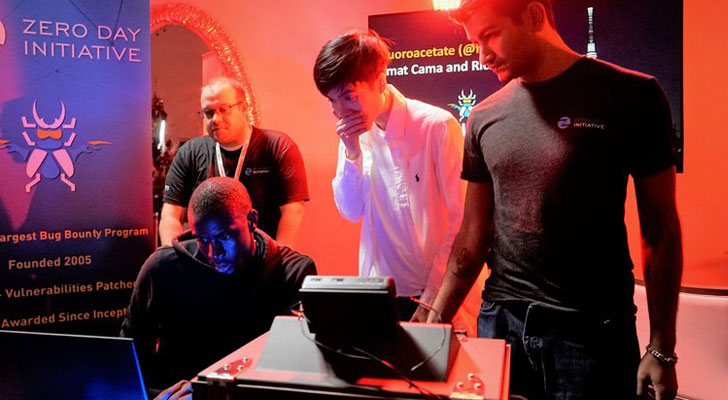 |
| Richard Zhu and Amat Cama (Team Fluoroacetate) |
Fluoroacetate team also attempted to exploit the baseband on the
iPhone X, but could not get their exploit working in the time
allotted.
Another team of researchers from UK-based MWR Labs (a division
of F-Secure), which included Georgi Geshev, Fabi Beterke, and Rob
Miller, also targeted the iPhone X in the browser category but
failed to get their exploit running within the time allotted.
ZDI said it will acquire those vulnerabilities through its
general ZDI program.
Samsung Galaxy S9 — Also, GOT HACKED!
Besides iPhone X, Fluoroacetate team also hacked into the Samsung
Galaxy S9 by exploiting a memory heap overflow vulnerability in the
phone’s baseband component and obtaining code execution. The team
earned $50,000 in prize money for the issue.
“Baseband attacks are especially concerning since someone can
choose not to join a Wi-Fi network, but they have no such control
when connecting to baseband,” Zero Day Initiative wrote in a
blog
post[1] (Day 1).
team, who combined them to successfully exploit the Samsung Galaxy
S9 over Wi-Fi by forcing the device to a captive portal without any
user interaction.
Next, the team used an unsafe redirect and an unsafe application
load in order to install their custom application on the target
Samsung Galaxy S9 device. MWR Labs was rewarded $30,000 for their
exploit.
Xiaomi Mi6 — Yes, This Too GOT HACKED!
Fluoroacetate did not stop there. The team also managed to
successfully exploit the Xiaomi Mi6 handset via NFC (near-field
communications).
“Using the touch-to-connect feature, they forced the phone to open
the web browser and navigate to their specially crafted webpage,”
ZDI said.
“During the demonstration, we didn’t even realize that action
was occurring until it was too late. In other words, a user would
have no chance to prevent this action from happening in the real
world.”
money.
On Day 2[2] of the competition, the
Fluoroacetate team also successfully utilized an integer overflow
vulnerability in the JavaScript engine of the web browser of the
Xiaomi Mi6 smartphone that allowed them to exfiltrate a picture
from the device.
The bug earned them another $25,000.
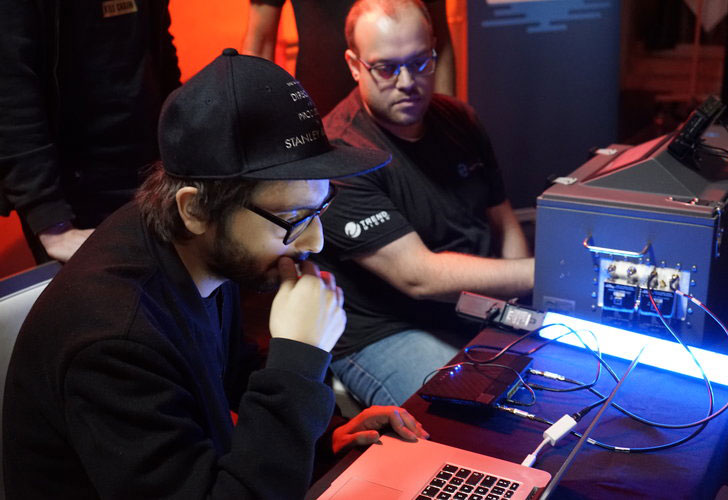 |
| Georgi Geshev, Fabi Beterke, and Rob Miller (MWR Labs) |
MWR Labs also tried its hands on the Xiaomi Mi6 smartphone and
combined five different bugs to silently install a custom
application via JavaScript, bypass the application whitelist, and
automatically launch the app.
To achieve their goal, the white hat hackers first forced the
Xiaomi Mi6 phone’s default web browser to navigate to a malicious
website, when the phone connected to a Wi-Fi server controlled by
them.
The combination of vulnerabilities earned the MWR team $30,000.
On Day 2, the MWR team combined a download flaw along with a
silent app installation to load their custom application and
exfiltrate some pictures from the phone. This earned them another
$25,000.
A separate researcher, Michael Contreras, managed to exploit a
JavaScript type confusion vulnerability to obtain code execution on
the Xiaomi Mi6 handset. He earned himself $25,000.
Fluoroacetate Won ‘Master of Pwn’ Title This Year
With the highest of 45 points and a total of $215,000 prize money,
Fluoroacetate researchers Cama and Zhu earned the title ‘Master of
Pwn,’ logging five out of six successful demonstrations of exploits
against iPhone X, Galaxy S9, and Xiaomi Mi6.
Details of all the zero-day vulnerabilities discovered and
exploited in the competition will be available in 90 days, as per
the pwn2Own contest’s protocol, which includes notifying vendors
and OEM patch deployments.
The vulnerabilities will remain open until the affected vendors
issue security patches to address them.
Read more http://feedproxy.google.com/~r/TheHackersNews/~3/sMKZ7IrXm7Q/mobile-hacking-exploits.html