vulnerability discovery policy
disaster recovery plan
business comtinuity plan
Who is Greater ?
- Lets Think of The Security of A Company that is located within a Defined PRemises
The primary Purpose of That Company is To make Money and To Stay in Business and to do that They Must Have a Continue Business plan at All Costs even at times of Disaster
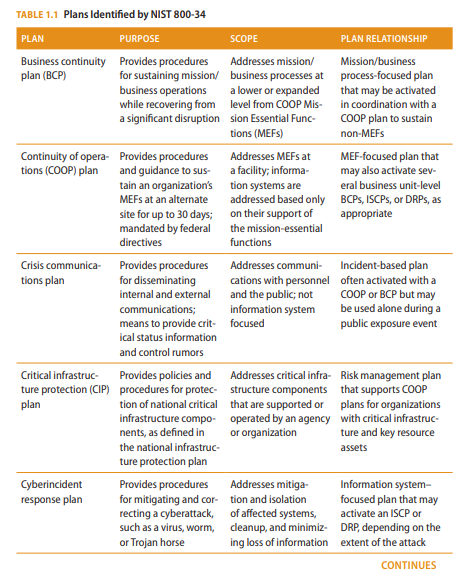
A BCP encompasses all business functions needed to keep the business operational, no matter the type of crisis or event. A DRP focuses mainly on specific systems or data that has been impacted by the event and looks at restoring those affected as quickly as possible.
Lets Look at Two Articles
1.

Contents
Business Continuity (BC) and Disaster Recovery (DR) are often wrongfully used interchangeably. Both approaches focus on safeguarding a business if disaster was ever to occur. However, some critical differences between the two set them apart.
It is critical for businesses to completely understand both BS and DR to plan and execute both strategies effectively. Though some companies choose to focus on one or the other, we highly recommend investing in both a Business Continuity and Disaster Recovery strategy to ensure maximum protection.
What is business continuity?
Business Continuity (BC) or a Business Continuity Plan (BCP) refers to a strategy or plan that encapsulates protocols that ensure that a business can maintain an operation level of business function even in a disaster.
What is disaster recovery?
Disaster Recovery (DR) or a Disaster Recovery Plan (DRP) is a strategy that outlines the process of resolving a disruption after the event has happened. DRP’s usually focus on finding the source of the issue, blocking it, recovering any lost data, and getting the business back up and running as soon as possible.
A business may have different DRPs that cover other kinds of disasters, such as natural disasters or cyberattacks.
4 key differences between Business Continuity and Disaster Recovery
Proactive vs Reactive
BCP is more proactive as it refers to implementing processes and procedures to ensure a business remains at a healthy level of operations in case a disaster ever happens.
Whereas a DRP is a reactive plan of what actions to take once the incident has already occurred.
Scope
Another key difference is the scope each approach has. A BCP encompasses all business functions needed to keep the business operational, no matter the type of crisis or event. A DRP focuses mainly on specific systems or data that has been impacted by the event and looks at restoring those affected as quickly as possible.
Components
Components of a BCP and a DRP vary from business to business. However, there are vital steps that each plan should include.
A business continuity plan should include:
- Define your business continuity team
- Perform a business impact analysis
- Outline your crisis communication channels
- Train and educate your employees
- Test, monitor and maintain your strategy regularly
A disaster recovery plan should include:
- Define your disaster recovery team
- Identify business critical functions and potential vulnerabilities
- Create a disaster recovery plan
- Create backup procedures
- Train and educate staff
- Regularly test, analyse, and maintain the DR plan
Timings
Another key difference between business continuity plans and disaster recovery plans is when they are actioned.
A business continuity plan is set in motion as the crisis or event is happening and is sustained throughout until the crisis has been resolved.
However, a disaster recovery plan would be set in motion once the emergency is over and will continue until the business has returned to ‘normal’.
We recommend having both a business continuity plan and a disaster recovery plan to ensure you have a well-rounded defence against any form of disaster. Employing both will significantly decrease the impact of an event, protecting the business and the businesses stakeholders.
2.
Both Are Needed to Ensure Business Resilience
In practice, organizations should simultaneously implement both BCP and DRP when possible. The BCP is your first line of defense against disasters while DRP is advantageous when your business operations require vital business data to continue functioning
Business Continuity Plan (BCP) vs. Disaster Recovery Plan (DRP): What Are the Key Differences?
Over time, enterprises, institutions, and organizations will face disasters that could temporarily or permanently disrupt their operations. These events could be man-made (industrial sabotage, cyber-attacks, workplace violence) or natural disasters (pandemics, hurricanes, floods), etc.
Business Continuity Plan vs. Disaster Recovery Plan
Savvy organizational leaders employ corporate strategies such as disaster recovery (DR) and business continuity (BC) to nimbly navigate through such emergencies and maintain functionality in the face of disasters. To help you decide which of these strategies you should deploy, let’s explore the differences between business continuity and disaster recovery plans, and when, how, and in what scenarios they are most effective.
What is a Business Continuity Plan or BCP?
Business continuity planning describes the process of documenting a holistic set of protocols and procedures to help businesses maintain a certain minimum level of functionality when a crisis hits. The outcome of that planning process is the business continuity plan, or BCP. It is a strategy designed to help businesses continue operating with minimal disruption during a disruptive event.
Processes, steps, and guidelines in a business continuity plan answer one question: “How businesses can continue offering acceptable service levels when disaster strikes.”
The BCP is a master document that details your organization’s entire prevention, mitigation, response, and recovery protocols for all kinds of threats and disasters.
At a high level, some of the key elements of a BCP are:
- Information about and/or references to BC governance, policies and standards
- The purpose and scope of the BCP
- Instructions about how to use the plan end-to-end, from activation to de-activation phases
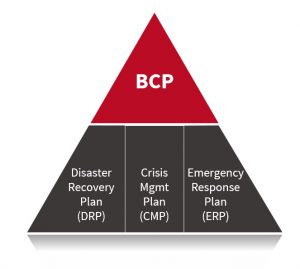
- References to Crisis Management and Emergency Response plans
- References to Runbooks detailing all applicable procedures step-by-step, with checklists and flow diagrams
- A schedule defining reviews, tests of the plan
What Is a Disaster Recovery Plan or DRP?
At a high level, a disaster recovery plan is a formal document containing clear action plans for rapidly responding to, dealing with, and recovering from disruptive contingencies. A DR plan helps organizations reduce the impact and duration of unexpected disruptions by minimizing the downtime of key IT infrastructure and critical operations.
The goal of a DRP is to minimize downtime and data loss as much as possible.
Some of the key elements of the DRP include:
- guidelines on how and when to use the DR plan
- incident response and recovery steps
- contact information and responsibilities of individual DR team members
The DRP must be constantly reviewed, revised, tested, and maintained to ensure its effectiveness and responsiveness in the face of an evolving business environment.
⇒ Learn More About what is Disaster Recovery Plan
Business Continuity And Disaster Recovery: What Are The Similarities?
Although business continuity and disaster recovery strategies differ in several areas, they have similar goals, objectives, and intended outcomes. Let’s explore some of the similarities between BCP and DRP.
DRP Is Part of a Successful BCP
A well-designed DRP guides businesses on how to restore communications, critical operations, and systems to a secondary business location if the primary location has been compromised. Since most businesses today are heavily IT reliant, a disaster recovery plan tends to focus on business data and information systems by addressing one or several points of failure including application downtime, network outages, hardware failure, data loss, etc.
This makes DRP a crisis response and recovery strategy for IT infrastructure in modern organizations. As such, it is a component of a successful BCP because it details the objectives, procedures, and resources the organization needs to secure its IT assets and continue providing services following a disaster.
Both Are Needed to Ensure Business Resilience
In practice, organizations should simultaneously implement both BCP and DRP when possible. The BCP is your first line of defense against disasters while DRP is advantageous when your business operations require vital business data to continue functioning.
The DRP assumes that a disaster has disrupted your organization’s IT operations and/or infrastructure, and that certain measures need to be activated to return to normal operating conditions in the shortest possible time.
As noted previously, the BCP is about all the activities and actions to be taken across the organization to ensure the business can continue offering acceptable service levels when a disruptive event strikes. The same goes for the DRP.
Note that the DRP can be invoked without triggering the activation of the BCP. For instance, the loss of cooling in a datacenter would trigger the DRP, with a response to activate a secondary site before the primary one would go offline due to the servers overheating. But no BCP would have to be activated in that scenario.
⇒ A definition of Business Resilience
Both Require Testing Regularly to Ensure the Plans Work
Savvy business leaders begin with a small but easily scalable BCP or DRP and rigorously test to identify loopholes and minimize vulnerabilities. Over time, these plans can be expanded as resources, capacity, and business functionality increase. However, testing each new iteration of the disaster recovery or business continuity plan is essential to its success. Test simulations validate the efficacy of your plan’s response and recovery processes and help identify areas of improvement.
⇒ Disaster Recovery Testing – It may Just Save Your Business
How Does Disaster Recovery Planning Differ From Business Continuity Planning?
The business continuity vs disaster recovery debate continues to rage on. It is absolutely clear that organizations need both to respond to the immediate aftermath of a disaster as well as move on to a more stable mode following the initial period of crisis. Although they have similar objectives, DRP and BCP differ in several subtle ways.
BCP Includes Business Impact Analysis, Risk Assessment, And Strategy Development
BCP addresses every aspect of disaster preparedness (prevention, mitigation, and recovery) by analyzing critical business processes and defining the repercussions of disruptive events on said processes. This helps the business continuity management team (BCMT) to create a priority list of critical processes and key resources (such as employees, IT infrastructure, and data) to safeguard at all times.
Essentially, business continuity planning entails business impact analysis, risk assessment, and strategy development and goes further than the DRP to find ways of rebuilding and returning the organization to a more stable mode of operation.
⇒ Risk Assessment: 3 Key Starting Points for Effective Business Impact Analysis
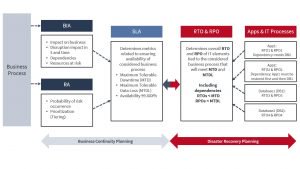
Service-Level Agreements (SLAs) for BC, Recovery Point Objectives (RPO) and Recovery Time Objectives (RTO) for DR
Timing is a key difference between BCP and DRP. The BCP contains emergency response activities that should kick in as soon as a disruption is identified. After the initial emergency response, the recovery plan follows suit. The risk assessment and BIA activities in the BC planning will help an organization to determine its availability SLAs.
These SLAs in turn are translated into the relevant RTOs and RPOs that must be achieved to meet the given SLAs. This makes RTO and RPO calculations a key part of the DR planning process. RTOs and RPOs guide the rest of the DR planning process as well as the choice of recovery technologies, failover options, and data backup platforms.
DR Planning Is More Hands-On
A business continuity plan has a much broader scope than a DRP and encompasses an organization’s entire operational ecosystem. It details a holistic framework that enables organizations to maintain a certain minimum level of functionality and productivity, no matter the prevailing circumstances. It includes policies, standards and procedures that map out the end-to-end flow and activities the organization will have to go through when faced with a disruptive event.
Conversely, disaster recovery has a narrower focus area and answers the question: “How do we recover from a disaster?” The DRP is more hands-on and focuses on the resources and steps needed to recover from a disruptive event. It does this by addressing issues concerning data loss, infrastructural failure, and critical technology assets. Your DR plan helps restore data and applications if an organization’s IT infrastructure, data centers, and servers are damaged or destroyed when a crisis hits.
Begin Your BCP Journey With A Strong DR Plan
In the wake of a crisis, unprepared businesses have little choice but to completely shut down operations. Rather than take a reactive approach to disaster management, leading organizations leverage business continuity and disaster recovery planning to stay ahead. With more and more organizations relying on IT infrastructure for core business functions, a strong DR plan is a great way to begin your business continuity journey.