A group of academics from Tel Aviv University have disclosed
details of now-patched “severe” design flaws in Android-based
Samsung smartphones that could have resulted in the extraction of
secret cryptographic keys.
The shortcomings are the result of an analysis of the
cryptographic design and implementation of Android’s
hardware-backed Keystore in Samsung’s Galaxy S8, S9, S10, S20, and
S21 flagship devices, researchers Alon Shakevsky, Eyal Ronen, and
Avishai Wool said[1].
Trusted Execution Environments (TEEs[2]) are a secure zone that
provide an isolated environment for the execution of Trusted
Applications (TAs) to carry out security critical tasks to ensure
confidentiality and integrity.
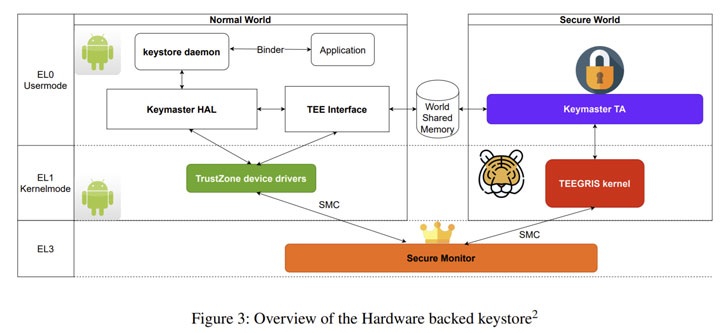
On Android, the hardware-backed Keystore[3]
is a system that facilitates the creation and storage of
cryptographic keys within the TEE, making them more difficult to be
extracted from the device in a manner that prevents the underlying
operating system from having direct access.
Instead, the Android Keystore exposes APIs in the form of
Keymaster TA (trusted application) to perform cryptographic
operations within this environment, including secure key
generation, storage, and its usage for digital signing and
encryption. On Samsung mobile devices, the Keymaster TA runs in an
ARM TrustZone-based TEE.
However, security flaws[4]
uncovered in Samsung’s implementation[5] meant that they could
provide an adversary with root privileges a workable path to
recover the hardware-protected private keys from the secure
element. The list of issues identified is as below –
- Initialization Vector (IV) reuse in Keymaster TA
(CVE-2021-25444[6]) – An IV reuse
vulnerability in Keymaster prior to SMR AUG-2021 Release 1 allows
decryption of custom keyblob with privileged process. (Impacts
Galaxy S9, J3 Top, J7 Top, J7 Duo, TabS4, Tab-A-S-Lite, A6 Plus,
and A9S) - Downgrade attack in Keymaster TA (CVE-2021-25490[7]) – A keyblob downgrade
attack in Keymaster prior to SMR Oct-2021 Release 1 allows [an] attacker to trigger IV reuse vulnerability with privileged process.
(Impacts Galaxy S10, S20, and S21)
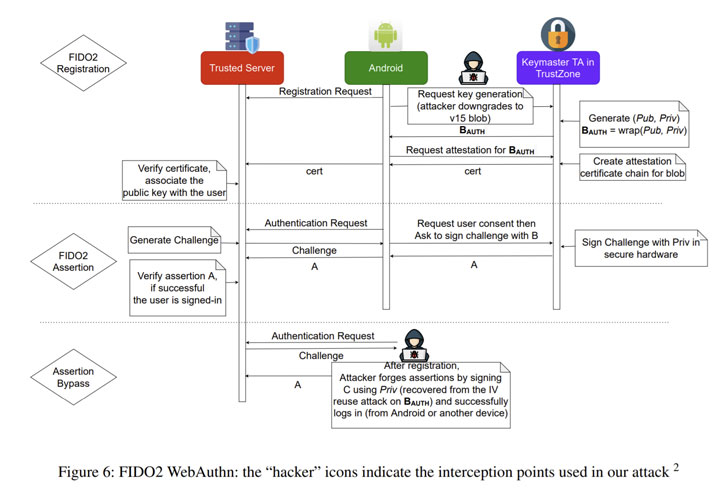
In a nutshell, successful exploitation of the flaws against the
Keymaster TA could achieve unauthorized access to
hardware-protected keys and data secured by the TEE. Implications
of such an attack could range from an authentication bypass to
advanced attacks that can break fundamental security guarantees
offered by cryptographic systems.
Following responsible disclosure in May and July 2021, the
issues were addressed via security updates shipped in August[8]
and October 2021[9]
for the affected devices. The findings are expected to be presented
at the USENIX Security Symposium[10] later this August.
“Vendors including Samsung and Qualcomm maintain secrecy around
their implementation and design of [TrustZone operating systems]
and Tas,” the researchers said. “The design and implementation
details should be well audited and reviewed by independent
researchers and should not rely on the difficulty of reverse
engineering proprietary systems.”
References
- ^
said
(eprint.iacr.org) - ^
TEEs
(en.wikipedia.org) - ^
Keystore
(source.android.com) - ^
security
flaws (github.com) - ^
Samsung’s implementation
(twitter.com) - ^
CVE-2021-25444
(github.com) - ^
CVE-2021-25490
(github.com) - ^
August
(security.samsungmobile.com) - ^
October
2021 (security.samsungmobile.com) - ^
USENIX
Security Symposium (www.usenix.org)
Read more https://thehackernews.com/2022/02/100-million-samsung-galaxy-phones.html